
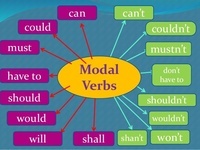
Modal Verbs

Flashcard
•
English
•
9th Grade
•
Practice Problem
•
Hard
+4
Standards-aligned

Wayground Content
FREE Resource
Student preview

15 questions
Show all answers
1.
FLASHCARD QUESTION
Front
What are modal verbs?
Back
Modal verbs are auxiliary verbs that express necessity, possibility, permission, or ability. Examples include can, could, may, might, must, shall, should, will, and would.
Tags
CCSS.L.4.1C
CCSS.L.9-10.1B
2.
FLASHCARD QUESTION
Front
What does 'must' indicate in a sentence?
Back
'Must' indicates a strong obligation or necessity. It is used when something is required or essential.
Tags
CCSS.L.4.1C
CCSS.L.9-10.1B
3.
FLASHCARD QUESTION
Front
What does 'have to' imply in terms of obligation?
Back
'Have to' implies an external obligation or requirement, often due to circumstances or rules.
Tags
CCSS.L.4.1C
CCSS.L.9-10.1B
4.
FLASHCARD QUESTION
Front
What is the difference between 'can' and 'may'?
Back
'Can' is used to express ability or possibility, while 'may' is used to express permission or a polite request.
Tags
CCSS.L.4.1C
CCSS.L.9-10.1B
5.
FLASHCARD QUESTION
Front
What does 'should' suggest in terms of advice?
Back
'Should' suggests a recommendation or advice, indicating what is considered the right or best action.
Tags
CCSS.L.4.1C
CCSS.L.9-10.1B
6.
FLASHCARD QUESTION
Front
What does 'might' express in terms of possibility?
Back
'Might' expresses a lower degree of possibility compared to 'may' and is often used for hypothetical situations.
Tags
CCSS.L.4.1C
CCSS.L.9-10.1B
7.
FLASHCARD QUESTION
Front
What does 'don't have to' mean?
Back
'Don't have to' indicates that there is no obligation to do something; it is not necessary.
Tags
CCSS.L.4.1C
CCSS.L.9-10.1B
Access all questions and much more by creating a free account
Create resources
Host any resource
Get auto-graded reports

Continue with Google

Continue with Email

Continue with Classlink

Continue with Clever
or continue with

Microsoft
%20(1).png)
Apple

Others
Already have an account?



