
Carbon Cycle Review

Flashcard
•
Science
•
5th Grade
•
Practice Problem
•
Hard
+11
Standards-aligned

Wayground Content
FREE Resource
Student preview

15 questions
Show all answers
1.
FLASHCARD QUESTION
Front
What is the carbon cycle?
Back
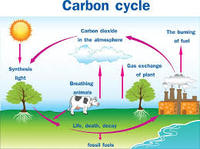
The carbon cycle is the process by which carbon is exchanged between the atmosphere, land, water, and living organisms. It involves processes like photosynthesis, respiration, decomposition, and combustion.
Tags
NGSS.MS-ESS2-1
NGSS.MS-LS1-6
NGSS.MS-LS2-3
2.
FLASHCARD QUESTION
Front
What is photosynthesis?
Back
Photosynthesis is the process by which green plants use sunlight to convert carbon dioxide and water into glucose and oxygen. It is a key part of the carbon cycle.
Tags
NGSS.MS-LS1-6
NGSS.MS-LS2-3
3.
FLASHCARD QUESTION
Front
What is cellular respiration?
Back
Cellular respiration is the process by which living organisms convert glucose and oxygen into energy, carbon dioxide, and water. It releases carbon back into the atmosphere.
Tags
NGSS.MS-LS1-2
NGSS.MS-LS2-3
4.
FLASHCARD QUESTION
Front
What role do plants play in the carbon cycle?
Back
Plants absorb carbon dioxide from the atmosphere during photosynthesis, helping to reduce CO2 levels and providing oxygen as a byproduct.
Tags
NGSS.MS-LS1-6
NGSS.MS-LS2-3
5.
FLASHCARD QUESTION
Front
What is a carbon reservoir?
Back
A carbon reservoir is a natural feature that stores carbon, such as the atmosphere, oceans, soil, and living organisms.
Tags
NGSS.MS-LS1-6
NGSS.MS-LS2-3
6.
FLASHCARD QUESTION
Front
Which is the largest carbon reservoir?
Back
The ocean is the largest carbon reservoir, storing more carbon than the atmosphere, soil, and living organisms combined.
Tags
NGSS.MS-LS1-6
7.
FLASHCARD QUESTION
Front
How do humans impact the carbon cycle?
Back
Humans impact the carbon cycle through activities like deforestation, burning fossil fuels, and driving cars, which increase carbon dioxide levels in the atmosphere.
Tags
NGSS.MS-ESS3-4
Access all questions and much more by creating a free account
Create resources
Host any resource
Get auto-graded reports

Continue with Google

Continue with Email

Continue with Classlink

Continue with Clever
or continue with

Microsoft
%20(1).png)
Apple

Others
Already have an account?
Similar Resources on Wayground

8 questions
Solar System 4th Grade
Flashcard
•
4th Grade
14 questions
CADEIA ALIMENTAR
Flashcard
•
KG
15 questions
Science 4 - Human activities affect the environment
Flashcard
•
4th Grade
9 questions
Where we live
Flashcard
•
4th Grade
8 questions
American Holidays
Flashcard
•
6th Grade
14 questions
The Canadian Charter of Rights and Freedoms
Flashcard
•
6th Grade
11 questions
Organisational Change
Flashcard
•
5th Grade
Popular Resources on Wayground
15 questions
Fractions on a Number Line

Quiz
•
3rd Grade
10 questions
Probability Practice
Quiz
•
4th Grade
15 questions
Probability on Number LIne
Quiz
•
4th Grade
20 questions
Equivalent Fractions
Quiz
•
3rd Grade
25 questions
Multiplication Facts
Quiz
•
5th Grade
22 questions
fractions
Quiz
•
3rd Grade
6 questions
Appropriate Chromebook Usage

Lesson
•
7th Grade
10 questions
Greek Bases tele and phon
Quiz
•
6th - 8th Grade
Discover more resources for Science
20 questions
Weathering, Erosion, Deposition
Quiz
•
5th Grade
20 questions
Food Chains and Food Webs Review
Quiz
•
5th Grade
28 questions
4th Grade The Need for Speed
Quiz
•
3rd - 5th Grade
20 questions
The Water Cycle
Quiz
•
4th - 5th Grade
20 questions
Food Webs
Quiz
•
5th Grade
45 questions
5th Science STAAR Review
Quiz
•
5th Grade
18 questions
Circuits
Quiz
•
5th Grade
15 questions
5.L.3.1/3.2: Inherited/Acquired Traits
Quiz
•
5th Grade