
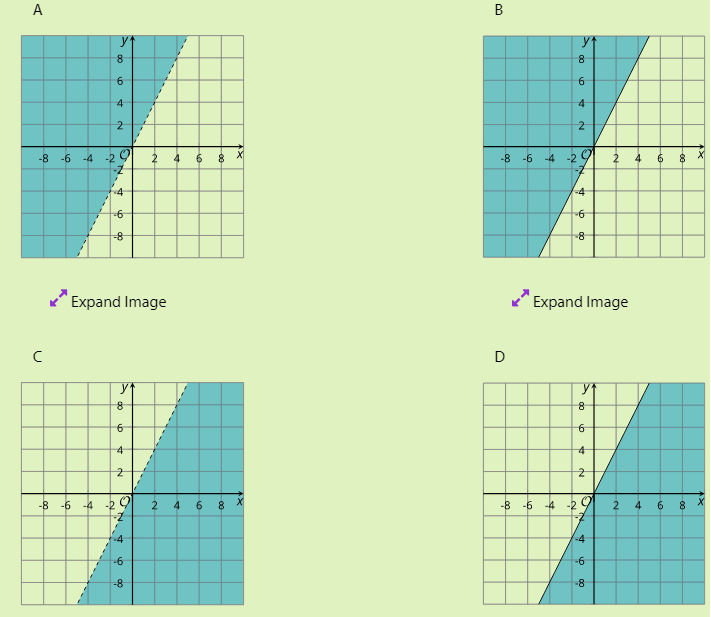
3B Graphing systems of Linear Inequalities

Flashcard
•
Mathematics
•
9th - 12th Grade
•
Practice Problem
•
Hard

Wayground Content
FREE Resource
Student preview

15 questions
Show all answers
1.
FLASHCARD QUESTION
Front
What is a linear inequality?
Back
A linear inequality is a mathematical statement that compares a linear expression to a value using inequality symbols (>, <, ≥, ≤).
2.
FLASHCARD QUESTION
Front
How do you graph a linear inequality?
Back
To graph a linear inequality, first graph the corresponding linear equation as a dashed or solid line, then shade the region that satisfies the inequality.
3.
FLASHCARD QUESTION
Front
What does the symbol '>' indicate in an inequality?
Back
The symbol '>' indicates that the value on the left is greater than the value on the right.
4.
FLASHCARD QUESTION
Front
What does the symbol '≥' indicate in an inequality?
Back
The symbol '≥' indicates that the value on the left is greater than or equal to the value on the right.
5.
FLASHCARD QUESTION
Front
What is the solution set of a system of linear inequalities?
Back
The solution set is the region on the graph where the shaded areas of all inequalities overlap.
6.
FLASHCARD QUESTION
Front
How can you determine if a point is a solution to a linear inequality?
Back
To determine if a point is a solution, substitute the point's coordinates into the inequality. If the inequality holds true, the point is a solution.
7.
FLASHCARD QUESTION
Front
What is the difference between a dashed line and a solid line in graphing inequalities?
Back
A dashed line indicates that points on the line are not included in the solution (for < or >), while a solid line indicates that points on the line are included (for ≤ or ≥).
Access all questions and much more by creating a free account
Create resources
Host any resource
Get auto-graded reports

Continue with Google

Continue with Email

Continue with Classlink

Continue with Clever
or continue with

Microsoft
%20(1).png)
Apple

Others
Already have an account?

