
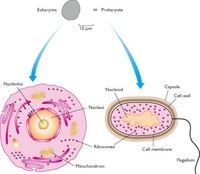
Prokaryotes vs. Eukaryotes

Flashcard
•
Biology
•
10th - 12th Grade
•
Practice Problem
•
Hard

Wayground Content
FREE Resource
Student preview

15 questions
Show all answers
1.
FLASHCARD QUESTION
Front
What is a prokaryote?
Back
A prokaryote is a single-celled organism that lacks a nucleus and membrane-bound organelles. Examples include bacteria and archaea.
2.
FLASHCARD QUESTION
Front
What is a eukaryote?
Back
A eukaryote is an organism whose cells contain a nucleus and membrane-bound organelles. Examples include plants, animals, fungi, and protists.
3.
FLASHCARD QUESTION
Front
What is the size difference between prokaryotic and eukaryotic cells?
Back
Prokaryotic cells are generally smaller than eukaryotic cells.
4.
FLASHCARD QUESTION
Front
What is the function of the nucleus in eukaryotic cells?
Back
The nucleus houses the cell's genetic material (DNA) and controls cellular activities.
5.
FLASHCARD QUESTION
Front
Which type of cell is more complex, prokaryotic or eukaryotic?
Back
Eukaryotic cells are more complex than prokaryotic cells due to their larger size and the presence of organelles.
6.
FLASHCARD QUESTION
Front
What evidence supports the idea that prokaryotes evolved before eukaryotes?
Back
Prokaryotes have no nucleus and fewer genes, indicating a simpler structure and function.
7.
FLASHCARD QUESTION
Front
What is the smallest unit of a living organism?
Back
The smallest unit of a living organism is a cell.
Access all questions and much more by creating a free account
Create resources
Host any resource
Get auto-graded reports

Continue with Google

Continue with Email

Continue with Microsoft
or continue with

%20(1).png)
Apple

Others
Already have an account?

