
Period 5 Part 1

Flashcard
•
Social Studies
•
11th Grade
•
Practice Problem
•
Hard

Wayground Content
FREE Resource
Student preview

32 questions
Show all answers
1.
FLASHCARD QUESTION
Front
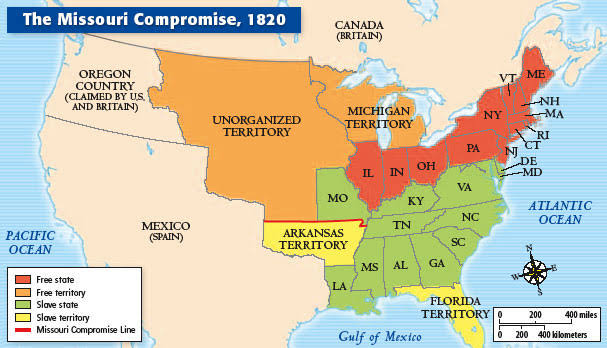
The Missouri Compromise (1820), the Compromise of 1850, and the Kansas-Nebraska Act (1854) were all efforts to settle disputes over the spread of slavery to western territories.

Back
settle disputes over the spread of slavery to western territories
2.
FLASHCARD QUESTION
Front
What was the Southern point of view about the expansion of slavery?
Back
They feared that if slavery could not expand then eventually slavery would be outlawed.
3.
FLASHCARD QUESTION
Front
Supreme Court case which ruled that slaves are not citizens but are property, slaves do not become free if they travel to free territories or states, which fueled the abolitionist movement and seemed like a victory for the south.
Back
Dred Scott Decision
4.
FLASHCARD QUESTION
Front
What is sectionalism and how did it contribute to the tensions leading to the Civil War?
Back
Sectionalism contributed to the tensions leading to the Civil War by creating divisions between the Northern and Southern states, particularly over the issue of slavery.
5.
FLASHCARD QUESTION
Front
What impact did Uncle Tom's Cabin have on the abolitionist movement and the nation as a whole?
Back
It increased anti-slavery sentiment, sparked debates about slavery, and contributed to the start of the Civil War.
6.
FLASHCARD QUESTION
Front
What were the differences between the Northern and Southern economies that contributed to sectionalism?
Back
The Northern economy was based on industry and manufacturing, while the Southern economy relied heavily on agriculture, particularly cotton production using slave labor.
7.
FLASHCARD QUESTION
Front
What were the key events leading up to the outbreak of the Civil War? Options: The Missouri Compromise, the Dred Scott decision, the Kansas-Nebraska Act, and the election of Abraham Lincoln, The Trail of Tears, the Battle of Little Bighorn, the Emancipation Proclamation, and the Treaty of Versailles, The Declaration of Independence, the Treaty of Paris, the Louisiana Purchase, and the Emancipation Proclamation, The Boston Tea Party, the Louisiana Purchase, the Emancipation Proclamation, and the Battle of Gettysburg
Back
The Missouri Compromise, the Dred Scott decision, the Kansas-Nebraska Act, and the election of Abraham Lincoln

Access all questions and much more by creating a free account
Create resources
Host any resource
Get auto-graded reports

Continue with Google

Continue with Email

Continue with Classlink

Continue with Clever
or continue with

Microsoft
%20(1).png)
Apple

Others
Already have an account?
Similar Resources on Wayground

20 questions
order of adjectives
Flashcard
•
10th Grade
27 questions
Statistical Terms and Concepts
Flashcard
•
11th Grade
20 questions
Imparfait
Flashcard
•
9th - 12th Grade
21 questions
Political Parties in the UK
Flashcard
•
12th Grade
21 questions
English
Flashcard
•
KG
26 questions
Introduction to Entrepreneurship
Flashcard
•
12th Grade
24 questions
Spreadsheet Software Concepts
Flashcard
•
12th Grade
25 questions
IGCSE Computer Science Revision - Paper 1
Flashcard
•
10th Grade
Popular Resources on Wayground
15 questions
Fractions on a Number Line

Quiz
•
3rd Grade
10 questions
Probability Practice
Quiz
•
4th Grade
15 questions
Probability on Number LIne
Quiz
•
4th Grade
20 questions
Equivalent Fractions
Quiz
•
3rd Grade
25 questions
Multiplication Facts
Quiz
•
5th Grade
22 questions
fractions
Quiz
•
3rd Grade
6 questions
Appropriate Chromebook Usage

Lesson
•
7th Grade
10 questions
Greek Bases tele and phon
Quiz
•
6th - 8th Grade
Discover more resources for Social Studies
12 questions
Unit 8: The Early Cold War
Quiz
•
11th Grade
16 questions
USHC 4.8 Immigration and Urbanization
Quiz
•
9th - 12th Grade
9 questions
Unit 8: The 1950s & Early Civil Rights
Quiz
•
11th Grade
16 questions
SBAC Practice HSS26
Quiz
•
9th - 12th Grade
12 questions
Understanding the Vietnam War Responses
Quiz
•
11th Grade
64 questions
USHC 4 Key Terms 22-23
Quiz
•
11th Grade - University
36 questions
Unit 5 Key Terms
Quiz
•
11th Grade - University
27 questions
Unit 2- Constitution Quiz
Quiz
•
9th - 12th Grade