
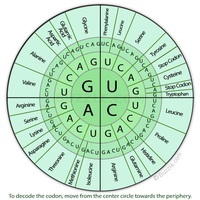
Replication, Transcription and Translation

Flashcard
•
Biology
•
9th - 11th Grade
•
Practice Problem
•
Hard

Wayground Content
FREE Resource
Student preview

15 questions
Show all answers
1.
FLASHCARD QUESTION
Front
What is replication in the context of DNA?
Back
Replication is the process by which a DNA molecule makes a copy of itself, resulting in two identical DNA strands.
2.
FLASHCARD QUESTION
Front
What is transcription in molecular biology?
Back
Transcription is the process of synthesizing RNA from a DNA template, where the DNA sequence is converted into a complementary RNA sequence.
3.
FLASHCARD QUESTION
Front
What is translation in protein synthesis?
Back
Translation is the process by which ribosomes synthesize proteins using the mRNA sequence as a template, translating the nucleotide sequence into an amino acid sequence.
4.
FLASHCARD QUESTION
Front
What is the role of mRNA in protein synthesis?
Back
mRNA (messenger RNA) carries the genetic information from DNA to the ribosome, where it serves as a template for protein synthesis.
5.
FLASHCARD QUESTION
Front
What are codons?
Back
Codons are sequences of three nucleotides in mRNA that correspond to specific amino acids or stop signals during protein synthesis.
6.
FLASHCARD QUESTION
Front
What is the complementary base pairing rule in DNA?
Back
In DNA, adenine (A) pairs with thymine (T), and cytosine (C) pairs with guanine (G).
7.
FLASHCARD QUESTION
Front
What is the significance of the 5' and 3' ends of a DNA strand?
Back
The 5' end has a phosphate group, while the 3' end has a hydroxyl group. This orientation is crucial for DNA replication and transcription.
Access all questions and much more by creating a free account
Create resources
Host any resource
Get auto-graded reports

Continue with Google

Continue with Email

Continue with Microsoft
or continue with

%20(1).png)
Apple

Others
Already have an account?



