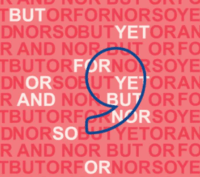
Using Commas with Coordinating Conjunctions

Flashcard
•
English
•
3rd - 5th Grade
•
Practice Problem
•
Hard

Wayground Content
FREE Resource
Student preview

15 questions
Show all answers
1.
FLASHCARD QUESTION
Front
What is a coordinating conjunction?
Back
A coordinating conjunction is a word that connects words, phrases, or clauses that are similar or equal. Examples include 'and', 'but', and 'or'.
2.
FLASHCARD QUESTION
Front
When should you use a comma before a coordinating conjunction?
Back
You should use a comma before a coordinating conjunction when it connects two independent clauses.
3.
FLASHCARD QUESTION
Front
What is an independent clause?
Back
An independent clause is a group of words that can stand alone as a sentence. It has a subject and a verb.
4.
FLASHCARD QUESTION
Front
Give an example of a sentence with a coordinating conjunction and a comma.
Back
I wanted to go to the park, but it started to rain.
5.
FLASHCARD QUESTION
Front
What is the correct way to write this sentence: 'I wanted to play video games but I had to study.'?
Back
The correct way is: 'I wanted to play video games, but I had to study.'
6.
FLASHCARD QUESTION
Front
Is this sentence correct? 'Our babysitter was late so our parents were upset.'
Back
No, it is incorrect. It should be: 'Our babysitter was late, so our parents were upset.'
7.
FLASHCARD QUESTION
Front
What is the purpose of using commas in a list?
Back
Commas are used in a list to separate items, making it clear that they are distinct from one another.
Access all questions and much more by creating a free account
Create resources
Host any resource
Get auto-graded reports

Continue with Google

Continue with Email

Continue with Classlink

Continue with Clever
or continue with

Microsoft
%20(1).png)
Apple

Others
Already have an account?
Similar Resources on Wayground

8 questions
Kyri- Vocabulary Flashcards
Flashcard
•
4th Grade
15 questions
Spelling 3 (Week 5)
Flashcard
•
4th Grade
10 questions
latihan kelas5 pai24
Flashcard
•
5th Grade
15 questions
PROBlem and solution
Flashcard
•
1st - 5th Grade
12 questions
Nanotechnology
Flashcard
•
5th Grade
7 questions
Prehistoria e Historia
Flashcard
•
5th Grade
15 questions
REPASO - Dictado 25: Palabras con r suave
Flashcard
•
3rd Grade
11 questions
Climate Change and Its Causes
Flashcard
•
KG
Popular Resources on Wayground
15 questions
Fractions on a Number Line

Quiz
•
3rd Grade
20 questions
Equivalent Fractions
Quiz
•
3rd Grade
25 questions
Multiplication Facts
Quiz
•
5th Grade
22 questions
fractions
Quiz
•
3rd Grade
20 questions
Main Idea and Details
Quiz
•
5th Grade
20 questions
Context Clues
Quiz
•
6th Grade
15 questions
Equivalent Fractions
Quiz
•
4th Grade
20 questions
Figurative Language Review
Quiz
•
6th Grade
Discover more resources for English
20 questions
Main Idea and Details
Quiz
•
5th Grade
9 questions
Point of View
Quiz
•
3rd - 4th Grade
12 questions
Figurative Language Review

Interactive video
•
5th Grade
20 questions
Prefix and Suffix Review
Quiz
•
3rd - 5th Grade
20 questions
Character perspective, theme, summarize, author's purpose
Quiz
•
5th Grade
18 questions
Context Clues Practice
Quiz
•
5th Grade
20 questions
Figurative Language
Quiz
•
5th Grade
15 questions
Main Idea and Supporting Details.
Quiz
•
4th - 11th Grade