
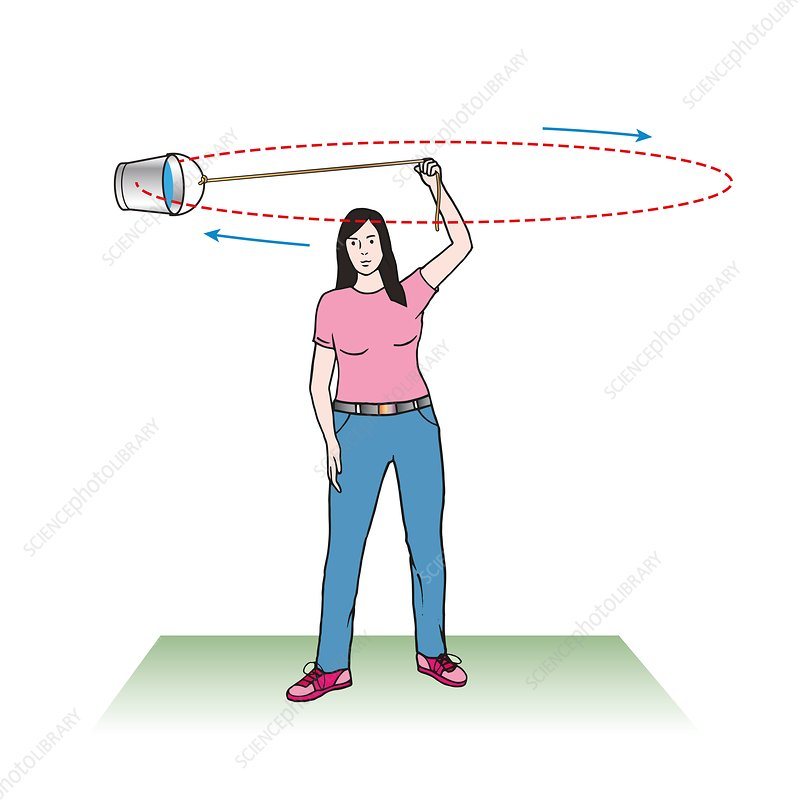
Unit 4 Pre Assessment

Flashcard
•
Physics
•
11th Grade
•
Practice Problem
•
Hard

Wayground Content
FREE Resource
Student preview

15 questions
Show all answers
1.
FLASHCARD QUESTION
Front
What is tangential velocity?
Back
Tangential velocity is the linear speed of an object moving along a circular path, measured at any point along the path. It is calculated as the product of the radius of the circular path and the angular velocity.
2.
FLASHCARD QUESTION
Front
How do you calculate tangential velocity?
Back
Tangential velocity (v) can be calculated using the formula: v = r * ω, where r is the radius of the circular path and ω is the angular velocity in radians per second.
3.
FLASHCARD QUESTION
Front
What is the relationship between radius and tangential velocity?
Back
Tangential velocity is directly proportional to the radius of the circular path. As the radius increases, the tangential velocity increases, assuming constant angular velocity.
4.
FLASHCARD QUESTION
Front
What is Newton's law of universal gravitation?
Back
Newton's law of universal gravitation states that every point mass attracts every other point mass in the universe with a force that is directly proportional to the product of their masses and inversely proportional to the square of the distance between their centers.
5.
FLASHCARD QUESTION
Front
What is gravitational force?
Back
Gravitational force is the attractive force between two masses. It is calculated using the formula: F = G * (m1 * m2) / r^2, where G is the gravitational constant, m1 and m2 are the masses, and r is the distance between the centers of the two masses.
6.
FLASHCARD QUESTION
Front
What factors affect gravitational force?
Back
Gravitational force is affected by the masses of the objects and the distance between them. Greater mass results in a stronger gravitational force, while greater distance results in a weaker gravitational force.
7.
FLASHCARD QUESTION
Front
What is inertia?
Back
Inertia is the property of an object to resist changes in its state of motion. An object at rest stays at rest, and an object in motion continues in motion at a constant velocity unless acted upon by an external force.
Access all questions and much more by creating a free account
Create resources
Host any resource
Get auto-graded reports

Continue with Google

Continue with Email

Continue with Microsoft
or continue with

%20(1).png)
Apple

Others
Already have an account?


