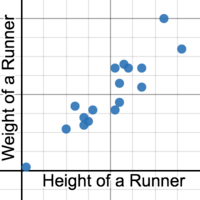
Linear Regression and Residuals - Using Desmos

Flashcard
•
Mathematics
•
9th Grade
•
Practice Problem
•
Hard
+8
Standards-aligned

Wayground Content
FREE Resource
Student preview

15 questions
Show all answers
1.
FLASHCARD QUESTION
Front
What is Linear Regression?
Back
Linear regression is a statistical method used to model the relationship between a dependent variable and one or more independent variables by fitting a linear equation to observed data.
Tags
CCSS.8.SP.A.2
2.
FLASHCARD QUESTION
Front
What does the correlation coefficient (r) indicate?
Back
The correlation coefficient (r) measures the strength and direction of a linear relationship between two variables. Values range from -1 to 1, where 1 indicates a perfect positive correlation, -1 indicates a perfect negative correlation, and 0 indicates no correlation.
Tags
CCSS.HSS.ID.C.8
3.
FLASHCARD QUESTION
Front
What is a residual in linear regression?
Back
A residual is the difference between the observed value and the predicted value from a regression model. It indicates how far off the model's prediction is from the actual data point.
Tags
CCSS.HSS.ID.B.6B
4.
FLASHCARD QUESTION
Front
How do you interpret a positive residual?
Back
A positive residual indicates that the observed value is higher than the predicted value, suggesting that the model underestimates the actual data point.
Tags
CCSS.HSS.ID.B.6B
5.
FLASHCARD QUESTION
Front
How do you interpret a negative residual?
Back
A negative residual indicates that the observed value is lower than the predicted value, suggesting that the model overestimates the actual data point.
Tags
CCSS.HSS.ID.B.6B
6.
FLASHCARD QUESTION
Front
What is the equation of a linear regression line?
Back
Tags
CCSS.8.F.B.4
CCSS.HSF.LE.A.2
7.
FLASHCARD QUESTION
Front
What does the slope (m) represent in a linear regression equation?
Back
The slope (m) represents the change in the dependent variable (y) for a one-unit change in the independent variable (x). It indicates the direction and steepness of the line.
Tags
CCSS.8.EE.B.5
Access all questions and much more by creating a free account
Create resources
Host any resource
Get auto-graded reports

Continue with Google

Continue with Email

Continue with Classlink

Continue with Clever
or continue with

Microsoft
%20(1).png)
Apple

Others
Already have an account?
Similar Resources on Wayground

10 questions
Mastering Linear Equations
Flashcard
•
9th Grade
17 questions
Westward Expansion Review
Flashcard
•
9th Grade
11 questions
Identify Parts of an Algebraic Expression and Evaluate
Flashcard
•
9th Grade
12 questions
Data Transmission
Flashcard
•
9th Grade
10 questions
Contestability in History
Flashcard
•
8th Grade
12 questions
تمييز العدد 1
Flashcard
•
8th Grade
12 questions
Fun Brain Riddles and Teasers Flashcard
Flashcard
•
8th Grade
9 questions
Evolution and Genetic Variation
Flashcard
•
8th Grade
Popular Resources on Wayground
15 questions
Fractions on a Number Line

Quiz
•
3rd Grade
20 questions
Equivalent Fractions
Quiz
•
3rd Grade
25 questions
Multiplication Facts
Quiz
•
5th Grade
22 questions
fractions
Quiz
•
3rd Grade
20 questions
Main Idea and Details
Quiz
•
5th Grade
20 questions
Context Clues
Quiz
•
6th Grade
15 questions
Equivalent Fractions
Quiz
•
4th Grade
20 questions
Figurative Language Review
Quiz
•
6th Grade
Discover more resources for Mathematics
20 questions
Graphing Inequalities on a Number Line
Quiz
•
6th - 9th Grade
12 questions
Exponential Growth and Decay
Quiz
•
9th Grade
20 questions
Exponent Rules Review
Quiz
•
8th - 9th Grade
25 questions
Complementary and Supplementary Angles
Quiz
•
7th - 10th Grade
12 questions
Add and Subtract Polynomials
Quiz
•
9th - 12th Grade
13 questions
Model Exponential Growth and Decay Scenarios
Quiz
•
9th - 12th Grade
15 questions
Combine Like Terms and Distributive Property
Quiz
•
8th - 9th Grade
27 questions
7.2.3 Quadrilateral Properties
Quiz
•
9th - 12th Grade