
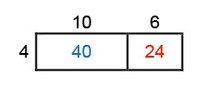
Distributive Property of Multiplication

Flashcard
•
Mathematics
•
3rd - 4th Grade
•
Practice Problem
•
Hard

Wayground Content
FREE Resource
Student preview

15 questions
Show all answers
1.
FLASHCARD QUESTION
Front
What is the Distributive Property of Multiplication?
Back
The Distributive Property states that a number multiplied by a sum is equal to the sum of the products of that number and each addend. For example, a(b + c) = ab + ac.
2.
FLASHCARD QUESTION
Front
How can you use the Distributive Property to solve 15 x 7?
Back
You can break it down as (10 x 7) + (5 x 7).
3.
FLASHCARD QUESTION
Front
What is an example of using the Distributive Property with 28 x 9?
Back
You can solve it as (20 x 9) + (8 x 9).
4.
FLASHCARD QUESTION
Front
If you have 6 groups of 5 and 6 groups of 2, how can you find the total using the Distributive Property?
Back
You can find the total by calculating (6 x 5) + (6 x 2).
5.
FLASHCARD QUESTION
Front
What does it mean to 'distribute' in multiplication?
Back
To 'distribute' means to multiply each addend in a sum by the number outside the parentheses.
6.
FLASHCARD QUESTION
Front
Can you give an example of a problem that uses the Distributive Property?
Back
Sure! For 4 x (3 + 5), you can distribute it as (4 x 3) + (4 x 5) = 12 + 20 = 32.
7.
FLASHCARD QUESTION
Front
What is the first step in using the Distributive Property?
Back
The first step is to identify the number outside the parentheses and the numbers inside the parentheses.
Access all questions and much more by creating a free account
Create resources
Host any resource
Get auto-graded reports

Continue with Google

Continue with Email

Continue with Microsoft
or continue with

%20(1).png)
Apple

Others
By signing up, you agree to our Terms of Service & Privacy Policy
Already have an account?



