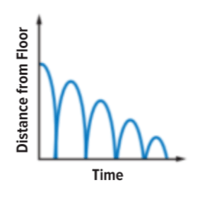
Qualitative Graphs

Flashcard
•
Mathematics
•
7th - 9th Grade
•
Practice Problem
•
Hard
+4
Standards-aligned

Wayground Content
FREE Resource
Student preview

15 questions
Show all answers
1.
FLASHCARD QUESTION
Front
What is a qualitative graph?
Back
A qualitative graph is a type of graph that represents the relationship between variables without using numerical values, focusing instead on the general trends and patterns.
Tags
CCSS.HSF-IF.C.7E
2.
FLASHCARD QUESTION
Front
What does it mean when a graph shows a constant rate of change?
Back
A constant rate of change means that the variable increases or decreases at a steady pace over time, resulting in a straight line on the graph.
Tags
CCSS.HSF-LE.A.1B
3.
FLASHCARD QUESTION
Front
What is a variable rate of change in a graph?
Back
A variable rate of change indicates that the variable's rate of increase or decrease is not consistent, leading to a curved line on the graph.
Tags
CCSS.HSF-LE.A.1B
4.
FLASHCARD QUESTION
Front
How can you describe a graph that shows an increase followed by a plateau?
Back
This type of graph indicates that the variable increases at a constant rate until it reaches a maximum point, after which it remains constant.
Tags
CCSS.8.EE.B.5
5.
FLASHCARD QUESTION
Front
What does it mean when a graph shows a decrease at a constant rate?
Back
It means that the variable is reducing in value steadily over time, resulting in a straight downward slope on the graph.
Tags
CCSS.8.EE.B.5
6.
FLASHCARD QUESTION
Front
What is the significance of the maximum point on a graph?
Back
The maximum point on a graph represents the highest value reached by the variable before it starts to decrease.
Tags
CCSS.HSF-IF.C.7A
7.
FLASHCARD QUESTION
Front
How can you interpret a graph that shows a back-and-forth movement?
Back
This indicates that the variable is fluctuating, moving away from a starting point and then returning, often seen in situations like walking in a circular path.
Tags
CCSS.HSF.TF.A.2
Access all questions and much more by creating a free account
Create resources
Host any resource
Get auto-graded reports

Continue with Google

Continue with Email

Continue with Classlink

Continue with Clever
or continue with

Microsoft
%20(1).png)
Apple

Others
Already have an account?
Similar Resources on Wayground

16 questions
7A Context Clues
Flashcard
•
7th Grade
10 questions
Foundations of Algebra for Grade 7
Flashcard
•
7th Grade
10 questions
Organelles
Flashcard
•
6th - 8th Grade
11 questions
Civilizações da América e a Conquista Espanhola
Flashcard
•
7th Grade
15 questions
Solving One Step Equations with Addition or Subtraction
Flashcard
•
6th - 7th Grade
9 questions
Advantages of Cloud Storage
Flashcard
•
9th - 10th Grade
11 questions
H Chem: Chemical Analysis
Flashcard
•
KG
13 questions
Báo 1
Flashcard
•
KG
Popular Resources on Wayground
15 questions
Fractions on a Number Line

Quiz
•
3rd Grade
20 questions
Equivalent Fractions
Quiz
•
3rd Grade
25 questions
Multiplication Facts
Quiz
•
5th Grade
22 questions
fractions
Quiz
•
3rd Grade
20 questions
Main Idea and Details
Quiz
•
5th Grade
20 questions
Context Clues
Quiz
•
6th Grade
15 questions
Equivalent Fractions
Quiz
•
4th Grade
20 questions
Figurative Language Review
Quiz
•
6th Grade
Discover more resources for Mathematics
22 questions
distributive property
Quiz
•
7th Grade
15 questions
Product of Powers Property A1 U7
Quiz
•
8th Grade
20 questions
Laws of Exponents
Quiz
•
8th Grade
16 questions
8th U5L5 Graphs of Functions
Quiz
•
8th Grade
20 questions
Graphing Inequalities on a Number Line
Quiz
•
6th - 9th Grade
16 questions
Adding and Subtracting Integers
Quiz
•
7th Grade
12 questions
Exponential Growth and Decay
Quiz
•
9th Grade
20 questions
Exponent Rules Review
Quiz
•
8th - 9th Grade