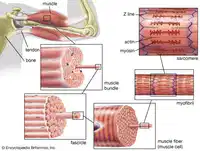
3.6.3 Skeletal muscles

Flashcard
•
Biology
•
12th Grade
•
Hard

Ross Kearns
FREE Resource
Student preview

15 questions
Show all answers
1.
FLASHCARD QUESTION
Front
What is the primary function of antagonistic muscle pairs?
Back
To work against each other to move bones
Answer explanation
Antagonistic muscle pairs work against each other to create movement by contracting and relaxing, allowing bones to move at joints. This is essential for coordinated motion, making the correct answer 'To work against each other to move bones'.
2.
FLASHCARD QUESTION
Front
What best describes the ultrastructure of a myofibril?
Back
A bundle of actin and myosin filaments
Answer explanation
A myofibril is best described as a bundle of actin and myosin filaments, which are the key proteins involved in muscle contraction. This structure is essential for the function of muscle fibers.
3.
FLASHCARD QUESTION
Front
What role does calcium ions play in myofibril contraction?
Back
They bind to tropomyosin to expose binding sites
Answer explanation
Calcium ions bind to tropomyosin, causing a conformational change that exposes the binding sites on actin for myosin. This is crucial for initiating muscle contraction.
4.
FLASHCARD QUESTION
Front
Which molecule is directly responsible for the power stroke in muscle contraction?
Back
ATP
Answer explanation
ATP is crucial for muscle contraction as it provides the energy needed for the myosin heads to perform the power stroke, pulling actin filaments and causing muscle shortening.
5.
FLASHCARD QUESTION
Front
What is the role of phosphocreatine in muscle contraction?
Back
It provides a rapid source of ATP
Answer explanation
Phosphocreatine serves as a rapid source of ATP during muscle contraction, allowing for quick energy replenishment. This is crucial for sustaining high-intensity activities, making it essential for muscle function.
6.
FLASHCARD QUESTION
Front
Characteristic of slow skeletal muscle fibres?
Back
They have a high density of mitochondria
Answer explanation
Slow skeletal muscle fibres are characterized by a high density of mitochondria, which supports endurance activities by providing sustained energy. In contrast, they fatigue slowly and are not primarily used for short bursts of power.
7.
FLASHCARD QUESTION
Front
Where are fast skeletal muscle fibres typically located?
Back
In muscles used for quick, powerful movements
Answer explanation
Fast skeletal muscle fibers are primarily found in muscles responsible for quick, powerful movements, such as sprinting or weightlifting, due to their ability to contract rapidly and generate high force.
Create a free account and access millions of resources
Create resources
Host any resource
Get auto-graded reports

Continue with Google

Continue with Email

Continue with Classlink

Continue with Clever
or continue with

Microsoft
%20(1).png)
Apple

Others
By signing up, you agree to our Terms of Service & Privacy Policy
Already have an account?
Similar Resources on Wayground

8 questions
Improving Doctor-Patient Communication
Flashcard
•
University
8 questions
Qualitative Research Designs
Flashcard
•
University
7 questions
Colors and clothes
Flashcard
•
University
15 questions
Conditional sentences type 2
Flashcard
•
12th Grade
15 questions
Adsız Test
Flashcard
•
University
15 questions
¡Flashcardz en español!
Flashcard
•
University
10 questions
examen de anatomia dental
Flashcard
•
University
10 questions
stats vocab 5.1 - 5.2
Flashcard
•
12th Grade
Popular Resources on Wayground
20 questions
Halloween Trivia

Quiz
•
6th - 8th Grade
25 questions
Multiplication Facts
Quiz
•
5th Grade
15 questions
Order of Operations
Quiz
•
5th Grade
20 questions
Halloween
Quiz
•
5th Grade
16 questions
Halloween
Quiz
•
3rd Grade
12 questions
It's The Great Pumpkin Charlie Brown
Quiz
•
1st - 5th Grade
20 questions
Possessive Nouns
Quiz
•
5th Grade
10 questions
Halloween Traditions and Origins

Interactive video
•
5th - 10th Grade
Discover more resources for Biology
20 questions
Food Chains and Food Webs
Quiz
•
7th - 12th Grade
16 questions
AP Biology: Unit 2 Review (CED)
Quiz
•
9th - 12th Grade
20 questions
Cell Transport
Quiz
•
9th - 12th Grade
15 questions
Cell Cycle and Mitosis
Quiz
•
9th - 12th Grade
20 questions
SB1e. Photosynthesis & Cellular Respiration Review
Quiz
•
9th - 12th Grade
30 questions
Cell Cycle Review
Quiz
•
KG - University
25 questions
Cell Transport
Quiz
•
KG - University
9 questions
DNA structure

Lesson
•
10th - 12th Grade