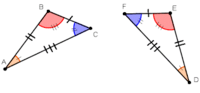
Triangle Congruence Theorems

Flashcard
•
Mathematics
•
8th - 10th Grade
•
Practice Problem
•
Hard

Wayground Content
FREE Resource
Student preview

15 questions
Show all answers
1.
FLASHCARD QUESTION
Front
What is the AAA triangle congruence theorem?
Back
AAA (Angle-Angle-Angle) does not prove triangle congruence; it only shows that triangles are similar.
2.
FLASHCARD QUESTION
Front
What does the RHS triangle congruence theorem stand for?
Back
RHS stands for Right angle-Hypotenuse-Side, which is used to prove congruence in right triangles.
3.
FLASHCARD QUESTION
Front
Which triangle congruence theorem is used for proving congruence with two sides and the included angle?
Back
SAS (Side-Angle-Side) is used to prove triangle congruence when two sides and the included angle are known.
4.
FLASHCARD QUESTION
Front
What does AAS stand for in triangle congruence?
Back
AAS stands for Angle-Angle-Side, which is a theorem that proves triangle congruence when two angles and a non-included side are known.
5.
FLASHCARD QUESTION
Front
What is the SSS triangle congruence theorem?
Back
SSS (Side-Side-Side) states that if three sides of one triangle are equal to three sides of another triangle, the triangles are congruent.
6.
FLASHCARD QUESTION
Front
Can SSA (Side-Side-Angle) be used to prove triangle congruence?
Back
No, SSA does not guarantee triangle congruence; it can lead to ambiguous cases.
7.
FLASHCARD QUESTION
Front
What is the significance of the included angle in SAS?
Back
In SAS, the included angle is the angle between the two sides, which is crucial for proving congruence.
Access all questions and much more by creating a free account
Create resources
Host any resource
Get auto-graded reports

Continue with Google

Continue with Email

Continue with Classlink

Continue with Clever
or continue with

Microsoft
%20(1).png)
Apple

Others
Already have an account?
Similar Resources on Wayground

14 questions
Transformations - Rigid Motions
Flashcard
•
9th - 10th Grade
15 questions
Algebra 1 MCAP Review #1
Flashcard
•
8th - 10th Grade
15 questions
Estimating Roots
Flashcard
•
8th - 9th Grade
15 questions
Naming Angles
Flashcard
•
9th - 10th Grade
15 questions
Geometric Constructions
Flashcard
•
9th - 10th Grade
10 questions
Geometry review
Flashcard
•
9th - 11th Grade
10 questions
Surface Area and Volume
Flashcard
•
9th - 11th Grade
13 questions
Area
Flashcard
•
9th - 10th Grade
Popular Resources on Wayground
15 questions
Fractions on a Number Line

Quiz
•
3rd Grade
20 questions
Equivalent Fractions
Quiz
•
3rd Grade
25 questions
Multiplication Facts
Quiz
•
5th Grade
22 questions
fractions
Quiz
•
3rd Grade
20 questions
Main Idea and Details
Quiz
•
5th Grade
20 questions
Context Clues
Quiz
•
6th Grade
15 questions
Equivalent Fractions
Quiz
•
4th Grade
20 questions
Figurative Language Review
Quiz
•
6th Grade
Discover more resources for Mathematics
15 questions
Product of Powers Property A1 U7
Quiz
•
8th Grade
20 questions
Laws of Exponents
Quiz
•
8th Grade
16 questions
8th U5L5 Graphs of Functions
Quiz
•
8th Grade
20 questions
Graphing Inequalities on a Number Line
Quiz
•
6th - 9th Grade
12 questions
Exponential Growth and Decay
Quiz
•
9th Grade
20 questions
Exponent Rules Review
Quiz
•
8th - 9th Grade
20 questions
One Step equations addition and subtraction
Quiz
•
5th - 8th Grade
20 questions
Translations
Quiz
•
8th Grade