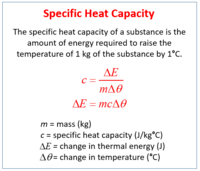
Water’s High Heat Capacity

Flashcard
•
Science
•
11th Grade
•
Practice Problem
•
Hard

Wayground Content
FREE Resource
Student preview

15 questions
Show all answers
1.
FLASHCARD QUESTION
Front
What is a change in temperature?
Back
A change in temperature can also include a change in state of matter, such as ice to liquid water.
2.
FLASHCARD QUESTION
Front
Why does ice melt slowly?
Back
When ice melts, the water molecules vibrate more rapidly, providing energy to break hydrogen bonds. Due to the large number of hydrogen bonds, melting takes time.
3.
FLASHCARD QUESTION
Front
What energy source is required for melting ice?
Back
Melting ice requires an energy source (heat) to break hydrogen bonds; without it, the bonds will not break.
4.
FLASHCARD QUESTION
Front
Why is the graph flat along the 0°C line of temperature?
Back
The graph is flat because hydrogen bonds are either forming or breaking, and it takes time for all of them to break.
5.
FLASHCARD QUESTION
Front
Define a calorie.
Back
A calorie equals the amount of heat energy necessary to raise the temperature of 1 gram of water by one degree Celsius.
6.
FLASHCARD QUESTION
Front
What happens to water molecules when ice melts?
Back
Water molecules vibrate more rapidly, which helps to break the hydrogen bonds holding them together.
7.
FLASHCARD QUESTION
Front
What is the significance of hydrogen bonds in water?
Back
Hydrogen bonds are responsible for water's unique properties, including its high specific heat and surface tension.
Access all questions and much more by creating a free account
Create resources
Host any resource
Get auto-graded reports

Continue with Google

Continue with Email

Continue with Classlink

Continue with Clever
or continue with

Microsoft
%20(1).png)
Apple

Others
Already have an account?
Similar Resources on Wayground

9 questions
Tuesdays with Morrie
Flashcard
•
12th Grade
6 questions
PROBABILITY DISTRIBUTION
Flashcard
•
11th Grade
15 questions
LT 1.2-1.3 - Photosynthesis
Flashcard
•
11th - 12th Grade
14 questions
Deviance
Flashcard
•
11th Grade
10 questions
Algebra
Flashcard
•
12th Grade
12 questions
E4 Final Exam: Biographies and Autobiographies (Smith)
Flashcard
•
12th Grade
12 questions
Biologi Tingkatan 5 Bab 3
Flashcard
•
12th Grade
Popular Resources on Wayground
15 questions
Fractions on a Number Line

Quiz
•
3rd Grade
20 questions
Equivalent Fractions
Quiz
•
3rd Grade
25 questions
Multiplication Facts
Quiz
•
5th Grade
22 questions
fractions
Quiz
•
3rd Grade
20 questions
Main Idea and Details
Quiz
•
5th Grade
20 questions
Context Clues
Quiz
•
6th Grade
15 questions
Equivalent Fractions
Quiz
•
4th Grade
20 questions
Figurative Language Review
Quiz
•
6th Grade
Discover more resources for Science
14 questions
Natural Selection and Adaptation

Lesson
•
9th - 12th Grade
38 questions
Water Cycle and Groundwater
Quiz
•
9th - 12th Grade
12 questions
Cell Organelles and Their Functions
Lesson
•
9th - 12th Grade
12 questions
Homeostasis: Positive and Negative Feedback Loops

Interactive video
•
11th Grade
13 questions
Amoeba Sisters: Biomolecules
Interactive video
•
9th - 12th Grade
60 questions
2025 Genetics Test Study Guide
Quiz
•
9th - 12th Grade
10 questions
Understand Cell Functions and Organelles
Quiz
•
9th - 12th Grade
16 questions
Explore Cell Cycle Stages and Mitosis
Quiz
•
9th - 12th Grade