

Parts of a Plant

Flashcard
•
Science
•
6th - 8th Grade
•
Practice Problem
•
Hard

Barbara White
FREE Resource
Student preview

34 questions
Show all answers
1.
FLASHCARD QUESTION
Front
Organ Noun
[or-gan]
Back
Organ
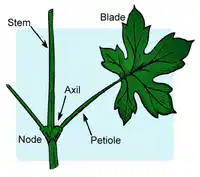
A structure formed by multiple tissue types working together to perform a specific function within a plant.
Example: This diagram shows plant organs, like the stem and leaf, and their specific parts, such as the blade and petiole which make up the leaf.
2.
FLASHCARD QUESTION
Front
Central Vacuole Noun
[sen-truhl vak-yoo-ohl]
Back
Central Vacuole
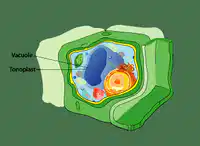
A large organelle in plant cells that stores water and dissolved substances, helping to maintain cellular shape and support.
Example: This diagram shows a plant cell, highlighting the large, central vacuole that stores water and maintains pressure. The label also points to the tonoplast, its outer membrane.
3.
FLASHCARD QUESTION
Front
Cell Wall Noun
[sel wawl]
Back
Cell Wall
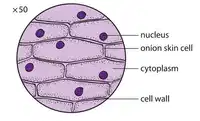
A rigid outer layer located outside the cell membrane of a plant cell that provides shape, support, and protection.
Example: This diagram shows onion cells under a microscope, with a label clearly pointing to the cell wall, the rigid outer layer that gives the plant cell its shape.
4.
FLASHCARD QUESTION
Front
Plastids Noun
[plas-tidz]
Back
Plastids
A class of small organelles in plant cells responsible for functions like photosynthesis and storing food or pigments.
Example: This diagram shows that plastids are a family of organelles in plant cells, with different types like chloroplasts for photosynthesis and others for storing substances.

5.
FLASHCARD QUESTION
Front
Chloroplasts Noun
[klor-uh-plasts]
Back
Chloroplasts
A specialized plastid containing chlorophyll that serves as the primary site for photosynthesis in plant and algal cells.
Example: This diagram shows a chloroplast inside a plant leaf, labeling the key internal parts where photosynthesis occurs, such as the thylakoid and stroma.

6.
FLASHCARD QUESTION
Front
Chlorophyll Noun
[klor-uh-fil]
Back
Chlorophyll
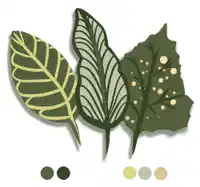
The green pigment within chloroplasts that absorbs light energy from the sun, essential for the process of photosynthesis.
Example: This image shows that chlorophyll is the pigment that gives leaves their green color, while the non-green areas of a leaf do not have chlorophyll.
7.
FLASHCARD QUESTION
Front
Parenchymal Cells Noun
[puh-reng-kuh-muhl selz]
Back
Parenchymal Cells
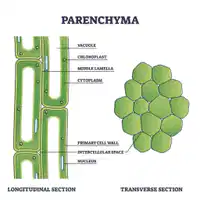
A versatile type of plant cell involved in photosynthesis, cellular respiration, and the storage of organic molecules.
Example: This diagram shows parenchyma cells, a type of plant cell, from two views. It labels key parts like the cell wall, nucleus, and chloroplasts.

Access all questions and much more by creating a free account
Create resources
Host any resource
Get auto-graded reports

Continue with Google

Continue with Email

Continue with Classlink

Continue with Clever
or continue with

Microsoft
%20(1).png)
Apple

Others
Already have an account?



