
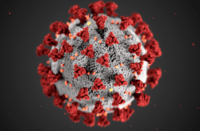
Biology TEKS 4.C: Viruses

Flashcard
•
Biology, Science
•
9th - 10th Grade
•
Practice Problem
•
Hard

Wayground Content
FREE Resource
Student preview

15 questions
Show all answers
1.
FLASHCARD QUESTION
Front
What is a virus?
Back
A virus is a microscopic infectious agent that can only replicate inside the living cells of an organism.
2.
FLASHCARD QUESTION
Front
How do viruses differ from living organisms?
Back
Viruses do not have cellular structures, cannot reproduce independently, and do not carry out metabolic processes.
3.
FLASHCARD QUESTION
Front
What is the structure of a virus?
Back
A virus typically consists of genetic material (DNA or RNA) surrounded by a protein coat called a capsid.
4.
FLASHCARD QUESTION
Front
What is a host cell?
Back
A host cell is a living cell that a virus infects in order to replicate and produce new virus particles.
5.
FLASHCARD QUESTION
Front
What is viral replication?
Back
Viral replication is the process by which a virus invades a host cell and uses the cell's machinery to produce new virus particles.
6.
FLASHCARD QUESTION
Front
What are the different types of viruses?
Back
Viruses can be classified into several types, including DNA viruses, RNA viruses, retroviruses, and bacteriophages.
7.
FLASHCARD QUESTION
Front
What is a bacteriophage?
Back
A bacteriophage is a type of virus that specifically infects and replicates within bacteria.
Access all questions and much more by creating a free account
Create resources
Host any resource
Get auto-graded reports

Continue with Google

Continue with Email

Continue with Classlink

Continue with Clever
or continue with

Microsoft
%20(1).png)
Apple

Others
Already have an account?



