

Community Ecology

Flashcard
•
Science
•
6th - 8th Grade
•
Hard

Barbara White
FREE Resource
Student preview

20 questions
Show all answers
1.
FLASHCARD QUESTION
Front
Community Ecology Noun
[kuh-myoo-ni-tee ee-kol-uh-jee]
Back
Community Ecology
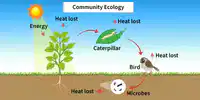
The scientific study of the interactions between populations of different species that form a biological community within a shared environment.
Example: This diagram shows how different species in a community, like plants, caterpillars, birds, and microbes, interact through a food chain, transferring energy.
2.
FLASHCARD QUESTION
Front
Species Richness Noun
[spee-sheez rich-ness]
Back
Species Richness
The total number of different species that are represented within a particular ecological community, landscape, or region.
Example: This ecosystem has high species richness because it contains many different types of organisms, such as deer, foxes, birds, insects, and various plants.

3.
FLASHCARD QUESTION
Front
Species Diversity Noun
[spee-sheez di-vur-si-tee]
Back
Species Diversity
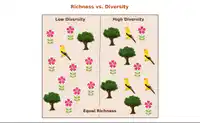
A measure of biological variety in a community, considering both the number of species and their relative abundance.
Example: This image shows that species diversity considers both the number of different species (richness) and how evenly individuals are distributed among those species (evenness).
4.
FLASHCARD QUESTION
Front
Niche Noun
[nich]
Back
Niche
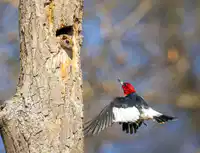
The specific ecological role and position of a species, including its interactions with biotic and abiotic factors in its environment.
Example: This image shows a woodpecker and a flying squirrel competing for the same nesting hole, demonstrating how an organism's niche includes its interactions with others.
5.
FLASHCARD QUESTION
Front
Fundamental Niche Noun
[fun-duh-men-tl nich]
Back
Fundamental Niche
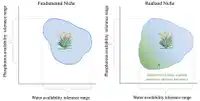
The full range of environmental conditions and resources an organism can possibly occupy and use without any limiting factors.
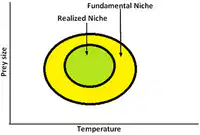
Example: This diagram shows the full range of environmental conditions (like water and nutrient availability) where a species *could* potentially live, which is its fundamental niche.
6.
FLASHCARD QUESTION
Front
Realized Niche Noun
[ree-uh-lahyzd nich]
Back
Realized Niche
The portion of a fundamental niche that a species actually occupies due to limiting factors like competition or predation.
Example: A species' realized niche (green) is the actual range of conditions it occupies, which is a smaller part of its potential fundamental niche (yellow).
7.
FLASHCARD QUESTION
Front
Resource Partitioning Noun
[ree-sors pahr-tish-uh-ning]
Back
Resource Partitioning
The division of limited environmental resources by species to help avoid competition in an ecological niche and allow coexistence.
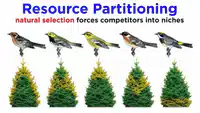
Example: Different warbler species avoid competition by feeding in different parts of the same tree, dividing the resource so they can coexist in one habitat.

Access all questions and much more by creating a free account
Create resources
Host any resource
Get auto-graded reports

Continue with Google

Continue with Email

Continue with Classlink

Continue with Clever
or continue with

Microsoft
%20(1).png)
Apple

Others
Already have an account?



