

Populations

Flashcard
•
Science
•
6th - 8th Grade
•
Hard

Barbara White
FREE Resource
Student preview

17 questions
Show all answers
1.
FLASHCARD QUESTION
Front
Population Density Noun
[pop-yuh-ley-shuhn den-si-tee]
Back
Population Density
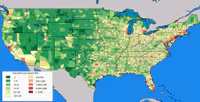
The number of individuals of a population per unit of area or within a specified amount of space.
Example: This map shows population density across the U.S. Red areas are densely populated (many people per square mile), while green areas are sparsely populated.
2.
FLASHCARD QUESTION
Front
Population Dispersion Noun
[pop-yuh-ley-shuhn dih-spur-zhuhn]
Back
Population Dispersion
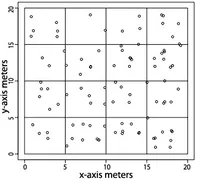
The relative distribution or pattern describing how individuals in a population are spread out over an area.
Example: This diagram shows one pattern of population dispersion, where individuals (circles) are spread out within a defined area, illustrating their spatial relationship to one another.
3.
FLASHCARD QUESTION
Front
Biotic Potential Noun
[bahy-ot-ik puh-ten-shuhl]
Back
Biotic Potential
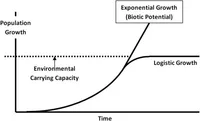
The fastest rate at which a species' population can grow when living under ideal environmental conditions.
Example: This graph shows that biotic potential is the maximum, unrestricted growth of a population over time, represented by the steep exponential growth curve.
4.
FLASHCARD QUESTION
Front
Reproductive Potential Noun
[ree-pruh-duhk-tiv puh-ten-shuhl]
Back
Reproductive Potential
The maximum number of offspring that each female member of a population is capable of producing.
Example: This image shows the development of male and female reproductive systems in a fetus, which is unrelated to the ecological concept of 'Reproductive Potential'.

5.
FLASHCARD QUESTION
Front
Carrying Capacity Noun
[kar-ee-ing kuh-pas-i-tee]
Back
Carrying Capacity
The largest population size that a given environment can sustainably support over a long period of time.
Example: This fishbowl represents an environment with limited resources, showing the maximum population of fish it can support, which is its carrying capacity.

6.
FLASHCARD QUESTION
Front
Density-Dependent Factor Noun
[den-si-tee dih-pen-duhnt fak-ter]
Back
Density-Dependent Factor
A limiting factor whose effect on a population increases as the population's density increases.
Example: This image shows many hands reaching for one piece of bread, illustrating competition for a limited resource, which is a key density-dependent factor.

7.
FLASHCARD QUESTION
Front
Density-Independent Factor Noun
[den-si-tee in-dih-pen-duhnt fak-ter]
Back
Density-Independent Factor
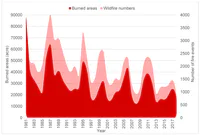
A limiting factor that affects a population's size and growth regardless of the population's density.
Example: This chart shows data on wildfires, which are a density-independent factor because they can reduce a population's size no matter how crowded or sparse it is.



Access all questions and much more by creating a free account
Create resources
Host any resource
Get auto-graded reports

Continue with Google

Continue with Email

Continue with Microsoft
or continue with

%20(1).png)
Apple

Others
By signing up, you agree to our Terms of Service & Privacy Policy
Already have an account?



