

Momentum and Collisions

Flashcard
•
Science
•
6th - 8th Grade
•
Hard

Barbara White
FREE Resource
Student preview

15 questions
Show all answers
1.
FLASHCARD QUESTION
Front
Momentum Noun
[moh-men-tuhm]
Back
Momentum
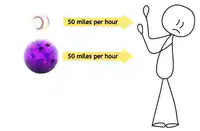
The quantity of motion of a moving object, calculated as the product of the object's mass and velocity.
Example: An object's momentum depends on its mass and velocity; a heavier bowling ball has more momentum than a lighter baseball at the same speed.
2.
FLASHCARD QUESTION
Front
Mass Noun
[mas]
Back
Mass
A measure of the amount of matter in an object, which determines its resistance to acceleration when a force is applied.
Example: This image shows that different objects have different amounts of mass. The rock has more mass than the feather, causing the balance scale to tip.

3.
FLASHCARD QUESTION
Front
Velocity Noun
[vuh-los-i-tee]
Back
Velocity
The rate of change of an object's position with respect to a frame of reference, including its speed and direction.
Example: This diagram shows the relationship between velocity (v), displacement (d), and time (t) using a formula triangle, a tool to remember how to calculate each variable.

4.
FLASHCARD QUESTION
Front
Vector Quantity Noun
[vek-ter kwon-ti-tee]
Back
Vector Quantity
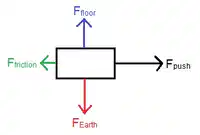
A physical quantity that is fully described by both a magnitude, which is its numerical size, and a direction.
Example: This diagram shows forces acting on a block. Each force is a vector quantity because it is represented by an arrow that has both a direction and a magnitude (length).
5.
FLASHCARD QUESTION
Front
Magnitude Noun
[mag-ni-tood]
Back
Magnitude
The numerical size or amount of a physical quantity, considered separately from its direction in space.
Example: A speedometer shows a car's speed, which is the magnitude (or size) of its velocity, but not its direction.

6.
FLASHCARD QUESTION
Front
Impulse Noun
[im-puls]
Back
Impulse
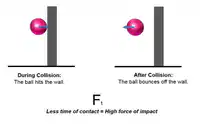
The change in momentum of an object when a force is applied over a specific interval of time.
Example: This diagram shows that impulse is a force acting over time. A ball hitting a wall experiences a large force for a short time, causing it to bounce back.
7.
FLASHCARD QUESTION
Front
Conservation of Momentum Noun
[kon-ser-vey-shuhn of moh-men-tuhm]
Back
Conservation of Momentum
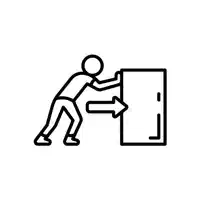
The principle stating that the total momentum of an isolated system remains constant before and after any interaction.
Example: When two cars collide, the total momentum of the system before the crash is the same as the total momentum after the crash.


Access all questions and much more by creating a free account
Create resources
Host any resource
Get auto-graded reports

Continue with Google

Continue with Email

Continue with Microsoft
or continue with

%20(1).png)
Apple

Others
Already have an account?

