

Chemical Equilibrium

Flashcard
•
Science
•
6th - 8th Grade
•
Hard

Barbara White
FREE Resource
Student preview

16 questions
Show all answers
1.
FLASHCARD QUESTION
Front
Reversible Reaction Noun
[ri-vur-suh-buhl ree-ak-shun]
Back
Reversible Reaction
A chemical reaction where products can react to re-form reactants, proceeding in both forward and reverse directions.
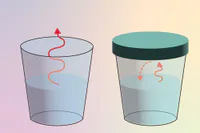
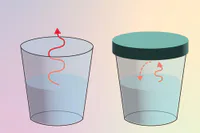
Example: This image shows that in a closed glass, water evaporates and condenses back into liquid. This is a reversible process, unlike the open glass where water only evaporates away.
2.
FLASHCARD QUESTION
Front
Chemical Equilibrium Noun
[kem-i-kuhl ee-kwuh-lib-ree-uhm]
Back
Chemical Equilibrium
The state where forward and reverse reaction rates are equal, resulting in constant concentrations of reactants and products.
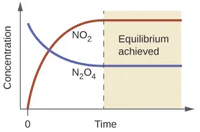
Example: This graph shows that in a reversible reaction, equilibrium is reached when the concentrations of reactants (N₂O₄) and products (NO₂) stop changing over time.
3.
FLASHCARD QUESTION
Front
Equilibrium Constant (K) Noun
[ee-kwuh-lib-ree-uhm kon-stuhnt]
Back
Equilibrium Constant (K)
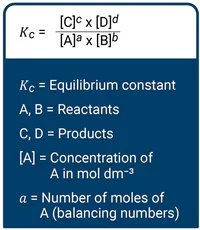
A value representing the ratio of product concentrations to reactant concentrations at equilibrium, each raised to its stoichiometric coefficient.
Example: This image shows the math formula for the equilibrium constant (Kc), which compares the amount of products to the amount of reactants in a reversible chemical reaction.
4.
FLASHCARD QUESTION
Front
Homogeneous Equilibrium Noun
[hoh-muh-jee-nee-uhs ee-kwuh-lib-ree-uhm]
Back
Homogeneous Equilibrium
A chemical equilibrium in which all reactants and products are in the same physical phase, such as all gaseous.
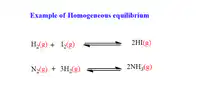
Example: This image shows two reversible chemical reactions where all substances—both reactants and products—are in the same gas phase, indicated by the symbol (g).
5.
FLASHCARD QUESTION
Front
Heterogeneous Equilibrium Noun
[het-er-uh-jee-nee-uhs ee-kwuh-lib-ree-uhm]
Back
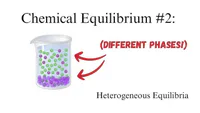
Heterogeneous Equilibrium
A chemical equilibrium in which the reactants and products are present in more than one physical phase.
Example: This diagram shows a chemical reaction at equilibrium inside a beaker where the substances are in different physical states (phases), like a solid at the bottom and dissolved particles in the liquid.
6.
FLASHCARD QUESTION
Front
Dynamic Equilibrium Noun
[dy-nam-ik ee-kwuh-lib-ree-uhm]
Back
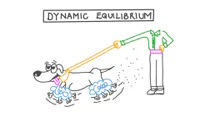
Dynamic Equilibrium
An equilibrium state where forward and reverse reactions continue at equal rates, resulting in no net change in the system.
Example: A dog running on a leash but staying in place shows dynamic equilibrium, where forward and reverse actions happen at the same rate.
7.
FLASHCARD QUESTION
Front
Law of Mass Action Noun
[law uv mas ak-shun]
Back
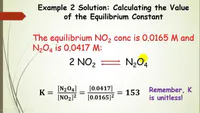
Law of Mass Action
The principle that a reaction's rate is proportional to the product of reactant concentrations, forming the basis for equilibrium expressions.
Example: This image shows a calculation for the equilibrium constant (K), a mathematical application of the Law of Mass Action for a specific chemical reaction.
Access all questions and much more by creating a free account
Create resources
Host any resource
Get auto-graded reports

Continue with Google

Continue with Email

Continue with Classlink

Continue with Clever
or continue with

Microsoft
%20(1).png)
Apple

Others
Already have an account?



