

Fission and Fusion

Flashcard
•
Science
•
6th - 8th Grade
•
Hard

Barbara White
FREE Resource
Student preview

19 questions
Show all answers
1.
FLASHCARD QUESTION
Front
Proton Noun
[pro-ton]
Back
Proton
A subatomic particle with a positive electric charge found within the nucleus of an atom, defining its atomic number.
Example: This diagram shows a proton, a particle with a positive charge (+), located inside the central nucleus of an atom, along with uncharged neutrons.

2.
FLASHCARD QUESTION
Front
Neutron Noun
[noo-tron]
Back
Neutron
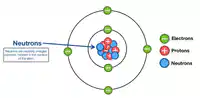
A subatomic particle with no electric charge (neutral) found within the nucleus of an atom, contributing to its mass.
Example: This diagram shows a neutron as a neutral particle (blue circle) located inside the atom's central nucleus, alongside positively charged protons (red circles).
3.
FLASHCARD QUESTION
Front
Isotope Noun
[eye-so-tope]
Back
Isotope
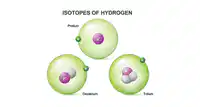
Atoms of the same element that have the same number of protons but different numbers of neutrons in their nuclei.
Example: This image shows three isotopes of hydrogen. All have one proton, but they have different numbers of neutrons (0, 1, and 2).
4.
FLASHCARD QUESTION
Front
Strong Force Noun
[strong fors]
Back
Strong Force
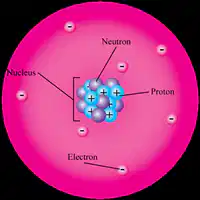
The fundamental force that binds protons and neutrons together in the atomic nucleus, acting over an extremely short range.
Example: This diagram shows protons and neutrons packed together in an atom's nucleus, the place where the strong force acts to hold the nucleus together.
5.
FLASHCARD QUESTION
Front
Electromagnetic Force Noun
[eh-lek-tro-mag-net-ik fors]
Back
Electromagnetic Force
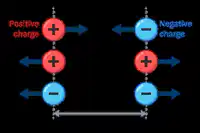
The fundamental force associated with charged particles, causing attraction between opposite charges and repulsion between like charges.
Example: This diagram shows that particles with the same charge (positive-positive) push each other away, while particles with opposite charges (positive-negative) pull toward each other. This is the electromagnetic force.
6.
FLASHCARD QUESTION
Front
Weak Force Noun
[week fors]
Back
Weak Force
The fundamental force responsible for certain nuclear decay processes, such as a neutron changing into a proton (beta decay).
Example: The weak force causes a neutron inside an atom's nucleus to change into a proton, releasing an electron and another tiny particle (an antineutrino).

7.
FLASHCARD QUESTION
Front
Gravitational Force Noun
[grav-i-tay-shun-ul fors]
Back
Gravitational Force
The fundamental force of attraction that exists between all objects that possess mass, acting over an infinite range.
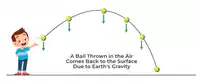
Example: An object thrown into the air, like a ball, follows a curved path and returns to the ground because of Earth's constant downward gravitational force.


Access all questions and much more by creating a free account
Create resources
Host any resource
Get auto-graded reports

Continue with Google

Continue with Email

Continue with Microsoft
or continue with

%20(1).png)
Apple

Others
Already have an account?


