

Life Cycle of a Star

Flashcard
•
Science
•
6th - 8th Grade
•
Hard

Barbara White
FREE Resource
Student preview

17 questions
Show all answers
1.
FLASHCARD QUESTION
Front
Stellar Mass Noun
[stel-er mas]
Back
Stellar Mass
The mass of a star, which is the key factor determining its life path, temperature, and fuel consumption rate.
Example: This diagram shows that a star's life path depends on its starting mass. An average-mass star has a different fate than a high-mass star.

2.
FLASHCARD QUESTION
Front
Nebula Noun
[neb-yuh-luh]
Back
Nebula
A vast cloud of gas and dust in interstellar space from which stars are born through gravitational collapse.
Example: This image shows a nebula, a giant cloud of gas and dust in space where new stars are born from collapsing material.

3.
FLASHCARD QUESTION
Front
Protoplanetary Disk Noun
[proh-toh-plan-i-ter-ee disk]
Back
Protoplanetary Disk
A rotating, flattened disk of dense gas and dust that forms around a newly developing protostar during star formation.
Example: A young star is surrounded by a rotating disk of gas and dust, from which planets begin to form by gathering material in their orbit.

4.
FLASHCARD QUESTION
Front
Protostar Noun
[proh-toh-star]
Back
Protostar
The earliest stage of a star's life, formed from a collapsing cloud of gas before nuclear fusion has begun.
Example: This image shows a protostar, a very young star, gathering mass from a swirling disk of gas and dust surrounding it.

5.
FLASHCARD QUESTION
Front
Nuclear Fusion Noun
[noo-klee-er fyoo-zhun]
Back
Nuclear Fusion
The process that powers a star, where atomic nuclei combine in the core to form heavier nuclei, releasing immense energy.
Example: Two light atomic nuclei, like hydrogen isotopes, combine to form a heavier nucleus, like helium, releasing a large amount of energy in the process.

6.
FLASHCARD QUESTION
Front
Main Sequence Star Noun
[meyn see-kwens star]
Back
Main Sequence Star
A star in the longest and most stable phase of its life, fusing hydrogen into helium in its core.
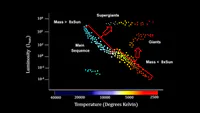
Example: This H-R diagram plots stars by temperature and brightness. Main sequence stars form a long, stable band where most stars spend their lives.
7.
FLASHCARD QUESTION
Front
Radiation Pressure Noun
[rey-dee-ey-shun presh-er]
Back
Radiation Pressure
The outward force exerted by the energy released during nuclear fusion, which counteracts the inward pull of gravity.
Example: Light from a star carries momentum and exerts a small push, called radiation pressure, on any object it hits, like a reflective surface.


Access all questions and much more by creating a free account
Create resources
Host any resource
Get auto-graded reports

Continue with Google

Continue with Email

Continue with Classlink

Continue with Clever
or continue with

Microsoft
%20(1).png)
Apple

Others
Already have an account?



