

Carrying Capacity and Limiting Factors

Flashcard
•
Science
•
6th - 8th Grade
•
Hard

Barbara White
FREE Resource
Student preview

18 questions
Show all answers
1.
FLASHCARD QUESTION
Front
Limiting Factor Noun
[lim-it-ing fak-ter]
Back
Limiting Factor
A resource or environmental condition that restricts the growth, abundance, or distribution of an organism or a population.
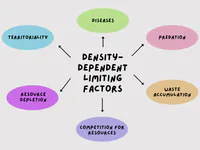
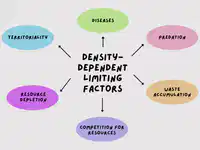
Example: This diagram shows examples of density-dependent limiting factors, which are things that limit population growth more as the population becomes denser.
2.
FLASHCARD QUESTION
Front
Carrying Capacity Noun
[kair-ee-ing kuh-pas-i-tee]
Back
Carrying Capacity
The maximum population size of a biological species that can be sustained indefinitely by a given environment.
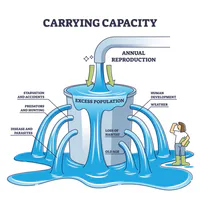
Example: This diagram uses a bucket metaphor to show carrying capacity. Reproduction fills the bucket (population growth), while limiting factors like predators and habitat loss act as drains, causing excess population to 'overflow'.
3.
FLASHCARD QUESTION
Front
Biotic Factor Noun
[bahy-ot-ik fak-ter]
Back
Biotic Factor
A living component or factor within an ecosystem that affects other organisms or the environment.
Example: This diagram shows that biotic factors are all the living or once-living parts of an ecosystem, including animals, plants, fungi, protists, bacteria, and archaea.

4.
FLASHCARD QUESTION
Front
Abiotic Factor Noun
[ey-bahy-ot-ik fak-ter]
Back
Abiotic Factor
A non-living chemical or physical part of the environment that affects living organisms and ecosystem functioning.
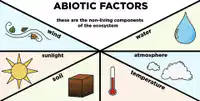
Example: This diagram defines abiotic factors as non-living parts of an ecosystem and shows key examples like sunlight, water, soil, and temperature.
5.
FLASHCARD QUESTION
Front
Tolerance Range Noun
[tol-er-uhns reynj]
Back
Tolerance Range
The specific range of environmental conditions, such as temperature or pH, within which a particular species can survive.
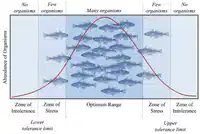
Example: This graph shows a species' population is largest in its 'optimum range.' In the 'zones of stress' and 'intolerance,' fewer or no organisms survive.
6.
FLASHCARD QUESTION
Front
Density-dependent Limiting Factor Noun
[den-si-tee di-pen-dent lim-it-ing fak-ter]
Back
Density-dependent Limiting Factor
A limiting factor whose effect on a population is determined by the total size and density of that population.
Example: This image shows many hands (a dense population) competing for a limited resource (one loaf of bread), which limits how many can be fed.

7.
FLASHCARD QUESTION
Front
Density-independent Limiting Factor Noun
[den-si-tee in-di-pen-dent lim-it-ing fak-ter]
Back
Density-independent Limiting Factor
A limiting factor that affects a population's size regardless of the population's density, such as a natural disaster.
Example: This image incorrectly shows examples of density-dependent factors, such as disease and predation, which become more severe as a population's density increases.

Access all questions and much more by creating a free account
Create resources
Host any resource
Get auto-graded reports

Continue with Google

Continue with Email

Continue with Classlink

Continue with Clever
or continue with

Microsoft
%20(1).png)
Apple

Others
Already have an account?



