

Gas Laws

Flashcard
•
Science
•
6th - 8th Grade
•
Hard

Barbara White
FREE Resource
Student preview

12 questions
Show all answers
1.
FLASHCARD QUESTION
Front
Pressure Noun
[presh-er]
Back
Pressure
The amount of force exerted by gas particles per unit area on the surface of a container.
Example: This image shows that atmospheric pressure is higher at lower altitudes because there is a greater column of air, and therefore more weight, pressing down.

2.
FLASHCARD QUESTION
Front
Volume Noun
[vol-yoom]
Back
Volume
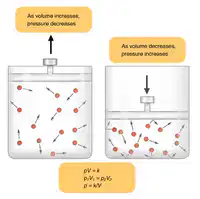
The amount of three-dimensional space a gas occupies, which is determined by the size of its container.
Example: This image shows that as the volume of a container with gas decreases, the gas particles have less space, causing pressure to increase.
3.
FLASHCARD QUESTION
Front
Kinetic Energy Noun
[ki-net-ik en-er-jee]
Back
Kinetic Energy
The energy that a particle possesses due to its motion, which is directly proportional to its temperature in Kelvin.
Example: This image of a family playing with a toy does not illustrate kinetic energy in the context of gas laws, which involves the motion of atoms and molecules.

4.
FLASHCARD QUESTION
Front
Kinetic Molecular Theory Noun
[ki-net-ik mo-lek-yuh-ler thee-uh-ree]
Back
Kinetic Molecular Theory
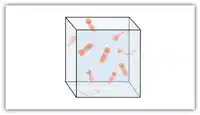
A scientific model describing a gas as numerous submicroscopic particles that are in constant, random motion.
Example: This image shows that gas is made of tiny particles that are in constant, random motion, bouncing off each other and the container walls.
5.
FLASHCARD QUESTION
Front
Elastic Collision Noun
[i-las-tik kuh-lizh-uhn]
Back
Elastic Collision
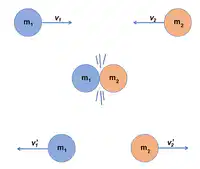
A collision between particles where the total kinetic energy is conserved, meaning no energy is lost during the interaction.
Example: Two particles (like gas molecules) collide and bounce off each other, showing how momentum is transferred in an elastic collision without losing total kinetic energy.
6.
FLASHCARD QUESTION
Front
Absolute Zero Noun
[ab-suh-loot zee-roh]
Back
Absolute Zero
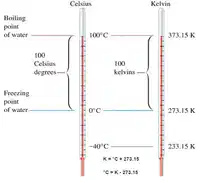
The lowest possible theoretical temperature, 0 on the Kelvin scale, where particles of matter have minimal motion.
Example: This diagram shows that absolute zero is the lowest possible temperature, corresponding to 0 on the Kelvin scale, -273°C, and -459°F.

7.
FLASHCARD QUESTION
Front
Kelvin Noun
[kel-vin]
Back
Kelvin
The SI base unit of thermodynamic temperature, using absolute zero as its null point, required for gas law calculations.
Example: This image compares the Kelvin and Celsius temperature scales, showing key reference points like water's freezing and boiling points and the conversion formula.
Access all questions and much more by creating a free account
Create resources
Host any resource
Get auto-graded reports

Continue with Google

Continue with Email

Continue with Microsoft
or continue with

%20(1).png)
Apple

Others
Already have an account?

