

INTRODUCTION TO HISTORY

Presentation
•
History
•
8th - 9th Grade
•
Practice Problem
•
Medium

Isabel Vilchez Ocaña
Used 40+ times
FREE Resource
10 Slides • 8 Questions
1
What is HISTORY?
HISTORY is the study of the past.
2
* History helps us to understand more about ourselves and the world around us. It tells us where we come from and explains our culture and traditions.
* YOU are part of history. In the future, historians will be interested in your life.
3
A person who studies history.
Historians are interested in :
- How people lived
- Important events in the past.
4
Historians study the past using historical sources. A historical source is anything that gives us information about the past. Here are some examples.
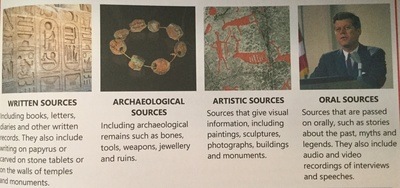
5

6
It is the science that studies the events that occurred in the past and the societies that played a part in them.
Herodotus is considered the father of historiography.
7
Historians and archaeologists use the information provided by the remains of past times, they extract the needed data and, once this is done, they reconstruct the past and they explain it.
8
Archaeology: It is an auxiliary science of history that studies the material remains of the past.
Palaeontology: It helps archaeologists study animal and plant fossils to determine what they look like.
Chemistry: It is essential to date the organic remains using the carbon-14 method.
9
There are two: Prehistory and History. They are separated by the invention of writing (around 3000BC)
10
Palaeolithic Period: it began 2.5 million years ago with the appearance of the first hominids.
Neolithic Period: it began around 10,000 BC with the discovery of agriculture and livestock farming.
Metal Ages: it began around 5000 BC with the discovery of metallurgy.
Antiquity: it began around 3500 BC with the invention of writing.
Middle Ages: it began in 476 with the end of the Western Roman Empire. It is divided into the Early Middle Ages—until the 13th century—and the Late Middle Ages—from the 13th century.
Early modern period: it began in 1492 with the discovery of America—other historians place its beginning in 1453, with the capture of Constantinople by the Turks
Late modern period: it began in 1789 with the outbreak of the French Revolution. It extends to the present day.
11
Multiple Select
A Roman bridge is a :
primary source
secondary source
12
Open Ended
What is History?
13
Fill in the Blanks
A source from the same time as the period we want to study. Examples: letters, photos, videos, tools diaries.
Type answer...
14
Fill in the Blanks
There are two main eras dividing History:
Type answer...
15
Open Ended
What is the Archeology?
16
Multiple Select
A book about Roman bridges written by a historian is a:
Primary source
Secondary source
17
Multiple Select
A biography of Picasso is a:
Primary source
Secondary source
18
Multiple Select
An interview with Picasso is a:
Primary source
Secondary source
What is HISTORY?
HISTORY is the study of the past.
Show answer
Auto Play
Slide 1 / 18
SLIDE
Similar Resources on Wayground

14 questions
French Revolution
Presentation
•
9th Grade
14 questions
West African Empires
Presentation
•
9th Grade
10 questions
Spread of the Cold War - Vietnam War
Presentation
•
9th Grade
16 questions
Early Quarrels and Accomplishments
Presentation
•
8th Grade
16 questions
Effects of Industrial Revolution
Presentation
•
9th Grade
13 questions
Ancient Rome - Gods and Goddesses
Presentation
•
8th - 9th Grade
13 questions
3/5th compromise
Presentation
•
8th Grade
14 questions
Effects of Exploration
Presentation
•
9th Grade
Popular Resources on Wayground
10 questions
Safety Day 2026 – Student Review

Quiz
•
9th Grade
21 questions
Continents and Oceans
Quiz
•
6th Grade
20 questions
Parts of Speech
Quiz
•
5th Grade
16 questions
Subject & Predicate
Quiz
•
5th Grade
25 questions
Multiplication Facts
Quiz
•
5th Grade
12 questions
Map Skills
Quiz
•
3rd Grade
22 questions
Continents and Oceans
Quiz
•
5th Grade
15 questions
Rounding Decimals
Quiz
•
5th Grade
Discover more resources for History
15 questions
Unit 3 - Part 1 Road to Revolution
Quiz
•
8th Grade
25 questions
WWII Assessment
Quiz
•
8th Grade
25 questions
The American Revolution
Quiz
•
7th - 10th Grade
15 questions
The Bill of Rights
Quiz
•
8th - 12th Grade
18 questions
American Revolution Review
Quiz
•
8th Grade
14 questions
Weekly Wrap Up #3: CE.1a/e -Fundamental Principles
Quiz
•
8th Grade
15 questions
Ancient Rome
Quiz
•
7th - 10th Grade
16 questions
Students of Civics Unit 2: The Constitution
Quiz
•
7th - 11th Grade