Search Header Logo
Chemistry of Life & Enzymes

Chemistry of Life & Enzymes

Assessment

Presentation

Biology

9th Grade

Practice Problem

Medium

NGSS
HS-PS1-5, HS-LS1-6, HS-PS1-4

Standards-aligned

Created by

Tiffany Paine

Used 48+ times

FREE Resource

10 Slides • 17 Questions

1

Chemistry of Life & Enzymes

Let's review for today's quiz!
Slide image

2

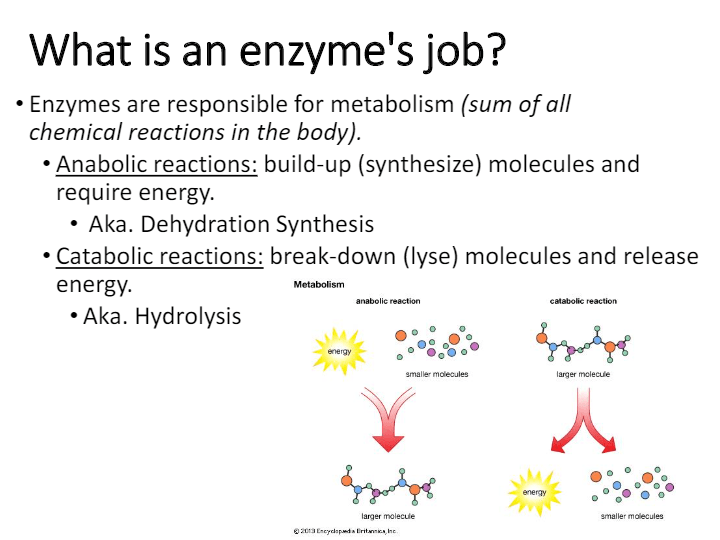
Slide image

3

Multiple Choice

Question image

What process is shown in this picture?

1

dehydration synthesis

2

hydrolysis

4

Multiple Choice

Question image

What process is shown in this picture?

1

dehydration synthesis

2

hydrolysis

5

Multiple Choice

Question image

Analyze the elements that compose the reactants and products. What are the reactants in this reaction?

1

nucleic acids

2

monosaccharides

3

amino acids

4

fatty acids

6

Multiple Choice

Based on your previous answer, what type of bond was made to join the two monomers together?

1

hydrogen bond

2

peptide bond

3

helium bond

4

glycerol bond

7

Slide image

8

Multiple Choice

Question image

Which reaction shows the amount of energy required without enzymes?

1

black line

2

red line

9

Multiple Choice

Question image

Which reaction shows the amount of energy required with enzymes?

1

black line

2

red line

10

Fill in the Blanks

Type answer...

11

Slide image

12

Slide image

13

Open Ended

What happens to an enzyme when it is heated above its optimal temperature?

14

Slide image

15

Multiple Choice

Question image

What is the optimal temperature of this enzyme?

1

50 degrees C

2

40 degrees C

3

60 degrees C

4

70 degrees C

16

Multiple Choice

Question image

At what temperature(s) does this enzyme begin to denature?

1

Above 15 degrees C

2

Below 15 degrees C

17

Slide image

18

Multiple Choice

Question image

What does substrate concentration refer to?

1

There aren't enough substrates compared to enzymes

2

There aren't enough enzymes compared to substrates

3

Substrates and enzymes are in equal amounts

19

Multiple Choice

Question image

What would increase the reaction rate?

1

adding more substrates

2

adding more products

3

adding more enzymes

4

adding more water

20

Slide image

21

Multiple Choice

Question image

What type of pH does pepsin function best in?

1

acidic

2

basic

3

neutral

22

Multiple Choice

Question image

What is the optimal pH of salivary amylase?

1

2

2

7

3

8

4

9

23

Slide image

24

Open Ended

What do competitive inhibitors compete for?

25

Slide image

26

Open Ended

What do non-competitive inhibitors do to an enzyme?

27

Multiple Choice

What do competitive and non-competitive inhibitors have in common?

1

they both bind to the active site

2

they both change the shape of the enzyme

3

they both increase the reaction rate

4

they both prevent a reaction from occuring

Chemistry of Life & Enzymes

Let's review for today's quiz!

Slide image

Show answer

Auto Play

Slide 1 / 27

SLIDE