Measuring Matter
Presentation
•
Science
•
6th Grade
•
Practice Problem
•
Medium
Mrs. Coleman
Used 30+ times
FREE Resource
1 Slide • 14 Questions
1
Measuring Matter
Independent Work
2
Multiple Choice
What object is pictured here?
Scale
Pan balance
Mass balance
Triple beam balance
3
Multiple Choice
What is mass?
The amount of matter in an object
The amount of space an object takes up
An object's ability to sink or float
An object's weight
4
Multiple Choice
What is this object used to measure?
Density
Mass
Volume
Amount
5
Multiple Choice
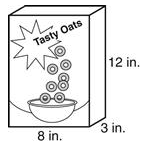
What is the volume of the cereal box?
230 in3
97 in3
132 in3
288 in3
6
Multiple Choice
What is the volume of this prism?
length =9 ft.
width = 7 ft.
height = 2 ft
229 ft3
126 ft2
126 ft3
187 ft3
7
Multiple Choice
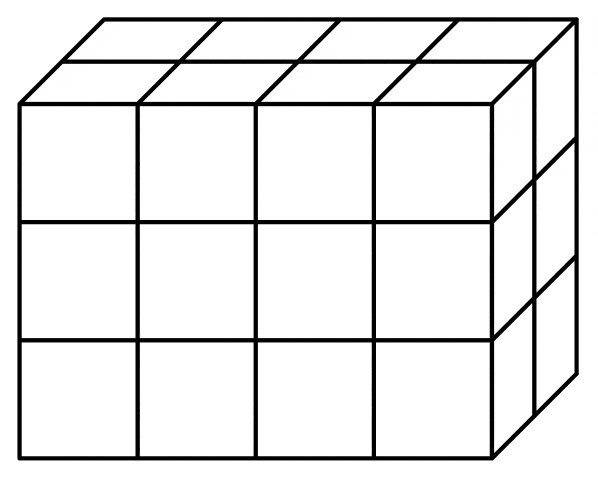
What is the volume of this rectangular prism?
26 cubic units
24 cubic units
24 square units
26 square units
8
Multiple Choice
What is the method that uses water to measure the volume of an object called?
displacement
displaced
discontent
9
Multiple Choice
What is weight?
The magnetic force acting on the body
The electric force acting on the body
The gravity acting on the body
The gravitational force acting on the body
10
Multiple Choice
Helium balloons rise on earth because
helium is less dense than air
helium is more dense than air
helium is cooler than air
helium is warmer than air
11
Multiple Choice
What is the density of a liquid that has a mass of 27g and a volume of 30ml?
0.9 g/ml
3 g/ml
57 g/ml
810 g/ml
12
Multiple Choice
A brick sinks in water while a wooden block of the same size floats. This is because the brick has a
lower volume than the wooden block
lower density than the wooden block
higher volume than the wooden block
higher density than the wooden block
13
Multiple Choice
Why do ice cubes float in a glass of water?
the ice cubes are more dense than the water
the water is more dense than the ice cubes
the water is more dense than the glass
the ice is more dense than the glass
14
Multiple Choice
Which property of matter is determined by dividing its mass by its volume?
elasticity
buoyancy
density
viscosity
15
Multiple Choice
An object's weight will always be the same anywhere on Earth.
True
False
Measuring Matter
Independent Work
Show answer
Auto Play
Slide 1 / 15
SLIDE

Similar Resources on Wayground
13 questions
Microorganisms
Presentation
•
6th Grade
11 questions
Sedimentary Rocks
Presentation
•
5th - 6th Grade
8 questions
Asexual Reproduction in Animals
Presentation
•
6th Grade
12 questions
WW- Inv 4.2 - Latitude
Presentation
•
6th Grade
14 questions
Moon phases
Presentation
•
6th Grade
12 questions
Major Tectonic Plates
Presentation
•
6th Grade
12 questions
Rock Cycle
Presentation
•
6th Grade
10 questions
Introducing Storms: Tornadoes
Presentation
•
5th - 6th Grade
Popular Resources on Wayground
19 questions
Naming Polygons
Quiz
•
3rd Grade
10 questions
Prime Factorization
Quiz
•
6th Grade
20 questions
Math Review
Quiz
•
3rd Grade
15 questions
Fast food
Quiz
•
7th Grade
20 questions
Main Idea and Details
Quiz
•
5th Grade
20 questions
Context Clues
Quiz
•
6th Grade
20 questions
Inferences
Quiz
•
4th Grade
19 questions
Classifying Quadrilaterals
Quiz
•
3rd Grade
Discover more resources for Science
16 questions
Interactions within Ecosystems
Presentation
•
6th - 8th Grade
20 questions
Rocks and The Rock Cycle
Quiz
•
6th Grade
20 questions
Moon Phases and Eclipses
Quiz
•
6th - 8th Grade
20 questions
Human Body Systems
Quiz
•
6th Grade
22 questions
6th & 8th Grade Science Material SOL Review
Quiz
•
6th - 8th Grade
15 questions
Punnett Squares
Quiz
•
6th Grade
20 questions
Cells! Cell Theory and Characteristics of Eukaryotes/Prokaryotes
Quiz
•
6th Grade
35 questions
Amplify Weather Patterns Unit Review
Quiz
•
6th Grade