Search Header Logo
American Revolution

American Revolution

Assessment

Presentation

History

9th - 12th Grade

Practice Problem

Medium

Created by

Joselito Ebro

Used 43+ times

FREE Resource

16 Slides • 10 Questions

1

American Revolution

World History

Slide image

2

Lesson Objectives

  • Describe America's colonies in the late 1700s.

  • List events that led to the American Revolution.

  • Explain the Enlightenment's influence on American government.

3

Slide image

British colonists formed large and thriving settlements along the eastern shore of North America. Each colony had its own government and colonists identified themselves as less British. However, they were still British subjects and were expected to obey British law.

4

Open Ended

How did geography affect the colonist's sense of independence?

5

Slide image

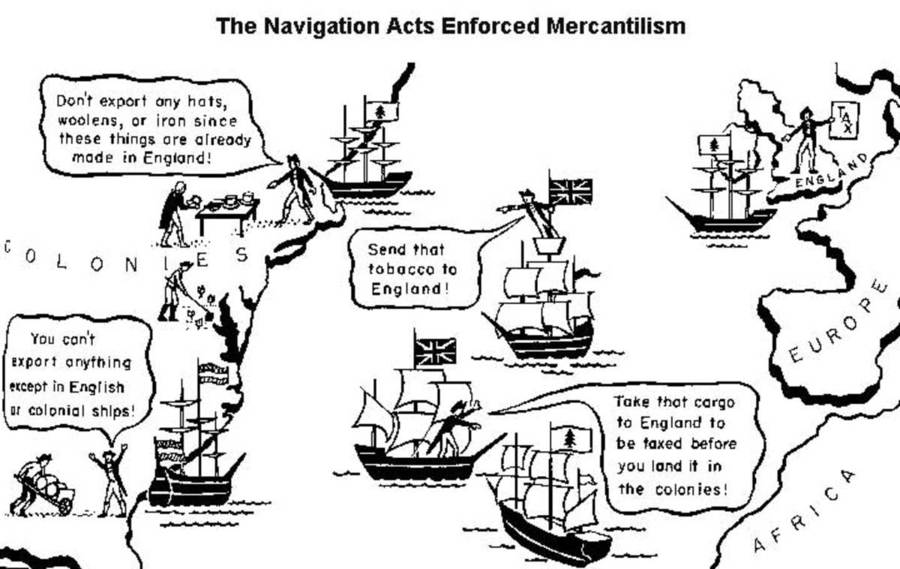
Some of these laws include the Navigation Act, payment of high tariff, selling of manufactured goods to America for a profit. Such laws made the colonies dependent on the economy of England.

6

Fill in the Blank

The Navigation Acts created a close trading relationship between the American colonies and Great Britain and raised the taxes on goods imported from the Netherlands and _____.

7

Open Ended

Why might Parliament (lawmaking body of England) want to restrict American colonial trade?

8

French and Indian War

  • War between England and France from 1754-63

  • The French enlisted numerous Native American tribes on their side

  • Britain emerged victorious and seized nearly all French land in North America

9

Colonists vs England

  • Tensions between Britain and the colonists grew the the former expected the latter to pay its huge debt.

  • Stamp Act - colonists paying extra taxes on to have an official documents

  • Colonists were outraged as they accused the government of "taxation without representation.

10

Fill in the Blank

The French and Indian War resulted in a large debt for Great Britain, and, as a result, Parliament imposed (the) _____ on the American colonies.

11

Open Ended

Why would taxation without representation seem unfair to Enlightenment thinkers?

12

Growing Hostilities

  • Boston Tea Party (1773) - colonists dumped a larger load of British tea into the Boston Harbor in protest of the import tax on tea.

  • Townshend Acts - required taxes on goods imported to the American colonies.

  • Intolerable Acts - punitive laws passed by the British Parliament in 1774 after the Boston Tea Party.

13

Growing Hostilities

  • On September 5, 1774, delegates from each of the 13 colonies (except for Georgia) met in Philadelphia as the First Continental Congress to organize colonial resistance to English rule.

  • When the king paid little attention to the complaints, the colonies decided to form the Second Continental Congress to debate their next move.


14

Growing Hostilities

  • April 19, 1775 - British soldiers and colonial militiamen exchanged gunfire in Lexington, Massachussetts.

  • June 17, 1775 - the British defeated the Americans at the Bttle of Bunker Hill in Massachussetts.

  • The Second Continental Congress voted to raise an army and organize for battle under the command of a Virginia named George Washington.

15

Influence of the Enlightenment

  • Colonial leaders used Enlightenment ideas to justify independence.

  • In July 1776, the Second Continental Congress issued the Declaration of Independence written by Thomas Jefferson.

16

Success for the Colonists

  • Despite with poorly trained army under George Washington, the colonists won their war for independence.

  • (1) American motivation

  • (2) Overconfident British general

  • (3) Time was on the side of the colonists

  • French help proved to be crucial for the victory of the colonists

17

Slide image

After declaring independence, the 13 states recognized the need for a national government. They built it based on two ancient Greek ideas: Constitutionalism and Republicanism as they didn't want the national government to be too strong and uneducated people rule through a democracy.

18

A weak national government

  • To protect themselves, the 13 states created a loose confederation with no executive and judicial branches.

  • The Congress could declare war, enter into treaties, and coin money, but no power to collect taxes or regulate trade.

  • Passing new laws was difficult because laws needed the approval of 9 of the 13 states.

19

Multiple Select

Why would the states want to avoid a strong national government? Which enlightenment thinkers does this recall?

1

to avoid problems of monarchies

2

Rosseau

3

to promote trade

4

Montesquieu

20

Multiple Choice

Which of the following was a major weakness of the Articles of Confederation?

1

The president could not declare war.

2

The Congress had no power to coin money.

3

Congress had no power to collect taxes.

4

The federal courts could not rule on state issues.

21

Multiple Choice

Why would the states want to avoid a strong national government?

1

to avoid problems of monarchies

2

Americans hated the government

3

to promote trade

4

to end British rule

22

A New Constitution

  • The Constitutional Convention held its first session on May 25, 1787.

  • The delegates were experienced statesmen who were familiar with the political theories of Locke, Montesquieu, and Rousseau.

  • Although the Constitution, created a strong central government, it did not eliminate local governments. Instead, the Constitution set up a federal system in which power was divided between national and state governments.

23

The Bill of Rights

  • The signing of the Constitution marked by sharp debate.

  • Federalist - believed that the new government would provide a better balance between national and state power.

  • Antifederalists - feared that the Constitution gave the central government too much power.

  • Congress formally added to the Constitution the ten amendments known as the Bill of Rights which protected basic rights such as freedom of speech, press, assembly, and religion.

24

Slide image

American democracy was a logical outgrowth of Enlightenment idea as it laid the foundation for the fledging American government.

25

Open Ended

If many of the concepts included in the U.S. Constitution are based upon European ideas, what key role did the framers of the U.S. Constitution play?

26

Open Ended

Why is it important that every citizen has, and exercises, his or her right to vote?

American Revolution

World History

Slide image

Show answer

Auto Play

Slide 1 / 26

SLIDE