Search Header Logo
Area and Volume CXC

Area and Volume CXC

Assessment

Presentation

Physics

10th - 12th Grade

Medium

Created by

r Henderson

Used 18+ times

FREE Resource

8 Slides • 14 Questions

1
Area and Volume CXC

Measure the area of both regular and irregular shapes. Measure the volume of both regular and irregular solids which float and sink in water.

media

2

Area and Volume

  • The surface area of regular objects, e.g a triangular lamina, is found by taking measurements of lengths and using appropriate mathematical formulae.

  • The surface area of an irregular object is found by the 'counting squares ' method. The basic unit of area is meter squared (m2).

  • The volume of a regular object such as a cylinder can be found from measurements of lengths and diameters- then using the appropriate formula.

  • The volume of an irregular objects is found by a displacement method.

3

Area

The space occupied by a flat shape or the surface of an object.  

Area is measured in square units.

media

4

Estimating the Area of irregularly shapes.

  • We impose a graph on the shap.

  • Count the squares completely covered.

  • we count squares that a half and more as being a complete square.

media

5

Volume

 3-dimensional space enclosed by a boundary or occupied by an object. Volume is measured in cubic units.

media

6

Displacement Method

Vsolid = Vfinal - Vinitial

media

7

Multiple Choice

What does area mean?

1

the distance around a shape

2

half the distance around a shape

3

the amount of space outside a shape

4

the amount of space inside a shape

8

Multiple Choice

What is the formula for finding area of a rectangle?

1

A = l•w

2

A = s•df

3

A = b•c

4

A and C

9

Multiple Choice

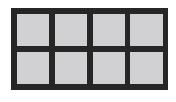
Question image

Find the area of the rectangle.

1

8 square units

2

9 square units

3

10 square units

4

12 square units

10

Multiple Choice

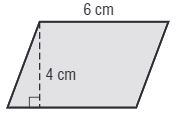
Question image

Find the area of the figure.

1

10 cm2

2

24 cm2

3

12 cm2

4

20 cm2

11

Multiple Choice

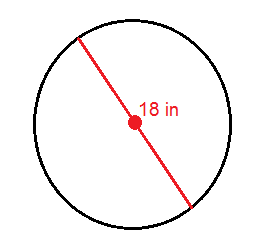
Question image

What is the area of this circle?

1

62.59 cm2

2

113.1 cm2

3

19.81 cm2

4

28.26 cm2

12

Multiple Choice

Question image

Find the area of the circle

1

56.52

2

254.34

3

1017.36

4

113.04

13

Multiple Choice

Question image

Find the Area.

1

91 ft2

2

77 ft2

3

78 ft2

4

105 ft2

14

Multiple Choice

Question image
Find the area of this triangle.
1
12 in2
2
22 in2
3
18 in2
4
24 in2

15

Multiple Choice

Question image

Estimate the area of this shape.

1

98 cm2

2

55 cm2

3

112 cm2

4

79 cm2

16

Multiple Choice

Question image

Anna is sending the following package in the mail to her sister. She needs to find the volume of the box before sending the package.

Which equation below would Anna use to find the volume of the package?

1

V = 12 + 14+ 31

2

V = 12 x 14 x 31

3

V = (12 x 2) + (14 x 2) + (31 x 2 )

4

V = (12 x 14) + 31

17

Multiple Choice

What is this formula used to find?

V=πr2h

1

The volume of a cylinder

2

The volume of a cone

3

The volume of a sphere

4

The area of a circle

18

Multiple Choice

What is the difference between area and volume?

1

Area is the space inside a 2D shape and volume is the space inside a 3D shape.

2

Area is measured in squared units and volume is also measured in squared units

3

Area changes for different shapes, but volume is the same for all shapes

4

There is no difference between both

19

Multiple Choice

Question image

What is the volume of Object X?

1

10.0 cm3

2

15.0 cm3

3

20.0 cm3

4

25.0 cm3

20

Multiple Choice

To calculate the amount of carpeting needed for your bedroom, which of the following should you find:

1

Area

2

Perimeter

3

Surface Area

4

Volume

21

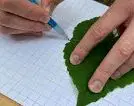
SCIENTIST TAKEOVER ACTIVITY: ESTIMATING THE SURFACE AREA OF A LEAF.

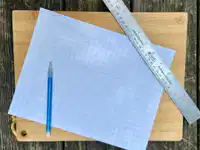
Material:

  • Graph paper

  • Leaf

  • Pencil

media

22

ESTIMATING THE SURFACE AREA OF A LEAF.

media
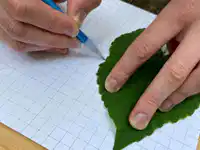
  1. Carefully remove leaf from plant and place on grid paper.

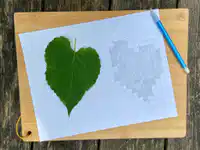
  2. Trace the leaf’s outline and remove the leaf.

  3. Trace the leaf’s outline and remove the leaf.

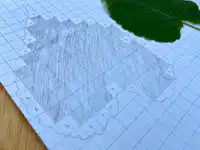
  4. Count the number of squares that are completely within the outline.

  5. ​Estimate the areas partially covered – The simplest way to do this is: count a partial square if it is at least half covered by the leaf; do not count partial squares that are less than half covered.

  6. Add up the number of squares counted (fully filled + half full squares) and you now have the surface area of the leaf in centimeters squared (cm2).

media
media
media

Area and Volume CXC

Measure the area of both regular and irregular shapes. Measure the volume of both regular and irregular solids which float and sink in water.

media

Show answer

Auto Play

Slide 1 / 22

SLIDE