

CHAPTER 14 LESSON 1

Presentation
•
History
•
10th Grade
•
Practice Problem
•
Medium

Richard Orton
Used 8+ times
FREE Resource
35 Slides • 13 Questions
1
CHAPTER 14 LESSON 1
The peoples of North America and Meso America

2
ESSENTIAL QUESTION
In what ways were civilizations in early Mesoamerica and South America complex?
How were civilizations in early Mesoamerica and South America influenced by previous cultures?

3
The Peoples of North America
During the last Ice Age, a natural land bridge connected the Asian and North American continents. Early hunters used this land bridge when they followed herds of bison and caribou into North America. These hunters became the first people to live in North America.
4
Open Ended

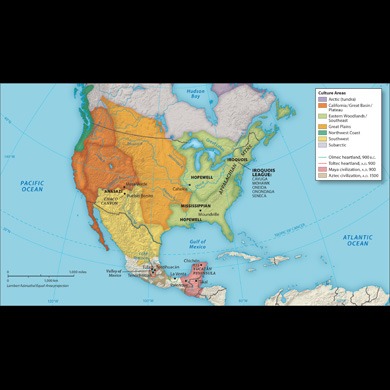
Environment and Society The Hopewell traded with other groups in North America. Based on the map, how do you think the Hopewell transported their goods?
5
Eastern Woodlands
Around 1000 b.c., farming villages appeared in the Eastern Woodlands, the land in eastern North America from the Great Lakes to the Gulf of Mexico. People here grew crops but also continued to gather wild plants for food. The Hopewell people, known as the Mound Builders, built large, elaborate earth mounds that were used as tombs or for ceremonies. Some were built in the shapes of animals.

6
Eastern Woodlands
The shift to full-time farming in approximately a.d. 700 led to a prosperous culture in the Mississippi River valley. This Mississippian culture grew corn, squash, and beans together to provide plants with nutrients, support, and shade.
7
Multiple Choice
8
Eastern Woodlands
Cities began to appear, and some of them contained 10,000 people or more. At the site of Cahokia (kuh • HOH • kee • uh), near the modern city of East St. Louis, Illinois, archaeologists found a burial mound more than 98 feet (30 m) high. It had a base larger than the base of the Great Pyramid in Egypt. Between a.d. 850 and 1150, Cahokia flourished and served as the seat of government. For reasons unknown, Cahokia collapsed during the 1200s.
9
Open Ended

The World in Spatial Terms Why do you think more culture groups were located in the south than in the north?
10
Eastern Woodlands
To the northeast of the Mississippian culture were people known as the Iroquois (IHR • uh • KWOY). The Iroquois lived in villages that consisted of longhouses surrounded by wooden fences for protection. Each longhouse, built of wooden poles covered with sheets of bark, was 150 to 200 feet (46 to 61 m) in length and housed about a dozen families.

11
Eastern Woodlands
Iroquois men hunted deer, bear, caribou, and small animals such as rabbits and beaver. They were warriors who protected the community. Women owned the dwellings, gathered wild plants, and grew crops. The most important crops were the "three sisters"—corn, beans, and squash.
12
Eastern Woodlands
Wars were common, especially among groups of Iroquois who lived in much of present-day Pennsylvania, New York, and parts of southern Canada. Legend holds that sometime during the 1500s, the Iroquois peoples were nearly torn apart by warfare. Deganawida, an elder of one Iroquois group, appeared and preached the need for peace.

13
Eastern Woodlands
One who listened was Hiawatha, a member of the Onondaga (AH • nuhn • DAW • guh) group. From the combined efforts of Deganawida and Hiawatha came the Great Peace, which created an alliance of five groups called the Iroquois League.

14
Eastern Woodlands
A council of representatives, a group of 50 Iroquois leaders known as the Grand Council, met regularly to settle differences. Representatives were chosen in a special way. Each Iroquois group was made up of clans, or groups of related families. The women of each clan singled out a well-respected woman as the clan mother. The clan mothers then chose the male members of the Grand Council.
15
Great Plains and Southwest
West of the Mississippi River basin, the Plains Indians cultivated beans, corn, and squash along the river valleys of the eastern Great Plains. Every summer, the men left their villages to hunt buffalo, a very important animal to the Plains culture. Hunters would work together to frighten a herd of buffalo, causing them to stampede over a cliff.

16
Great Plains and Southwest
The buffalo served many uses for Plains peoples. They ate the meat, used the skins for clothing, and made tools from the bones. By stretching buffalo skins over wooden poles, they made circular tents called tepees. Tepees provided excellent shelter; they were warm in winter and cool in summer.

17
Great Plains and Southwest
The Southwest covers the territory of present-day New Mexico, Arizona, Utah, and Colorado. Conditions are dry, but there is sufficient rain in some areas for farming. The Anasazi (AH • nuh • SAH • zee) peoples established an extensive farming society there.

18
Great Plains and Southwest
Between a.d. 500 and 1200, the Anasazi used canals and earthen dams to garden in the desert. They were skilled at making baskets and pottery. Using stone and adobe (sun-dried brick), they built pueblos, or multistoried structures that housed many people.
19
Multiple Choice
20
Great Plains and Southwest
At Chaco Canyon in northwestern New Mexico, they built an elaborate center for their civilization. At the heart of Chaco Canyon was Pueblo Bonito, a large complex that contained some 800 rooms housing more than 1,000 people. However, persistent droughts led the Anasazi to abandon it.

21
The Maya
Signs of civilization in Mesoamerica—a name we use for areas of Mexico and Central America that were civilized before the Spaniards arrived—appeared around 1200 b.c. On the Yucatán Peninsula, one of the most sophisticated civilizations in the Americas arose. This was the civilization of the Maya, which flourished between a.d. 300 and a.d. 900.

22
The Maya
Sometime around a.d. 800, the Maya civilization in the central Yucatán Peninsula began to decline

23
Political and Social Structures
Maya cities were built around a central pyramid topped by a shrine to the gods. Nearby were other temples, palaces, and a sacred ball court. Some scholars believe that more than 100,000 inhabitants might have lived in urban centers such as Tikal in present-day Guatemala.
24
Political and Social Structures
Maya civilization was composed of city-states, each governed by a hereditary ruling class. These Maya city-states were often at war with each other. Ordinary soldiers who were captured in battle became slaves. Captured nobles and war leaders were used for human sacrifice.
25
Multiple Choice
26
Political and Social Structures
In the powerful city-state of Palenque (pah • LEHNG • kay), the ruler Pacal claimed to be descended from the gods, as did other Maya rulers. These rulers were supported by nobles and a class of scribes who might also have been priests. Maya society also contained peasants and townspeople who worked as skilled artisans, officials, and merchants.

27
Multiple Choice
28
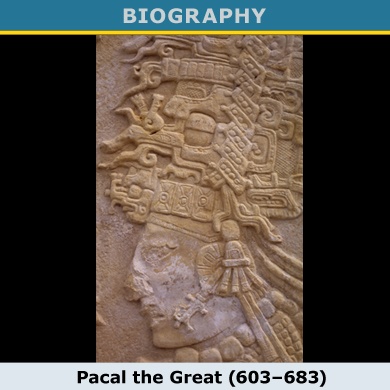
PACAL THE GREAT 603-683
At the age of 12, Pacal assumed the throne of the Maya city-state of Palenque and ruled for 67 years. During his reign, Palenque became a major force and dominated the Maya lowlands. The marriage between a noble woman from Palenque and the ruler of the nearby city-state of El Tortuguero formed an alliance between the two regions.
29
PACAL THE GREAT 603-683
However, many historians believe that the smaller El Tortuguero became subordinate to Pacal's state. Pacal provided political stability to his realm. He also supported a building program in Palenque that produced great works of art and architecture. After his death, Pacal was worshipped as a god.
30
Open Ended

Summarizing During Pacal’s reign, how did Palenque gain territory?
31
Religion and Culture
Religion and spiritual beliefs were central to Maya civilization. All of nature was sacred to the Maya. Maya artists personified aspects of nature like the Sun, Moon, rain, and lightning. Deities also represented abstract concepts, like Itzamna, the “god of knowledge and wisdom.” Ritual human sacrifice, most often of warriors captured from other groups, was also a common religious practice.
32
Religion and Culture
The Maya calendar is often called the Calendar Round, and is made up of two parts: one was based on a solar calendar of 365 days, divided into 18 months of 20 days each and an extra 5 days at the end. The other was based on a sacred calendar of 260 days, divided into 13 weeks of 20 days. The primary unique component was known as the Long Count, which tallied the number of days that had elapsed from a mythological “zero date.”

33
Multiple Choice
34
The Toltec
Around a.d. 1000, new peoples rose to prominence in central Mexico. Most significant were the Toltec. The Toltec empire reached its high point between a.d. 950 and 1150. The center of the empire was Tula, which was built on a high ridge about 43.5 miles (70 km) northwest of present-day Mexico City.
35
The Toltec
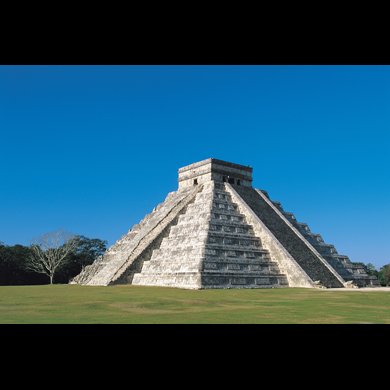
The Toltec were a warlike people. Their empire included much of northern and central Mexico. They also extended their conquests into the Maya lands of Guatemala and the northern Yucatán. The Toltec controlled the upper Yucatán Peninsula from Chichén Itzá for centuries.

36
The Toltec
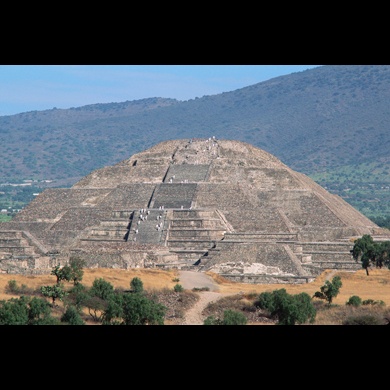
The Toltec were also builders who constructed pyramids and palaces. They brought metalworking to Mesoamerica and were the first people in the region to work in gold, silver, and copper.
37
The Toltec
The Toltec empire began to decline around 1125 as a result of fighting among different groups in Tula. Around 1170, the city was sacked and much of it burned. There was no single ruling group for nearly 200 years until the Aztec Empire emerged, carrying on many Toltec traditions.
38
Multiple Choice
39
The Aztec
The origins of the Aztec are uncertain. Sometime during the twelfth century, they began a long migration that brought them to the Valley of Mexico. They eventually established a capital at Tenochtitlán (tay • nawch • teet • LAHN), now Mexico City.

40
The Aztec
In 1325 under attack by another people, they were driven into the swamps and islands of Lake Texcoco (tehs • KOH • koh). On one island, they saw an eagle standing on a prickly pear cactus on a rock. There they built Tenochtitlán (or "place of the stone and prickly pear cactus"):

41
The Aztec
The Aztec at Tenochtitlán under Montezuma I formed a Triple Alliance with two other city states, Tetzcoco and Tlacopan. This alliance enabled the Aztec to dominate an empire that included much of today’s Mexico, from the Atlantic to the Pacific Ocean and as far south as the Guatemalan border. This alliance lasted until the reign of Montezuma II and the arrival of Spanish in the 1500s.

42
Multiple Choice
43
Political and Social Structures
By 1500, as many as four million Aztec lived in the Valley of Mexico and the surrounding valleys of central Mexico. Like all great empires in ancient times, the Aztec state was authoritarian. The monarch, who claimed lineage with the gods, held all power. A council of lords and government officials assisted the Aztec ruler.
44
Multiple Choice
45
Religion and Culture
Like other peoples in Central America and around the world, the Aztec had a polytheistic religion, believing in many gods. Huitzilopochtli, the god of the sun and war, was particularly important to Aztec warriors as they expanded control over neighboring peoples.

46
Religion and Culture
Aztec religion was based on a belief in an unending struggle between the forces of good and evil throughout the universe. This struggle created and destroyed four worlds, or suns. People believed they were now living in the time of the fifth sun. To postpone the day of reckoning, the Aztec practiced human sacrifice, which they believed would appease the sun god Huitzilopochtli.
47
Multiple Choice
48
Open Ended

In what ways were civilizations in early Mesoamerica and South America complex?
CHAPTER 14 LESSON 1
The peoples of North America and Meso America
Show answer
Auto Play
Slide 1 / 48
SLIDE


