

Context clues

Presentation
•
English
•
9th Grade
•
Hard

bhnhs lrc
Used 30+ times
FREE Resource
26 Slides • 0 Questions
1
Welcome Grade 9 students!
2
Context Clues
Types of Context Clues
3
Objectives of the lesson
This lesson will help you:
• determine the different types of context clues (definition,
synonym/restatement, antonyms);
• arrive at the meaning of words through context clues; and
• define unknown words through context clues.
4
Directions: Read the sentences carefully. Encircle the letter of the best
meaning for the underlined word as it is used in context.
5
1. My sister said, “I just freed myself from a very loquacious history
professor. All he seemed to want was an audience.”
A. grouchy
B. pretentious
C. talkative
D. worried
6
2. Many years before, Caesar’s men had tried and failed to invade Britain.
No doubt this contributed to the xenophobia of the Romans. They were
cautious about strangers who entered their country.
honesty
fear of foreigners
kindness
tubbornness
7
3. The prisoners liberated from the Nazi death camp were so emaciated
that they looked like skeletons.
A. well and fit
B. extremely hungry
C. healthy and fleshy
D. abnormally thin and weak
8
4. Instead of grimace, Crystal had a big smile on her face.
A. grin
B. frown
C. mask
D. smirk
9
5. She was an agile dancer, although her partner was quite clumsy.
A. quiet
B. nimble
c. shy
D. stiff
10
Context clues are hints or “clues” to the meaning of a word that are quite literally
hidden in plain sight.
11
Context clues are hints in the passage, paragraph or individual sentence
that can tell you the meaning of a word you are not familiar with. Sometimes even the title of
a piece or the illustrations that come with it offer context clues, as well.
12
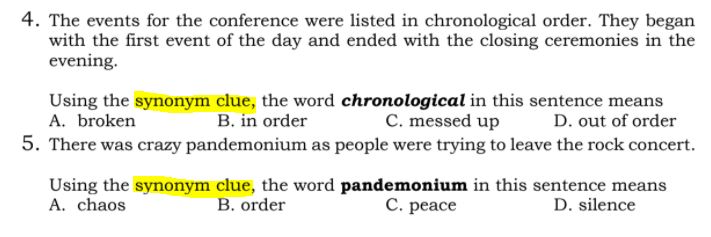
Context clues can be classified into four types:
synonym or restatement clues,
antonym or contrast clues,
definition or explanation clues,
and general or inference clues.
13

14

15

16

17

18

19
20

21

22
Remember
Context Clues are the hints writers use to help readers understand unfamiliar words. These hints or clues may appear within the same sentence with the word it refers or through looking at antonyms, definitions or explanations or a general inference on how the word is used in a sentence. In order to improve and widen your vocabulary, it is necessary that you learn to recognize context clues when reading.
23
Check Your Understanding
Directions: For each underlined word, use the context clues or words that surround it to find its meaning. Write the underlined word and its meaning and identify what type of context clue is used in the sentence.
Example A: I was really hungry, and the pear I ate did not appease my hunger.
Answer: appease- to fulfill or satisfy; General or inference clue
24
25
6. The bird sang from the bough of the tress. Then the bird hopped to another
branch and sang some more.
7. Nikola Tesla was an enigmatic figure. His inventions contribute to many of the
modern conveniences that we use to this day.
8. This is a clandestine operation. It is extremely important that no one discovers
what you’re doing!
9. The signal from the cable is too strong for our television. We’ll have to use a filter
to attenuate it.
10.Martha is a curator, a person who is responsible for looking after a museum’s
collection.
26
6. The bird sang from the bough of the tress. Then the bird hopped to another
branch and sang some more.
7. Nikola Tesla was an enigmatic figure. His inventions contribute to many of the
modern conveniences that we use to this day.
8. This is a clandestine operation. It is extremely important that no one discovers
what you’re doing!
9. The signal from the cable is too strong for our television. We’ll have to use a filter
to attenuate it.
10.Martha is a curator, a person who is responsible for looking after a museum’s
collection.
Welcome Grade 9 students!
Show answer
Auto Play
Slide 1 / 26
SLIDE
Similar Resources on Wayground

20 questions
Comma Drama
Presentation
•
8th Grade
20 questions
Apostrophe Lesson
Presentation
•
9th Grade
20 questions
Simple, Compound, and Complex sentences
Presentation
•
9th Grade
19 questions
Personal Narrative
Presentation
•
9th Grade
20 questions
RL.9-10.4 / RI.9-10.4
Presentation
•
9th - 10th Grade
21 questions
Oro A1 Entrance Test
Presentation
•
KG
23 questions
Research Writing
Presentation
•
9th Grade
21 questions
Holes Chapter 1-2
Presentation
•
9th Grade
Popular Resources on Wayground
10 questions
How much do you know about our Portrait of an Eagle?

Quiz
•
10th Grade
10 questions
Fast Food Slogans
Quiz
•
6th - 8th Grade
21 questions
Continents and Oceans
Quiz
•
6th Grade
20 questions
Parts of Speech
Quiz
•
5th Grade
16 questions
Subject & Predicate
Quiz
•
5th Grade
25 questions
Multiplication Facts
Quiz
•
5th Grade
12 questions
Map Skills
Quiz
•
3rd Grade
22 questions
Continents and Oceans
Quiz
•
5th Grade
Discover more resources for English
15 questions
Simple, compound, and complex sentences
Quiz
•
9th Grade
16 questions
Ethos, Pathos, Logos Practice
Quiz
•
9th Grade
20 questions
Parts of Speech Review
Quiz
•
9th Grade
10 questions
Making Inferences and Drawing Conclusions

Interactive video
•
6th - 10th Grade
10 questions
Crafting an Effective Thesis Statement
Interactive video
•
6th - 10th Grade
10 questions
Exploring Coordinating Conjunctions with FANBOYS
Interactive video
•
6th - 10th Grade
20 questions
AP World History Unit 2 Quiz
Quiz
•
9th Grade
15 questions
Flashback, Foreshadowing, & Suspense Practice
Quiz
•
7th - 9th Grade