

Conjugaciones -ar, -er, -ir

Presentation
•
World Languages
•
9th - 12th Grade
•
Easy

Ana Casique
Used 627+ times
FREE Resource
13 Slides • 23 Questions
1
Conjugaciones
How does it work?
2
Multiple Select
Before starting this lesson, make sure that you:
Have your pencil and notebook on hand to take notes
Have the time to concentrate only on this lesson
Open your mind to understand the concepts explained
Be ready to learn and practice
3
Conjugaciones. The basics.
In Spanish, all verbs end with -ar, -er or -ir.
Some examples are:
hablar, comer, dormir (to speak, to eat, to sleep)
4
ALERTA
Be prepared to write down in your notes the next slide.
5
First things first... pronombres
Yo (I)
Tú (you singular informal)
Él, ella, usted (he, she, you formal)
Nosotros, nosotras (we; masculine and feminine)
Ellos, ellas (they, masculine and feminine)
Ustedes (you plural)
6
Multiple Choice
The pronoun in Spanish for You (plural) is:
ustedes
nosotros
ellos
ellas
7
Multiple Choice
The pronoun in Spanish for You (singular informal) is:
tú
nosotros
ellos
ellas
8
Multiple Choice
The pronoun in Spanish for You (singular formal) is:
tú
nosotros
usted
ellas
9
Multiple Choice
The pronoun in Spanish for she is:
tú
ella
usted
ellas
10
Multiple Choice
The pronoun in Spanish for he is:
tú
ella
él
ellas
11
Multiple Choice
The pronoun in Spanish for we is:
tú
ella
él
nosotros, nosotras
12
Multiple Choice
The pronoun in Spanish for they is:
tú
ella
ellos, ellas
nosotros, nosotras
13
Multiple Choice
The pronoun in Spanish for I is:
tú
yo
ellos, ellas
nosotros, nosotras
14
Let's begin with the rule for regular verbs ending in -ar
All regular verbs ending in -ar, are conjugated in a way that they will always end with: o, as, a, amos, an
Example: caminar (to walk) We remove the ending -ar, keep the stem camin, and add instead:
yo camino
tú caminas
él, ella, usted camina
nosotros, nosotras caminamos
ellos, ellas, ustedes caminan
15
Multiple Choice
The conjugation for I walk, in Spanish is:
camina
camino
caminamos
16
Task 1
Be prepared to write down in your notes the next list of verbs.
17
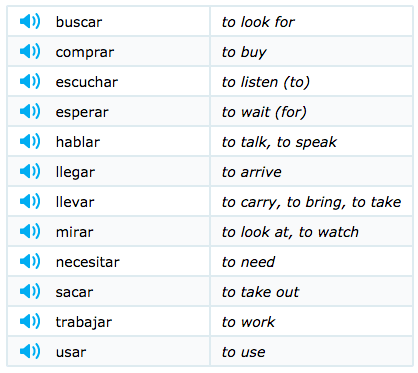
Some basic verbs ending in -ar that follow this rule, are:
18
Multiple Choice
¿Cómo se dice She speaks en español? how do you say She speaks in Spanish?
yo hablo
él habla
nosotros hablamos
ella habla
19
Multiple Choice
When we conjugate verbs ending in -ar in simple present tense, the endings change to:
o, as, a, amos, an
o, es, e, emos, en
o, es, e, imos, en
20
Multiple Select
The steps to conjugate a verb are:
1 to remove the end (ar)
2 to keep the stem
3 to add the new ending according to the pronoun
21
Poll
I understand how to conjugate verbs ending in -ar (being 1 nothing, and 5 everything)
1
2
3
4
5
22
Verbs ending with -er or -ir
For these verbs, the rule is similar
- We remove the ending -er or -ir
- We keep the stem of the verb
- We add the new ending according to the pronoun
23
Task 2
Be prepared to write down in your notes the next list of verbs.
24
Common regular verbs ending in -er or -ir

25
Let's study the rule for regular verbs ending in -er
All regular verbs ending in -er, are conjugated in a way that they will always end with: o, es, e, emos, en
Example: beber (to drink) We remove the ending -er, keep the stem beb, and add instead:
yo bebo
tú bebes
él, ella, usted bebe
nosotros, nosotras bebemos
ellos, ellas, ustedes beben
26
Multiple Choice
When we conjugate verbs ending in -er in simple present tense, the endings change to:
o, as, a, amos, an
o, es, e, emos, en
o, es, e, imos, en
27
Let's study the rule for regular verbs ending in -ir
All regular verbs ending in -ir, are conjugated in a way that they will always end with: o, es, e, imos, en
Example: vivir (to live) We remove the ending -ir, keep the stem viv, and add instead:
yo vivo
tú vives
él, ella, usted vive
nosotros, nosotras vivimos
ellos, ellas, ustedes viven
28
Multiple Choice
When we conjugate verbs ending in -ir in simple present tense, the endings change to:
o, as, a, amos, an
o, es, e, emos, en
o, es, e, imos, en
29
The only difference in the conjugation
The only conjugation that changes between -er and -ir is the ending for nosotros
For -er verbs is emos,
For -ir verbs is imos.
o, es, e, emos, en
o, es, e, imos, en
Bebemos, vivimos, comemos, escribimos
(We drink, we live, we eat, we write)
30
Poll
I understand how to conjugate verbs ending in -er and -ir (being 1 nothing, and 5 everything)
1
2
3
4
5
31
Multiple Choice
¿Cómo se dice she lives en español?
ella viva
ella vive
ella vivo
ella vivimos
32
Multiple Choice
¿Cómo se dice I speak en español?
yo hablo
yo habla
ellos hablo
nosotros hablo
33
Multiple Choice
¿Cómo se dice we understand en español?
comprendo
comprenden
comprendemos
comprende
34
Multiple Choice
¿Cómo se dice they read en español?
lees
leo
leemos
leen
35
Poll
How useful you found this type of lesson? 1 being useless, 5 being great
1
2
3
4
5
36
Poll
I need another class to understand the conjugations
Yes, I don't get it yet
No, I only need to practice more
Conjugaciones
How does it work?
Show answer
Auto Play
Slide 1 / 36
SLIDE
Similar Resources on Wayground

30 questions
Quinceañera
Presentation
•
9th - 12th Grade
32 questions
Affirmative/Negative Words
Presentation
•
9th - 12th Grade
25 questions
Saber y Conocer
Presentation
•
9th - 12th Grade
28 questions
Preterite tense of regular verbs 2
Presentation
•
9th - 12th Grade
26 questions
QC2: U2B.2: Más Verbos como Gustar
Presentation
•
9th - 12th Grade
28 questions
La Hora
Presentation
•
9th - 12th Grade
31 questions
Intro Simple Harmonic Motion
Presentation
•
9th - 12th Grade
32 questions
Quadratic Equations by Graphing
Presentation
•
9th - 12th Grade
Popular Resources on Wayground
21 questions
Continents and Oceans

Quiz
•
6th Grade
20 questions
Parts of Speech
Quiz
•
5th Grade
16 questions
Subject & Predicate
Quiz
•
5th Grade
25 questions
Multiplication Facts
Quiz
•
5th Grade
12 questions
Map Skills
Quiz
•
3rd Grade
22 questions
Continents and Oceans
Quiz
•
5th Grade
15 questions
Rounding Decimals
Quiz
•
5th Grade
20 questions
Brand Labels
Quiz
•
5th - 12th Grade
Discover more resources for World Languages
20 questions
REGULAR Present tense verbs
Quiz
•
8th - 9th Grade
21 questions
Los paises hispanohablantes y sus capitales
Quiz
•
12th Grade
20 questions
Ser vs Estar
Quiz
•
9th Grade
21 questions
Spanish speaking countries and capitals
Quiz
•
9th Grade
20 questions
Ser y estar
Quiz
•
9th - 10th Grade
25 questions
Spanish Speaking Countries Map Quiz Review
Quiz
•
9th - 12th Grade
20 questions
Preterite vs. Imperfect
Quiz
•
10th Grade
15 questions
PRESENTE CONTINUO
Quiz
•
9th - 12th Grade