Search Header Logo
Our Place in Space

Our Place in Space

Assessment

Presentation

Science

8th Grade

Practice Problem

Medium

NGSS
MS-ESS1-3, HS-ESS1-2, MS-ESS2-1

+6

Standards-aligned

Created by

Autumn Lambert

Used 21+ times

FREE Resource

28 Slides • 15 Questions

1

Our Place in Space

What makes up the universe?

media

2

Open Ended

What makes up the universe?

3

Earth is one of eight planets that orbits the sun, which is star.

  • A star is a celestial body made of gas that emits its own light.

  • A celestial body is any natural object outside of Earth's atmosphere.

  • The universe is space and all the matter and energy in it.

media

4

Open Ended

Name as many planets as you can remember OR tell me what your favorite planet is and why.

5

1 in 100 billion (or more!!)

  • Stars are grouped together into galaxies.

  • A galaxy is a large collection of stars, gas, and dust.

  • Our galaxy, the Milky Way, is just one of MANY galaxies in the universe.

media

6

Earth has just the right combination of conditions to support life.

media

7

Open Ended

Describe 2 to 3 factors that make our planet habitable.

8

media

9

media

10

Our Solar System

  • A solar system is a collection of large and small bodies that orbit our central star, the sun.

  • Ours has eight bodies called planets; a spherical body that orbits the sun.

  • (Typically planets are larger than other celestial bodies)

media

11

The Terrestrial Planets

  • Orbit nearest the sun.

  • Mercury, Venus, Earth, and Mars.

  • Rocky, dense, and relatively small.

media

12

media

13

media

14

The Gas Giants

  • Orbit furthest from the sun.

  • Jupiter, Saturn, Uranus, and Neptune.

  • Thick, gaseous atmospheres; small rocky cores; ring systems of ice, rock, and dust.

media

15

media

16

On December 21, 2020 , Jupiter and Saturn won’t be truly close together in space. They’ll appear near each other along our line of sight from Earth. (This is called "conjunction" and won't happen again until 2040.)

media

17

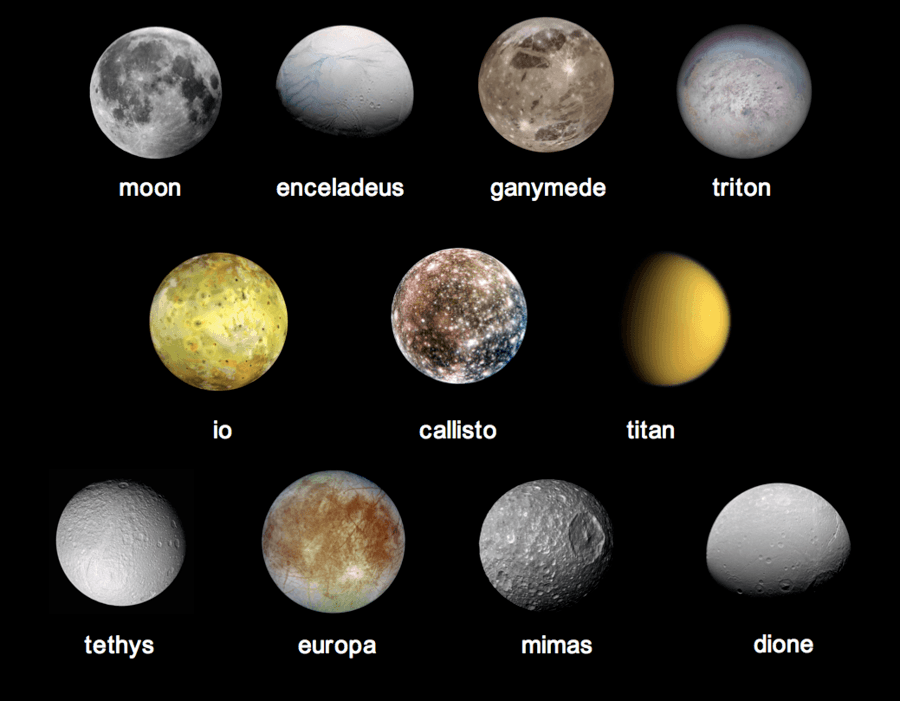
Moons

  • Smaller bodies that orbit planets.

  • Earth has one moon, but Jupiter has more than 60!

media

18

media

19

Other Bodies

  • Dwarf planets (e.g. Pluto), comets, asteroids, and meteoroids.

  • Altogether there are about a trillion small bodies in the solar system.

media
media

20

Stars

  • Large celestial body composed of gas that emits its own light.

  • Almost entirely hydrogen and helium.

media
media

21

Constellations

  • Patterns of stars

  • NOT all the same distance way

media

22

media

23

Orion Nebula

media

24

Nuclear fusion in the core emits energy.

  • Produces heat, light, wind, and other forms of radiation.

  • Stars can be "Earth-sized" to 1,000 times the size of our sun.

media
media

25

Galaxies

  • Large collection of stars, gas, and dust held together by gravity.

  • Our solar system is in the Milky Way galaxy.

  • Thought to be a spiral galaxy...but we're not sure!

media

26

There are other types of galaxies.

  • Elliptical

  • Irregular

media

27

media

28

How Big is BIG?

  • Distances in the universe are so big that astronomers use the speed of light.

  • A light-year is the distance light travels through space in one year.

  • 300,000 km/s or 9.5 trillion km in one year.

  • 670,616,629 mph!!

media

29

media

30

How is the structure of the universe like soap bubbles??

  • Clusters of galaxies along thin "walls".

  • Voids inside "bubbles" that take light hundreds of millions of years to cross.

media

31

media

32

Multiple Choice

Which of these is NOT part of the universe?

1

Light

2

Sound

3

Energy

4

Celestial Bodies

5

all of these are part of the universe

33

Multiple Choice

Question image

Which is the correct order of size from smallest to largest?

1

moon, planet, solar system, galaxy, universe

2

planet, moon, solar system, galaxy, universe

3

universe, galaxy, solar system, planet, moon

4

it all depends on which ones we're talking about

34

Multiple Choice

Question image

A large collection of gas, dust, and stars. (one is shown here)

1

Solar System

2

Constellation

3

Galaxy

4

Nebula

35

Multiple Choice

A smaller celestial body that orbits a planet.

1

asteroid

2

moon

3

comet

4

meteoroid

36

Multiple Choice

Question image

In our solar system there are _ planets.

1

7

2

8

3

9

4

10

37

Multiple Choice

The four terrestrial planets are

1

Jupiter, Saturn, Uranus, and Mars

2

Mercury, Mars, Neptune, and Venus

3

Earth, Mars, Jupiter, and Saturn

4

Mercury, Venus, Earth, and Mars

38

Multiple Choice

The gas giants are

1

Venus, Earth, Jupiter, and Saturn

2

Jupiter, Saturn, Uranus, and Neptune

3

Pluto, Neptune, Uranus, and Jupiter

4

Earth, Mars, Jupiter, and Saturn

39

Multiple Choice

True or False: A planet can have more than one moon.

1

True

2

False

40

Multiple Choice

Question image

Which of these celestial bodies does NOT orbit the sun?

1

planet Earth

2

a meteor

3

a comet

4

the Moon

41

Multiple Choice

Question image

What is the term for a meteoroid that has hit Earth's surface?

1

comet

2

meteor

3

meteorite

4

space debris

42

Multiple Choice

Question image

A "shooting star" is actually a

1

comet

2

meteor

3

meteorite

4

asteroid

43

Multiple Choice

Question image

A pattern of stars in the sky.

1

stellar connect-the-dots

2

solar system

3

constipation

4

constellation

Our Place in Space

What makes up the universe?

media

Show answer

Auto Play

Slide 1 / 43

SLIDE