Search Header Logo
7.Science.L16.EMRadiation

7.Science.L16.EMRadiation

Assessment

Presentation

Science

7th Grade

Hard

NGSS
MS-PS4-1, HS-PS4-3, HS-PS4-1

+2

Standards-aligned

Created by

Dana Goldsmith

Used 12+ times

FREE Resource

11 Slides • 17 Questions

1

Electromagnetic Spectrum
Slide image

2

Electromagnetic Spectrum

  • The electromagnetic (EM) spectrum is the range of all types of light radiation. The light energy that makes up the electromagnetic spectrum are: microwaves, infrared light, visible light, ultraviolet light, X-rays and gamma-rays.

  • Visible Light is the ONLY light we can see.

3

Slide image

4

Energy travels in waves

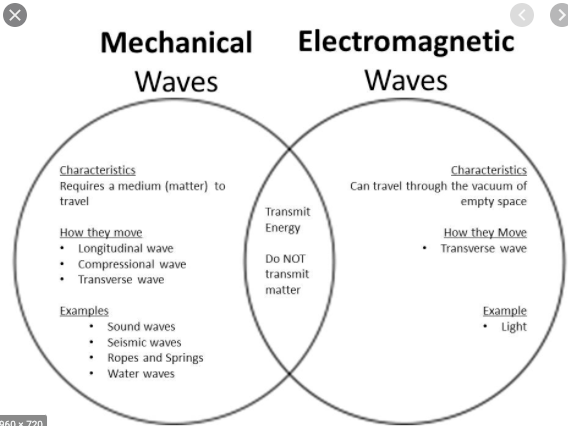
  • There are two types of waves: (1) Mechanical waves and (2) Electromagnetic waves

  • Mechanical waves need a medium (matter) to travel through.

  • Electromagnetic waves do NOT need a medium (matter) in order to travel.

5

Slide image

6

Multiple Choice

How do electromagnetic and mechanical waves compare?

1

Mechanical waves can only travel through a vacuum, but electromagnetic waves can travel through a solid, liquid, or gas.

2

Mechanical waves can only travel through a solid, liquid, or gas, but electromagnetic waves can travel through a vacuum.

3

Mechanical waves can travel through a solid, liquid, or gas, but electromagnetic waves can only travel through a gas.

4

mechanical waves can travel through a solid, liquid, or gas, but electromagnetic waves can only travel through a solid.

7

Multiple Choice

A student asks a series of questions about a wave. The answer to which question will allow the student to determine whether the wave is electromagnetic or mechanical?

1

Does it require a medium (matter) in order to travel?

2

Does it have a measurable speed?

3

Can it pass through air and water?

4

Does it have a measurable frequency.

8

Light waves are Transverse waves

  • Crest = tallest part of the wave

  • Trough = Lowest part of the wave

  • Amplitude = The distance between the Crest/Trough and the middle part of the wave. How tall the wave is.

  • Wavelength = The distance between 2 Crests/Troughs.

Slide image

9

Slide image

10

Multiple Choice

A student is measuring the distance between the crest and the rest position of both a mechanical wave and an electromagnetic wave. Which question is the student trying to answer?

1

What is the speed of the waves?

2

What is the wavelength of the waves?

3

What is the amplitude of the waves?

4

What is the frequency of the waves?

11

Multiple Choice

Question image

Which distance represents the wavelength?


Click on the image to the left to answer the question.

1

W

2

Y

3

X

4

Z

12

Multiple Choice

Question image

Which distance represents the amplitude?


Click on the image to the left to answer the question.

1

W

2

Y

3

X

4

Z

13

Multiple Choice

What do radio waves, microwaves, X-rays, and gamma rays all have in common?

1

They all have the same wavelength.

2

They are detected in the same way.

3

They are electromagnetic waves.

4

They store the same amount of energy.

14

Slide image

15

Energy

  • The shorter the wavelength = the more energy a wave has. If the wave travels at a high frequency it means it travels quickly.

  • The longer the wavelength = the less energy a wave has. If the wave travels at a low frequency it means it travels slowly.

Slide image

16

Slide image

17

Multiple Choice

Wavelength with a large wavelength will have a __________ frequency and ____________ energy.

1

high, low

2

low, high

3

high, high

4

low, low

18

Multiple Choice

Select the correct order of waves on the EMS.

1

Radio, Microwaves, Infrared, Visible, Ultra-violet, X-rays, Gamma rays

2

Visible light, Microwaves, Infrared, Ultra Violet, X-ray, Gamma, Radio

3

Gamma, X-ray, Ultra violet, Visible, Infrared, Microwave, Radio

4

Microwave, Radio, Visible, Infrared, Ultra-violet, X-ray, Gamma ray.

19

Multiple Choice

Question image

Which has the LONGEST wavelength and, therefore, the lowest frequency/energy?


Click the image to the left to answer the question.

1

Gamma Rays

2

Visible Light

3

Radio Waves

4

Infrared rays

20

Multiple Choice

Question image

Which has the SHORTEST wavelength and, therefore, the highest frequency/most energy.


Click on the image to the left to answer the question.

1

Radio Waves

2

Gamma Rays

3

Ultraviolet Rays

4

X-rays

21

Multiple Choice

Which section of the spectrum is the ONLY one we can see?

1

X-rays

2

Gamma Rays

3

Visible Light

4

Ultraviolet Rays

22

Multiple Choice

As the frequency of an electromagnetic wave increases, the amount of energy in that wave...

1

Increases

2

stays the same.

3

decreases

23

Slide image

24

Multiple Choice

The height of the wave is known as the ______________.

1

Amplitude

2

Trough

3

Crest

4

Wavelength

25

Multiple Choice

Question image

The blue section of the wave is measuring _______________.


Click on the image to the left to answer the question.

1

Wavelength

2

Trough

3

Crest

4

Amplitude

26

Multiple Choice

How are electromagnetic waves different from other waves?

1

They have very short wavelengths

2

They can travel through empty space.

3

They transmit energy instead of matter.

4

They can change directions by reflection.

27

Multiple Choice

Question image

High frequency waves have _____________ wavelengths.


Click on the image to the left to answer the question.

1

Varying

2

The same

3

Long

4

Short

28

Multiple Choice

What are electromagnetic waves?

1

sound waves

2

someone's name

3

electric & magnetic fields (energy) that travel through empty space very quickly

4

things like longitudinal waves

Electromagnetic Spectrum

Slide image

Show answer

Auto Play

Slide 1 / 28

SLIDE