

Logical Reasoning Part2: Arguments

Presentation
•
Mathematics
•
10th Grade
•
Practice Problem
•
Hard

THERESA Moe
Used 16+ times
FREE Resource
15 Slides • 13 Questions
1
Logical Reasoning
3.2 Arguments
Premises are a few statements that can justify a conclusion.
An argument is a process to make a conclusion based on a few given statements (premises).
Premise 1: ...
Premise 2: ...
Conclusion: ...
Deductive argument.

2
Deductive argument and Inductive argument
Deduction : process of making a specific conclusion based on general premises. The conclusion is certainly TRUE if all premises are true.
Induction : process of making a general conclusion based on specific premises. The conclusion might be false even though all premises are true.
3
Deductive argument and Inductive argument
Example: Premise 1: All pupils of class 4A are fluent in English. Premise 2: Aims is a pupil of class 4A. Conclusion: Aims is fluent in English. (Deductive argument)
Example: 12 + 32 = 4, 22 + 3 = 7, 32 + 3 = 12, ... Thus, the number sequence 4, 7, 12, ...can be written as n2 + 3 where n = 1, 2, 3, ... (Inductive argument)
4
Multiple Choice
Determine whether the following arguments is a deductive argument or an inductive argument.
All integers with unit digit 5 are divisible by 5.
Unit digit of 1245 is 5.
Hence, 1245 is divisible by 5.
deductive argument
inductive argument
5
Multiple Choice
Determine whether the following is a deductive argument or inductive argument.
(a1)2 = a2, (a2)3 = a6, (a3)4 = a12. Thus, (am)n = amxn
deductive argument
inductive argument
6
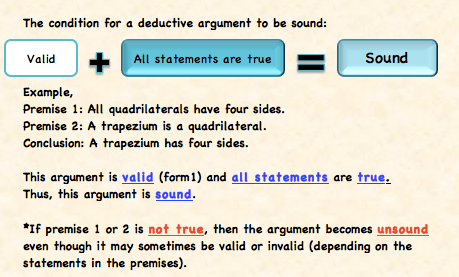
Determining whether a deductive argument is sound
A deductive argument is valid if its conclusion is certain to follow from the premises.
Example: Premise 1: All graduate teachers have a degree. Premise 2: Kevin is a graduate teacher. Conclusion: Kevin has a degree.
From the premises, it is certain that Kevin has a degree. Thus, deductive argument is valid.
Premise 1: All graduate teachers have a degree. Premise 2: Kevin has a degree. Conclusion: Kevin is a graduate teacher.
From the premises, it is not certain that Kevin is a graduate teacher. Kevin might be a doctor, an accountant and so on.
7

8
9

10

11
Multiple Choice
Determine whether the following argument is valid , sound.
Premise 1: if x is an odd number, then 2x is an even number.
Premise 2: x is not an odd number.
Conclusion: 2x is not an even number.
valid and sound
valid and not sound
not valid and not sound
12
Multiple Choice
Determine whether the following argument is valid, sound.
Premise 1: If 4 is a factor of N, then 2 is a factor of N
Premise 2: 4 is a factor of 32
Conclusion: 2 is a factor of 32
valid and sound
valid and not sound
not valid and not sound
13
Forming a valid deductive argument for a situation.
A true conclusion can be made for a valid deductive argument , based on the true two given premises.
Premise 1: All factors of 9 are odd numbers. Premise 2: x is a factor of 9. Conclusion: x is an odd number.
14
Fill in the Blanks
Write a suitable conclusion to form a valid and sound deductive argument.
Premise 1: If a candidate passes the SPM examination, then the candidate passes Bahasa Melayu.
Premise 2: Bob does not pass Bahasa Melayu.
Conclusion: ...?
(*put '.' at the end of the sentence)
Type answer...
15
Fill in the Blanks
State the conclusion..
Premise 1: All even numbers are divisible by 2.
Premise 2: m is an even number.
Conclusion: ...?
(put '.' at the end of the sentence)
Type answer...
16
Fill in the Blanks
Complete the premise to form a valid deductive argument.
Premise 1: All straight lines parallel to the x-axis has a gradient of 0.
Premise 2:
Type answer...
Conclusion: Straight line PQ has a gradient of 0.
17
Strength of an Inductive Argument
An inductive argument is strong when there is a high probability its conclusion is true.
A strong inductive argument has firm premises and high reliability level such that a logic and convincing conclusion can be made and the argument is cogent.
A weak inductive argument has doubtful premises causing the conclusion made to be not logical and not convincing. The argument is not cogent.
In general, an inductive argument (a) can be strong but not cogent (b) not cogent if there is a false premise or conclusion.
18

19

20
Multiple Select
Determine whether the following argument is strong or weak. Hence determine and justify whether the argument is cogent or not cogent.
Premise 1: 6 is divisible by 3.
Premise 2: 12 is divisible by 3.
Premise 3: 18 is divisible by 3.
Conclusion: All multiples of 6 are divisible by 3.
The argument is strong
The argument is weak
The argument is cogent because all the premises are true and the conclusion is true.
The argument is not cogent because the conclusion is false.
21
Multiple Select
Determine whether the following argument is strong or weak. Hence, determine if the argument is cogent or not cogent.
Premise 1: 24 is a multiple of 12.
Premise 2: 48 is a multiple of 12.
Premise 3: 64 is a multiple of 12.
Conclusion: All multiples of 12 are even numbers.
The argument is strong.
The arguement is weak.
The argument is cogent.
The argument is not cogent.
22
Multiple Select
Determine whether the following argument is strong or weak. Hence determine whether the argument is cogent or not cogent.
Premise 1: 2 is a prime number.
Premise 2: 3 is a prime number.
Premise 3: 5 is a prime number.
Conclusion: All prime numbers are odd numbers.
The argument is strong.
The argument is weak.
The argument is cogent.
The argument is not cogent.
23
Forming a Strong Inductive Argument for a situation.
A strong and cogent inductive argument depends on its premises and conclusion which are true.
The given premises provide the proof and support for the conclusion made.
24

25

26
Fill in the Blanks
Form a general conclusion by induction for the following number pattern.
7 = 12 - 5(1)
2 = 12 - 5(2)
-3 = 12 - 5(3)...
Type answer...
27
Fill in the Blanks
Write a suitable conclusion in order that the inductive argument is strong and cogent.
Premise 1: Prefects are chosen carefully among students with good conduct.
Premise 2: Abu is successfully chosen as prefeect in his school.
Conclusion: ...?
Type answer...
28
Multiple Choice
The number pattern 4, 7, 10, 13, ... can be concluded generally by
4 + 3n, n = 0, 1, 2, 3, 4, ...
4(1 + 3n), n = 0, 1, 2, 3, 4, ...
4n + 3, n = 0, 1, 2, 3, 4, ...
4n - 3, n = 0, 1, 2, 3, 4, ...
Logical Reasoning
3.2 Arguments
Premises are a few statements that can justify a conclusion.
An argument is a process to make a conclusion based on a few given statements (premises).
Premise 1: ...
Premise 2: ...
Conclusion: ...
Deductive argument.
Show answer
Auto Play
Slide 1 / 28
SLIDE
Similar Resources on Wayground

21 questions
Angle Pair Relationships
Presentation
•
10th Grade
22 questions
Rigid Transformations
Presentation
•
10th Grade
22 questions
Quadrilaterals
Presentation
•
10th Grade
20 questions
Classifying and Naming Angles
Presentation
•
10th Grade
23 questions
Geometric Mean
Presentation
•
10th Grade
23 questions
3-3 Proving Lines Parallel
Presentation
•
10th Grade
23 questions
Isosceles and Equilateral Triangles
Presentation
•
10th Grade
22 questions
Geometry, Section 3-1: Parallel Lines and Transversals
Presentation
•
9th - 10th Grade
Popular Resources on Wayground
10 questions
How much do you know about our Portrait of an Eagle?

Quiz
•
10th Grade
10 questions
Fast Food Slogans
Quiz
•
6th - 8th Grade
21 questions
Continents and Oceans
Quiz
•
6th Grade
20 questions
Parts of Speech
Quiz
•
5th Grade
16 questions
Subject & Predicate
Quiz
•
5th Grade
25 questions
Multiplication Facts
Quiz
•
5th Grade
12 questions
Map Skills
Quiz
•
3rd Grade
22 questions
Continents and Oceans
Quiz
•
5th Grade
Discover more resources for Mathematics
10 questions
Identifying equations
Quiz
•
KG - University
12 questions
Identify Rigid Transformations
Quiz
•
8th - 12th Grade
9 questions
Proving lines are parallel using angles
Quiz
•
9th - 11th Grade
10 questions
Midpoint Formula
Quiz
•
10th Grade
12 questions
Parallel Lines Cut by a Transversal
Quiz
•
10th Grade
15 questions
Triangle Sum Theorem and Exterior Angle Theorem
Quiz
•
10th Grade
15 questions
2.3 (b) Domain & Range Lesson Check
Quiz
•
9th - 12th Grade
20 questions
Classifying Real Numbers
Quiz
•
6th - 12th Grade