

Properties of waves, including light and sound

Presentation
•
Physics
•
9th - 11th Grade
•
Medium
+1
Standards-aligned

nabila zulkifli
Used 14+ times
FREE Resource
19 Slides • 18 Questions
1
2
Textbook P14
pages 561
3
Waves transfer energy without transferring matter

4
speed: time taken for one complete wave; the rate of motion (distance/time) of an object
frequency: the number of waves passing a fixed point in a given amount of time
wavelength: the distance between a point on one wave to the same point on the next wave
amplitude: the distance between the maximum position to the undisturbed position

5

rarefaction compression
6

7
Multiple Choice
What do all waves transmit?
matter
energy
water
sound
8
Multiple Choice
What is the distance between two consecutive points in phase on a wave called?
frequency
period
amplitude
wavelength
9
Multiple Choice
The number of waves produced in a given amount of time is the wave's ________.
amplitude
wave speed
wave length
frequency
10
Multiple Choice
What type of wave is a sound wave?
transverse
Doppler
longitudinal
heard
11
Multiple Choice
Transverse waves have crests and troughs. Longitudinal waves have:
reflections and echoes
compressions and rarefactions
dopplers and diffractions
anvils and stirrups
12
Textbook P13
pages 541
13
Reflection of Light

14

15
A bottle is placed 5 cm in front of a plane mirror. Draw an accurate scale diagram, and use it to show that the image of the lamp is 5 cm behind the mirror.
Need: graph paper and protractor
16
Refraction of Light

17
reflection – waves bounce off an object, reflected at a plane surface
refraction – waves pass across a boundary between 2 substances of different medium which have different density hence the waves change its speed causes it to change direction
v = fλ, where v is the speed of sound, f is its frequency, and λ is its wavelength

18
Multiple Choice

19
Multiple Choice
When light bounces back it is _____
Reflected
Refracted
Absorbed
Optical Density
20
Multiple Choice
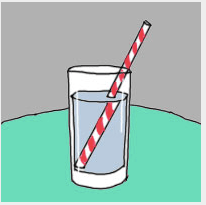
Why does the straw appear to be bent?
light is reflected
light is absorbed
light is turned
light is refracted

22
Thin Converging Lens

23
Multiple Choice
The point at which rays parallel to the optical axis meet is called the ____________________________.
focal point
virtual point
real point
optic point
24
Textbook P15
pages 575
25
speed of em waves in a vacuum is 3.0 x 10⁸ m/s

26

27
Multiple Choice
The visible light spectrum ranges between
radar waves and X-rays.
television waves and infrared rays.
infrared rays and ultraviolet rays.
ultraviolet rays and gamma rays.
28
Multiple Choice
The waves with the longest wavelengths in the electromagnetic spectrum are
Infrared rays.
radio waves
gamma rays
X-rays
29
Multiple Choice
Infrared rays have a shorter wavelength than
Ultraviolet ray.
X-rays.
radar waves.
gamma rays
30
Multiple Choice
Radio waves and _______ are used in communication
Microwaves
Gamma rays
Visible light
Ultraviolet
31
Multiple Choice
An electromagnetic wave in a vacuum has a wavelength of 0.07m. What is its frequency?
f= 3.0x 10^8 m/s
f= 3.0x 10^9Hz
f=4.3x 10^9Hz
f=4.3x 10^8m/s
32
sound is produced by vibrating sources
longitudinal; compressions and rarefactions
audible f 20 - 20000Hz
medium is needed to transmit sound waves
sound travels fastest in solid, then liquid then gas
amplitude-loud, frequency-pitch,
echo - reflected sound

33
Textbook P12
pages 530
34
Multiple Choice
There is no sound in space.
true
false
35
Multiple Choice
Which statement best explains why thunder is heard after lightning is seen?
light travels faster than sound
light travels slower than sound
thunder is produced by the impact of lightning against the ground
the eye works faster than the ear
36
Multiple Choice
Two sound waves are produced by a clarinet. Both sound waves have the same pitch, but the second one is louder. Which of the following properties is greater for the second sound wave?
frequency
amplitude
wavelength
speed in air
37
Multiple Choice
In which medium would sound move the fastest?
vacuum
air
water
steel
Show answer
Auto Play
Slide 1 / 37
SLIDE
Similar Resources on Wayground

33 questions
Mass vs. Weight
Presentation
•
9th - 12th Grade
27 questions
Newton's Second law of Motion
Presentation
•
9th - 12th Grade
34 questions
Biomolecule Notes
Presentation
•
9th - 11th Grade
32 questions
Properties of Radicals/Simplifying Radical Expressions
Presentation
•
9th - 10th Grade
32 questions
BANGS adjectives
Presentation
•
9th - 12th Grade
31 questions
Writing a Resume
Presentation
•
9th - 12th Grade
31 questions
parallel lines and angle relationships
Presentation
•
9th - 12th Grade
35 questions
Color (light Waves)
Presentation
•
9th - 12th Grade
Popular Resources on Wayground
10 questions
Safety Day 2026 – Student Review

Quiz
•
9th Grade
21 questions
Continents and Oceans
Quiz
•
6th Grade
20 questions
Parts of Speech
Quiz
•
5th Grade
16 questions
Subject & Predicate
Quiz
•
5th Grade
25 questions
Multiplication Facts
Quiz
•
5th Grade
12 questions
Map Skills
Quiz
•
3rd Grade
22 questions
Continents and Oceans
Quiz
•
5th Grade
15 questions
Rounding Decimals
Quiz
•
5th Grade
Discover more resources for Physics
20 questions
Position vs. Time Graphs
Quiz
•
9th Grade
10 questions
Exit Check 5.1 - Forms of Energy
Quiz
•
9th Grade
11 questions
Electricity Explained

Interactive video
•
9th - 12th Grade
87 questions
25-26 Unit 1.2 Review - Radioactivity & Earth's Age
Quiz
•
8th - 10th Grade
15 questions
Position vs. Time and Velocity vs. Time Graphs
Quiz
•
10th - 12th Grade
18 questions
Quiz #8 Practice: Forces on an Incline
Quiz
•
9th Grade
25 questions
Newton's Laws of Motion
Quiz
•
9th Grade