

Other Solar System Objects / Study Guide

Presentation
•
Science
•
4th - 6th Grade
•
Practice Problem
•
Medium
Standards-aligned

Keenan Hart
Used 19+ times
FREE Resource
31 Slides • 24 Questions
1
Other Solar System Objects / Study Guide
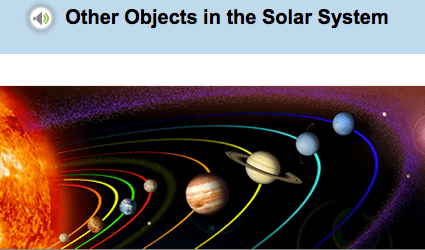
Most of the smaller objects in the solar system are found in three different regions: the asteroid belt, the Kuiper Belt, and the Oort Cloud. The asteroid belt is an area between Mars and Jupiter. Most asteroids, as well as one dwarf planet, are located in the asteroid belt.
2
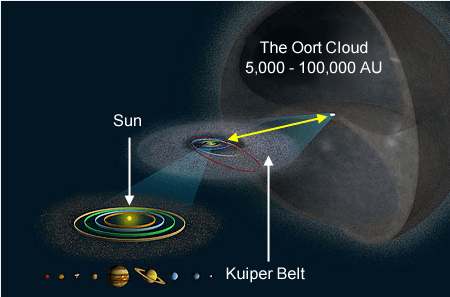
The Kuiper Belt is an area beyond the orbit of Neptune. Most dwarf planets are found in the Kuiper Belt. The Oort Cloud is the region that surrounds the solar system. It extends from beyond the Kuiper Belt halfway to the next nearest star. Most comets originate in the Kuiper Belt and Oort Cloud.
3
Multiple Choice
4
Multiple Choice
5
Multiple Choice
6
Like a planet, a dwarf planet is a spherical object that orbits the Sun. However, a dwarf planet does not have enough mass to clear other celestial bodies out of its orbit. For example, the dwarf planet Eris shares its orbital path with Neptune and Pluto. Therefore, it is not in the same category as a planet. A dwarf planet is a spherical object that orbits the Sun and does not clear the area of its orbit.

7
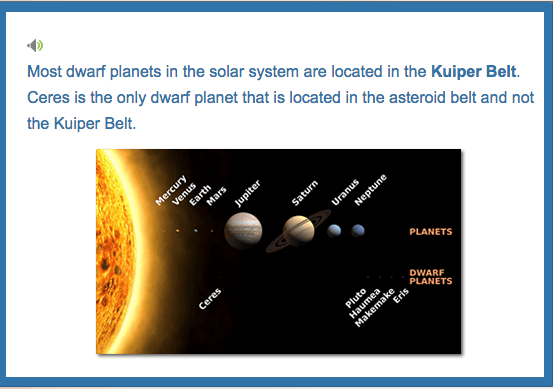
There are five dwarf planets that have been identified in our solar system. They include Pluto, Ceres, Makemake, Haumea, and Eris. All of the dwarf planets are made out of ice and rock, and all have masses smaller than Earth's Moon. Despite their small size, dwarf planets can have moons. For example, Pluto has five moons. All of the dwarf planets except for Ceres are located in the Kuiper Belt. Ceres is located in the asteroid belt.

8
Pluto was classified as a planet until 2006, when it was reclassified as a dwarf planet. In 2015, a spacecraft approached Pluto and took detailed images of it. These new images are helping astronomers to further study and understand dwarf planets.

9
Multiple Choice
10

11
Multiple Choice
12
13
Multiple Choice
14
Multiple Choice
15
Multiple Choice
16
Multiple Choice
17
Multiple Choice
18

19

20
A comet is an object is an object consisting of mostly ice and dust that usually orbits a star in a long, narrow, elliptical path. Most comets in our solar system originate from either the Oort or the Kuiper Belt. Learn about the four main parts of a comet as labeled at right.

21
#1 / Nucleus - The nucleus of the comet is the solid, inner core made of ice and rock.

22
#2 / Coma - If comets get close to the Sun, the heat will cause the ice inside of the nucleus to change to gas. Gas and dust form in layers around the nucleus and create a coma. The coma is a spherical cloud of gas and dust that extends out from the nucleus.
23
#3 / Gas Tail - Comets have two tails that can point in different directions. The gas tail always points away from the Sun because particles from the Sun push the gas outwards. Comet tails become longer as they get closer to the Sun and more ice turns to gas.
24
#4 / Dust Tail - The dust tail of the comet points along the path the comet has taken and is often curved.
25
Multiple Choice
26
Multiple Choice
27
Multiple Choice
28
Multiple Choice
29

30

31
Multiple Choice
32

33

34
Asteroids
If all of the asteroids in our solar system were combined together, they would still be smaller than Earth's Moon! An asteroid is an irregularly shaped, small, rocky object that orbits the Sun. Most asteroids are not spherical like planets or dwarf planets. Rather they have irregular shapes.

35
All asteroids except one are too small to be considered a planet or dwarf planet. The dwarf planet and an asteroid. Ceres is the largest known asteroid in the solar system, as it is more than 900 kilometers across. A space probe is currently in orbit around Ceres.

36
Most asteroids are located in what is called the asteroid belt. The asteroid belt is located between the orbits of Mars and Jupiter. The asteroid belt is over 300 million kilometers wide and it contains hundreds of thousands of asteroids. Smaller groups of asteroids are located in between the orbits of Jupiter and Neptune, while others are located in the Kuiper Belt.

37
Multiple Choice
38

39
Multiple Choice
40
Multiple Choice
41
Multiple Choice
42

43
Multiple Choice
44
Multiple Choice
45
Multiple Choice
46
Multiple Choice
47

48

49
Meteroids
There are some objects in space that orbit the Sun that are even smaller than asteroids. These are called meteoroids. A meteoroid is a body of rock or dust that is smaller than an asteroid. Most meteoroids are pieces of rock that come from an asteroid. Meteoroids can be as small as a grain of sand or as big as a boulder.

50
Sometimes, meteoroids enter Earth's atmosphere. Meteoroids move very fast, and the friction between the rock and the air creates heat and produces a bright streak of light. This creates a meteor. A meteor is a rocky body that burns as it moves through the atmosphere of a planet. Meteors often produce bright streaks of light in the sky. People often call meteors shooting stars. However, they are actually meteoroids that are burning up in the atmosphere before they reach Earth's surface.

51
Meteor showers on Earth occur when Earth orbits through an area with many meteoroids. Meteor showers occur every year when Earth passes through certain areas.

52

53
Multiple Choice
54

55

Other Solar System Objects / Study Guide
Most of the smaller objects in the solar system are found in three different regions: the asteroid belt, the Kuiper Belt, and the Oort Cloud. The asteroid belt is an area between Mars and Jupiter. Most asteroids, as well as one dwarf planet, are located in the asteroid belt.
Show answer
Auto Play
Slide 1 / 55
SLIDE


