
Search Header Logo
The Atom Review

The Atom Review

Assessment

Presentation

Chemistry

9th - 12th Grade

Hard

NGSS
HS-PS1-1, HS-PS1-2, MS-PS1-1

Standards-aligned

Created by

Lauren Wells

Used 8+ times

FREE Resource

11 Slides • 18 Questions

1

The Atom

Review

Slide image

2

Battle of the Greeks

  • Aristotle: Continuous Theory

    -Matter can be divided infinitely

  • Democritus & Leucippus: Discontinuous Theory

    - There is a tiny indivisible particle called an atom 

Slide image

3

Dalton's Atomic Theory

1. Elements are made of atoms


2. Atoms of an element are the same.


3. Compounds are formed from combinations of atoms

Slide image

4

JJ Thomson: Plum Pudding Model

Discovered the electrons while performing experiments with cathode rays

Slide image

5

Ernest Rutherford: Nuclear Model

Performed Gold Foil Experiment

- Proved the atom was mostly empty space

- Discovered the dense, tiny, positive nucleus
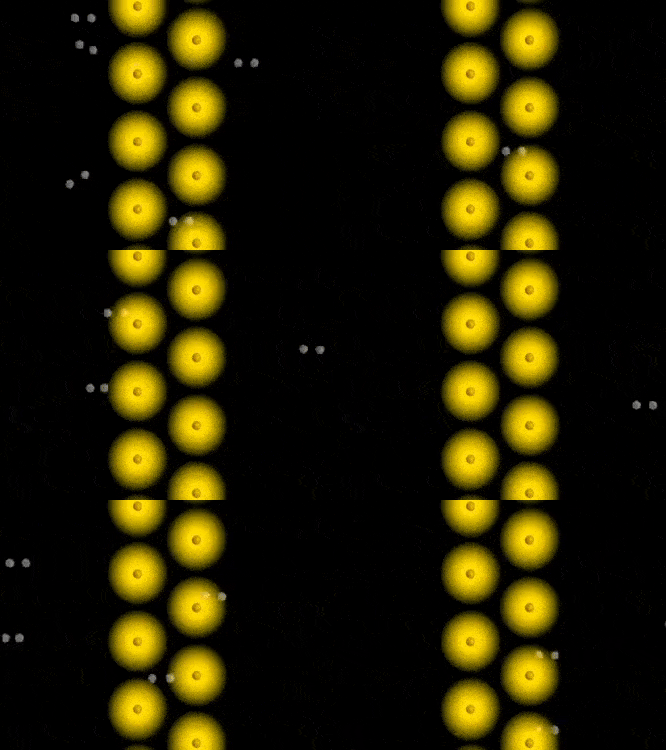
Slide image

6

Niel's Bohr: Planetary Model

  • Proposed e- traveled in fixed paths around the nucleus.  

  • Each level can hold a maximum # of e-

  • Energy Level = Shell

Slide image

7

Modern Atomic Model

  • AKA Wave-Mechanical or Electron Cloud

  • e- behave like waves and particles

  • Orbitals = most probable location of an e-

  • Electrons don't orbit the nucleus

Slide image

8

Multiple Choice

What happened to the cathode ray during Thomson’s experiment?

1

It was repelled by a positive charge

2

It bounced back to the cathode

3

It was stopped by a magnet

4

It was deflected away from a negative charge

9

Multiple Choice

Which of the following was a result of the gold foil experiment?

1

Most alpha particles bounced back.

2

All alpha particles went straight through.

3

Some alpha particles bounced back.

4

None of the above

10

Multiple Choice

Question image

Number 1 is _ while number 2 is _.

1

(+), (-)

2

(-), (+)

3

neutral , (+)

4

neutral, (-)

11

Multiple Choice

What conclusion did Rutherford come to after the gold foil experiment?

1

Most of the atom is empty space.

2

A dense region of (+) charge existed in the atom.

3

Thomson’s model was incorrect.

4

All of the above

12

Excited vs Ground State

  • Electrons jump to higher energy level when energy is absorbed

  • Electrons return to original ground state energy level when energy is released as light

  • Emission spectra used to identify elements (fingerprint)

  • Number of electrons doesn't change

Slide image

13

Multiple Choice

Which of the following shows an excited state electron configuration?

1

2-7-1

2

2-4

3

2-8-4

4

2-8-1

14

Multiple Choice

Which is a possible excited state electron configuration for Si?

1

2-8-4

2

1-9-4

3

2-8-8

4

2-8-3-1

15

Multiple Choice

The energy of an electron __________ as it moves further away from the nucleus
1
increases
2
decreases

16

Multiple Choice

What happens to energy as an atom goes from ground state to excited state?

1

It increases

2

It decreases

3

It remains the same

17

Using the Periodic Table

  • # p+ = 8

  • # e- = 8

  • # n0 = 16 - 8 = 8

Slide image

18

Multiple Choice

The nucleus of most atoms are made of:

1

protons and electrons

2

neutrons and electrons

3

electrons and protons

4

protons and neutrons

19

Multiple Select

Question image

The letter “X” in the diagram marks the:

select all that apply

1

Location of the neutrons

2

Electron cloud

3

Nucleus

4

Region of greatest density

5

Location of the electrons

20

Multiple Select

Which of the following descriptions apply to the nucleus?

(select all that apply)

1

positively charged

2

mostly empty space

3

small

4

dense

21

Multiple Choice

The _ constitute most of the volume of an atom

1

nucleus

2

protons

3

electrons

4

neutrons

22

Isotopes

  • Same number of protons & electrons (atomic #)

  • Different number of neutrons (mass number)

Slide image

23

Multiple Choice

Question image

If we assume pink represents protons and green represents neutrons, the nucleus depicted here is:

1

boron-5

2

boron-6

3

boron-11

4

carbon 11

24

Multiple Select

What is special about the atomic number?

1

Equals the number of protons in an atom

2

Identifies an element

3

Equals the number of electrons in an atom

4

Equals the number of neutrons in an atom

25

Multiple Choice

A carbon isotope consists of 6 protons, 6 electrons and 8 neutrons.  What is the mass number for this isotope?
1
12
2
14
3
6
4
8

26

Multiple Choice

A neutral atom of the isotope 2612Mg would consist of
1
12 protons, 26 neutrons, 26 electrons
2
26 protons, 12 neutrons, 26 electrons
3
26 protons, 14 neutrons, 14 electrons
4
12 protons, 14 neutrons, 12 electrons

27

Weighted Atomic Mass

  • Atomic mass = average of naturally occurring isotopes

  • Atomic mass will be closer to the most abundant isotope

Slide image

28

Multiple Choice

A new element, Tyserium (Ty), has recently been discovered and consists of two isotopes. One isotope has a mass of 331 amu and is 35.0 % abundant. The other isotope is 337 amu and is 65.0 % abundant. What is the mass of Ty as it appears on the periodic table?

1

335 amu

2

334 amu

3

333 amu

4

332 amu

29

Fill in the Blank

Magnesium has three of its own isotopes. 78.7% is Magnesium-24. 10.13% is Magnesium-25. 11.17% is Magnesium-26. Calculate the relative atomic mass of Magnesium, to two decimal places.

The Atom

Review

Slide image

Show answer

Auto Play

Slide 1 / 29

SLIDE
