


Motion, Speed, Distance vs. Time Graphs Review
Presentation
•
Science
•
6th Grade
•
Medium
+2
Standards-aligned
Stephanie Jenkins
Used 100+ times
FREE Resource
10 Slides • 13 Questions
1
Motion, Speed, Distance vs. Time Graphs Review
2
Standards
SC.6.P.12.1 Measure and graph distance versus time for an object moving at a constant speed. Interpret this relationship.
SC.6.P.12.1 Mida y grafica distancia frente al tiempo de un objeto que se mueve a una velocidad constante. Interpretar esta relación.
SC.6.P.13.3 Investigate and describe that an unbalanced force acting on an object changes its speed, or direction of motion, or both.
SC.6.P.13.3 Investigar y describir que una fuerza desequilibrada que actúa sobre un objeto cambia su velocidad, o dirección de movimiento, o ambos.
3
SC.6.P.13.3: Balanced and Unbalanced Forces
Investigate and describe that an unbalanced force acting on an object changes its speed, or direction of motion, or both.
Investigar y describir que una fuerza desequilibrada que actúa sobre un objeto cambia su velocidad, o dirección de movimiento, o ambos.
4
Multiple Choice
What is the unit of Force?
¿Cuál es la unidad de la Fuerza?
Kilograms
Kilogramos
Push
Empuje
Newtons
Meters
Metros
5
Multiple Choice
The sum of all forces acting on an object
La suma de todas las fuerzas que actúan sobre un objeto
Contact Force
Fuerza de contacto
Unbalanced force
Fuerza desequilibrada
Net force
fuerza neta
Balanced Force
fuerza equilibrada
6
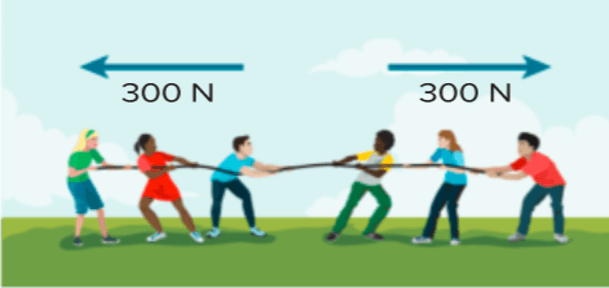
Balanced Forces
When the net force on an object is 0, the forces acting on it are balanced forces.
Cuando la fuerza neta en un objeto es 0, las fuerzas que actúan sobre él son fuerzas equilibradas.
7
Multiple Choice
Forces that have a net force of Zero (0)
Fuerzas que tienen una fuerza neta de cero (0)
Balanced Force
Fuerza equilibrada
Unbalanced force
Fuerza desequilibrada
8
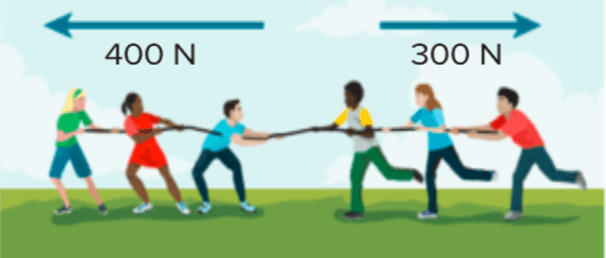
Unbalanced Forces
When the net force acting on an object is not 0, the forces acting on the object are unbalanced forces.
Cuando la fuerza neta que actúa sobre un objeto no es 0, las fuerzas que actúan sobre el objeto son fuerzas desequilibradas.
9
Multiple Choice
What will cause an object to move?
¿Qué hará que un objeto se mueva?
Applied Force
Fuerza aplicada
Unbalanced Force
Fuerza desequilibrada
Gravity
Gravedad
Wind
Viento
10
Calculating Net Force: Same Direction
When different forces act on an object in the same direction, the net force is the forces added together
Cuando diferentes fuerzas actúan sobre un objeto en la misma dirección, la fuerza neta es la fuerza agregada
11
Calculating Net Force: Opposite Direction
When forces act in opposite directions, forces to the right are usually considered to be positive values. Forces to the left are negative values
Cuando las fuerzas actúan en direcciones opuestas, las fuerzas a la derecha generalmente se consideran valores positivos. Las fuerzas a la izquierda son valores negativos
12
Multiple Choice
How will this object move?
¿Cómo se moverá este objeto?
It wont move
No se moverá
It will move to the left
Se moverá a la izquierda
It will move to the right
Se moverá a la derecha
It will move up
Se moverá hacia arriba
13
Multiple Choice
Which picture shows an object whose acceleration is zero?
¿Qué imagen muestra un objeto cuya aceleración es cero?
14
Multiple Choice
A rock is sitting on top of a hill. The rock suddenly begins moving down the side of the hill. Why did the rock begin to move?
Una roca está sentada en la cima de una colina. La roca de repente comienza a moverse por el lado de la colina. ¿Por qué la roca comenzó a moverse?
An unbalanced force acted on the rock and caused it to move.
Una fuerza desequilibrada actuó sobre la roca y hizo que se moviera.
A sudden change in gravitational force caused the rock to begin to move.
Un cambio repentino en la fuerza gravitacional hizo que la roca comenzara a moverse.
A balanced force caused the rock to move, and then gravity kept it moving.
Una fuerza equilibrada hizo que la roca se moviera, y luego la gravedad la mantuvo en movimiento.
An upward force balanced the gravitational force, so the rock began to move.
Una fuerza ascendente equilibrado la fuerza gravitacional, por lo que la roca comenzó a moverse.
15
SC.6.P.12.1 Distance vs. Time
Measure and graph distance versus time for an object moving at a constant speed. Interpret this relationship.
Mida y grafica distancia frente al tiempo de un objeto que se mueve a una velocidad constante. Interpretar esta relación.
16
17
Multiple Choice
During a science experiment, a metal ball was dropped from a height of 150 m. The graph shows the distance the metal ball traveled from its initial position to where it hit the ground. Which statement describes the information in the graph concerning how the speed of the metal ball increased over time?
Durante un experimento científico, una bola de metal fue lanzada desde una altura de 150 m. El gráfico muestra la distancia que la bola de metal viajó desde su posición inicial hasta donde golpeó el suelo. ¿Qué declaración describe la información en el gráfico sobre cómo aumentó la velocidad de la bola de metal con el tiempo?
The line rises at a constant rate
La línea se eleva a un ritmo constante
The slope of the line is constant.
La pendiente de la línea es constante.
The line becomes steeper over time.
La línea se vuelve más empinada con el tiempo.
The ball travels the same distance each second.
La pelota viaja a la misma distancia cada segundo.
18
Multiple Choice
At what point is the person not moving?
A and C
B and D
D and E
A and E
19
Calculating Speed
Speed (S) = distance traveled (d) divided by the amount of time it took (t)
20
Multiple Choice
Montez read that bobcats can reach speeds of up to 30 mi/h. What does the speed of a bobcat indicate?
the total amount of time it travels in one direction
the distance it travels to move between two points
the time it takes to reach its maximum speed
the distance it can travel in a certain amount of time
21
Fill in the Blank
Type answer...
22
Fill in the Blank
Type answer...
23
Fill in the Blank
Type answer...
Motion, Speed, Distance vs. Time Graphs Review

Show answer
Auto Play
Slide 1 / 23
SLIDE

Similar Resources on Wayground
15 questions
Earth's Layers and Plate Tectonics
Presentation
•
6th Grade
19 questions
Metals, Nonmetals and Metalloids
Presentation
•
6th - 7th Grade
19 questions
Gravity and Friction
Presentation
•
5th - 6th Grade
21 questions
Energy Flow in the Ecosystem
Presentation
•
6th Grade
18 questions
Law of Conservation of Energy
Presentation
•
6th Grade
19 questions
Levels of Cellular Organization
Presentation
•
6th Grade
16 questions
Force and Motion
Presentation
•
6th Grade
16 questions
Mrs. Johnson's Levels of Organization in an Ecosystem Lesson
Presentation
•
6th Grade
Popular Resources on Wayground
10 questions
5.P.1.3 Distance/Time Graphs
Quiz
•
5th Grade
10 questions
Fire Drill
Quiz
•
2nd - 5th Grade
20 questions
Equivalent Fractions
Quiz
•
3rd Grade
22 questions
School Wide Vocab Group 1 Master
Quiz
•
6th - 8th Grade
20 questions
Main Idea and Details
Quiz
•
5th Grade
20 questions
Context Clues
Quiz
•
6th Grade
20 questions
Inferences
Quiz
•
4th Grade
12 questions
What makes Nebraska's government unique?
Quiz
•
4th - 5th Grade
Discover more resources for Science
19 questions
Introduction to Properties of Waves
Presentation
•
6th - 8th Grade
16 questions
Interactions within Ecosystems
Presentation
•
6th - 8th Grade
10 questions
Exploring the Layers of the Earth
Interactive video
•
6th - 10th Grade
15 questions
Punnett Squares
Quiz
•
6th Grade
20 questions
Energy Transformations
Quiz
•
6th - 8th Grade
20 questions
Cell Organelles and Functions
Quiz
•
6th - 8th Grade
10 questions
Ecosystem levels of organization
Quiz
•
6th Grade
20 questions
Levels of Organization
Quiz
•
6th Grade