Search Header Logo
6.1 Work and Energy

6.1 Work and Energy

Assessment

Presentation

Physics

10th - 12th Grade

Practice Problem

Medium

Created by

Haley Carlson

Used 13+ times

FREE Resource

10 Slides • 14 Questions

1

6.1 Work and Energy
Slide image

2

Multiple Choice

Question image

What is energy?

1

It is a form of heat

2

It is the capacity to burn coal

3

It is the ability to do work or to produce transformations

4

It is a property of the matter used to meassure forces

3

Open Ended

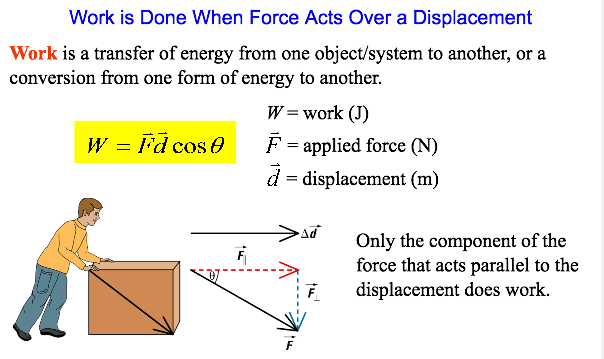
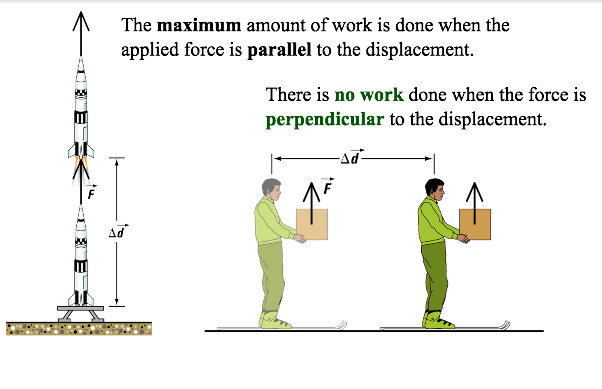
What is work?

4

Slide image

5

Slide image

6

Gravitational Potential Energy

  • Is the energy of an object due to its position above the surface of the Earth

  • When work is done to lift an object up at a constant speed it gains gravitational potential energy

  •  ΔEp=W=FΔd\Delta E_p=W=\overrightarrow{F}\Delta\overrightarrow{d}  

7

 Ep=mghE_p=mgh  

  • Ep = gravitational potential energy (J)

  • m = mass (kg)

  • g = acceleration due to gravity ( ms2\frac{m}{s^2}  )

  • h = height above reference (m)

  • A reference point is an arbitrarily chosen point where the potential energy is set to zero

Slide image

8

Multiple Choice

How could you increase the gravitational potential energy of an object without changing its mass and gravity?

1

Make the object larger

2

Lower the object towards the ground

3

Raise the object farther off the ground

4

Allow the object to roll on the ground

9

Multiple Choice

Question image

What is the gravitational potential energy of a 26 kg eagle, flying at an altitude of 65 m at a speed of 19 m/s?

1

32,110 J

2

1690 J

3

172.4 J

4

16,562 J

10

Multiple Choice

Question image

The highest inhabited town in the world has an elevation of 5.334 km above sea level. What would be the gravitational potential energy of a 64.0 kg person in this town?

1

3.35x10³ J

2

3.41x10⁵ J

3

3.35x10⁶ J

4

3.348x10⁹ J

11

Kinetic Energy

  • Energy due to the motion of an object

  •  Ek=12mv2E_k=\frac{1}{2}mv^2  

  • Ek = kinetic energy

  • m= mass (kg)

  • v = speed (m/s)

Slide image

12

Multiple Choice

A pitcher throws a 148 g baseball, giving it a kinetic energy of 134 J. Determine the speed of the ball

1

1.35 m/s

2

42.6 m/s

3

21.3 m/s

4

1.81 m/s

13

Hooke's Law

  • The defamation of an object is directly proportional to the force causing it

  •  Fs=kx\overrightarrow{F_s}=-k\overrightarrow{x}  

  • The meaning of the negative sign is that the direction of the restoring force is always opposite to the direction of the displacement

  • The spring constant (k) is number that indicates the stiffness of the spring

14

Multiple Choice

Which of the following springs is the stiffest?

1

A spring that requires a froce of 2000 N to compress it by 6.8 m.

2

A spring that requires a force of 4000 N to stretch it by 9.0 m.

3

A spring that requires a force of 8000 N to compress it by 45 m.

4

A spring that requires a force of 4800 N to stretch it by 14 m.

15

Multiple Choice

What force should be applied to compress a spring by 0.013 m if its spring constant is k = 1900 N/m?

1

1880 N

2

24.7 N

3

1900 N

4

0.127 N

16

For a vertical spring, a larger mass is required to compress the spring further from the equilibrium position (x=0)

Slide image

17

Multiple Choice

A spring has a spring constant of 330 N/m. How far is the spring compressed if 150 N of force are used?

1

2.2 m

2

0.0014 m

3

5.0 m

4

0.45 m

18

Multiple Choice

Question image

A mass of 0.64 kg extends a spring by 0.42 m. Calculate the spring constant.

1

14.93 Nm-1

2

0.27 Nm-1

3

1.52 Nm-1

4

2.7 Nm-1

19

Slide image

20

Multiple Choice

Hooke's Law fails when a material reaches its:

1

breakdown

2

elastic limit

3

end of tether

4

fracture stress

21

Elastic Potential Energy

  • The amount of energy stored in a spring is equal to the work done on it

  • For force vs. displacement graphs, work is the area under the line

  •  Ep=12kx2E_p=\frac{1}{2}kx^2  

Slide image

22

Multiple Choice

Question image

Calculate the elastic potential energy Leo puts into the trampoline mat when he stretches the mat (k= 473 Nm-1) by 0.35 m.

1

2.887 J

2

28.97 J

3

82.775 J

4

12.76. J

23

Multiple Choice

Question image

Ben has a mass of 37 kg and is stretching the trampoline mat by 0.30 m. Calculate the elastic potential energy he stores in the mat.

1

54.39 J

2

246.67 J

3

3.87 J

4

83 J

24

Multiple Choice

Question image

Leo (70 Kg) stretches the trampoline mat by 37 cm. Calculate the elastic potential energy he puts into the trampoline mat.

1

4.79 J

2

126.9 J

3

47.9 J

4

12.76. J

6.1 Work and Energy

Slide image

Show answer

Auto Play

Slide 1 / 24

SLIDE