Search Header Logo
Poems by Emily Dickinson

Poems by Emily Dickinson

Assessment

Presentation

English

9th - 12th Grade

Practice Problem

Easy

CCSS
RL.9-10.10, RI. 9-10.9, RI. 9-10.6

+24

Standards-aligned

Created by

Caroline Salvadore

Used 29+ times

FREE Resource

8 Slides • 13 Questions

1

Poems by Emily Dickinson

Analyzing Word Choice!

Slide image

2

Open Ended

Warm-Up!


Today we are reading a few poems. Review and analyze the words in each of the titles. Then, pick which one seems most interesting to you and explain why.


“The Soul Selects Her Own Society”,


“Because I could not stop for Death”,


“Much Madness Is divinest Sense”,


“Tell the Truth but tell it slant”

3

Standard

  • LAFS.1112.RL.2.4 - Determine the meaning of words and phrases as they are used in the text, including figurative and connotative meanings; analyze the impact of specific word choices on meaning and tone, including words with multiple meanings or language that is particularly fresh, engaging, or beautiful. 

4

Essential Question

How do words and phrases develop the theme and impact the meaning throughout the text?

5

Multiple Select

Select our objectives for today! Hint: It is all of them!

1

Analyze author's word choice

2

Describe how word choice impacts meaning/tone

3

Analyze cumulative impact of word choice on theme

6

Agenda

Warm-Up

Review/HK

Poetry Analysis--Dickinson Collection

I do, we do, you do

Exit-Ticket

Achieve 3000

Slide image

7

Slide image

8

Multiple Choice

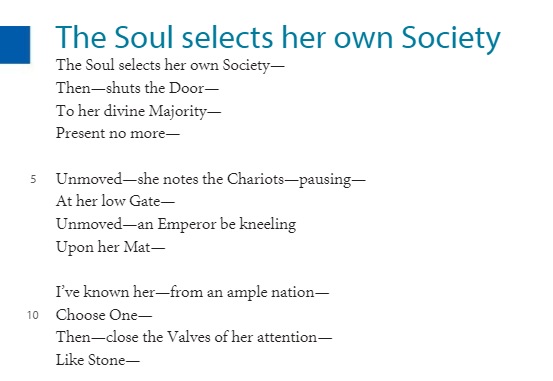
Which of the following BEST represents the topic being discussed in the poem?


Remember, topic = subject

1

The soul

2

The author's soul

3

the Soul and who it chooses to spend time with

4

the Soul and its inability to reach out

9

Multiple Choice

Select evidence that best supports your conclusion on the previous slide.

1

"The Soul selects her own Society" (line 1).

2

"Unmoved--she notes the Chariots" (line 5).

3

"I've known her--from an ample nation" (line 9).

4

All of the above.

10

Multiple Choice

Part A: Which of the following best represents the underlying message or theme in the poem?

1

that the Soul is patient and willing to socialize with anyone

2

the Soul has no control over who she interacts with

3

The Soul is stubborn and selective about who she socializes with

4

None of the above.

11

Multiple Select

Part B: SELECT TWO pieces of evidence in the poem that support the idea that the Soul is stubborn and selective with who she socializes with.

1

the image of the Soul shutting the door (line 2)

2

Keeping the door shut even when chariots and an emperor wait outside her door (lines 5-8).

3

"From an ample nation" (Line 9).

4

"Present no more" (line 5).

5

The punctuation itself.

12

Open Ended

Question image

Reread the last two lines of the poem and identify the simile. What is being compared? How does this support the theme you identified previously?

13

Slide image

14

Slide image

15

Open Ended

Question image

In a METAPHOR, a writer compares one thing to another without using connecting words such as like or as. In this poem, Dickinson uses an extended metaphor throughout that personifies death, or compares it to a person.


Use text evidence to analyze the poem and explain what death is being compared to.

16

Multiple Select

Which evidence best supports the idea that the speaker compares death to a person?

1

"He kindly stopped for me--The Carriage held but just Ourselves" (lines 2-3).

2

"Because I could not stop for Death"

3

"We passed the School, where Children strove at Recess" (lines 9-10).

4

"I had put away My labor and my leisure too, For His Civility" (lines 6-8).

17

Open Ended

PERSONIFICATION is a figure of speech where human characteristics are given to an object, animal, or even an idea. The metaphor Dickinson uses is also an example of personification.


How does Dickinson's personification of death affect the meaning of the poem?


18

Slide image

19

Open Ended

Question image

Word choice has a powerful impact on meaning.


Sometimes, authors deliberately choose words with multiple meanings or words with more than one definition.


Explain the central meaning of the word "sense" as it is used in the poem, using other words and phrases from the poem to support your explanation.

20

Open Ended

Question image

What are some potential other meanings of "sense?" Cite details in the text that reflect subtle connections to these meanings.

21

Open Ended

Question image

Exit-Ticket!


How does the author's word choice (for example the multiple meanings of the word sense) add to the overall meaning of the poem? Restate, answer, cite, elaborate.

Poems by Emily Dickinson

Analyzing Word Choice!

Slide image

Show answer

Auto Play

Slide 1 / 21

SLIDE