

Unit 3/4 Review

Presentation
•
Mathematics
•
9th - 12th Grade
•
Medium
+5
Standards-aligned

Joe Burton
Used 3+ times
FREE Resource
14 Slides • 23 Questions
1
Unit 3/4 Review
Mr. Burton Algebra 2

2
Increasing and Decreasing Intervals
Increasing intervals are going up
Decreasing intervals are going down
Interval Notation: (start, end)

3
Multiple Choice

Describe the intervals of increase and decrease.
4
Vertex Form
You should be able to identify a graph, the vertex, axis of symmetry, direction of opening, and the max/min value (y of the vertex).
You should also be able to change from standard form to vertex form. To do this, simply graph the standard form and locate vertex information.

5
Multiple Choice

6
Multiple Choice

7
Multiple Choice

8
Standard Form
Find: Vertex, Axis of Symmetry, Min/Max value

9
Multiple Choice

10
Intercept Form
You should be able to graph
You should be able to FOIL and give the standard form equation

11
Multiple Choice

12
Multiple Choice

13
Systems
Graph the two equations (Desmos)
Find Intersection points
No intersections = no solution
Could have 0, 1, or 2 solutions
Your solution(s) are coordinates

14
Multiple Choice

15
Polynomial Operations
Add/Subtract: Combine like terms
Multiply: FOIL or box method

16
Multiple Choice

17
Multiple Choice

18
Pascal's Triangle and finding terms
Start at 1
Each row represents the sum of the terms above it
Each row represents a different degree polynomial (starting at 0)
Each number represents a coefficient of the term
The first term of the binomial starts at the degree and counts down, second term counts up

19
Multiple Choice

20
Factoring Trinomials
Check for GCF (Factor out if there is one)
Factor using chosen method: AC/Grouping, Shortcut (to the right), graphing (find the zeros)

21
Multiple Choice

22
Sum and Differences of Cubes
Identify a and b
Always use SOAP

23
Multiple Choice

24
Remainder/Factor Theorem
Use synthetic division
If the remainder is zero it is a factor

25
Multiple Choice

Find the remainder
26
Zeros of Polynomials
You can use the rational root theorem to find all possible roots, then synthetic division to test those roots
You can also graph the polynomial in desmos and find all zeros (x-intercepts)

27
Multiple Choice

28
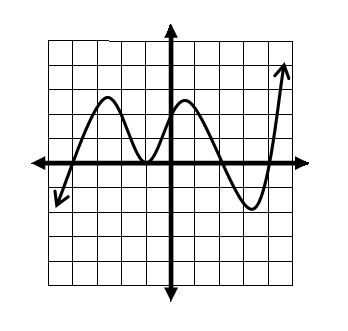
Graphs of Polynomials
End Behavior: What is happening on the left and right of the graph?
Multiplicity: Does the zero "bounce" or "cross"?
Bounce: factor has an even degree
Cross: factor has an odd degree

29
Multiple Choice

30
Multiple Choice
31
Multiple Choice
32
Multiple Choice

33
Multiple Choice
34
35
Multiple Choice
36
Multiple Choice
37
Multiple Choice

Based on the table, which function can best be used to model this situation?
Unit 3/4 Review
Mr. Burton Algebra 2
Show answer
Auto Play
Slide 1 / 37
SLIDE


