Search Header Logo
gene regulation and meiosis

gene regulation and meiosis

Assessment

Presentation

Biology

9th Grade

Easy

NGSS
HS-LS3-2, HS-LS1-1, HS-LS3-1

+1

Standards-aligned

Created by

Stacy King

Used 14+ times

FREE Resource

14 Slides • 19 Questions

1

gene regulation and meiosis Slides

Slide image

2

Gene

a segment of coding DNA that expression is regulated by the cell/organism

Slide image

3

Human Genome (all DNA)

  • 23 pairs of chromosomes

  • pairs are formed from mother and father

  • karyotyping- categorizing of chromosomes based on the size and the last set is the sex determining

Slide image

4

Multiple Choice

Most gene regulation happens at which step along the way?
1
translation
2
transcription
3
signal transduction
4
DNA replication

5

Protein synthesis

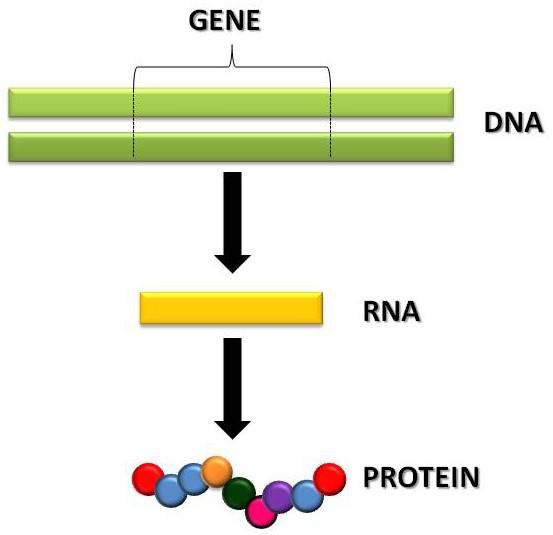
  • transcription- DNA to mRNA in the nucleus

  • translation- mRNA and tRNA build amino acid chain that folds into a protein in the ribosome

  • tRNA- has a anticodon end that adheres to the mRNA strand and an amino acid attachment

Slide image

6

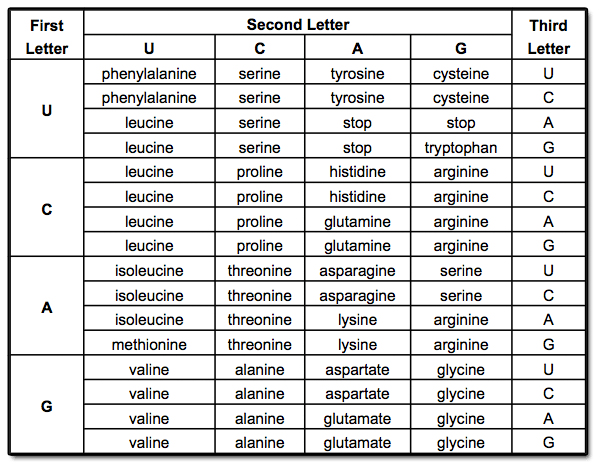
mRNA codon chart

  • mRNA is read in segments of 3 nucleotide

  • each set of 3 nucleotides codes for an amino acid

  • STOP codons signal the completion of the gene sequence and the amino acid chain is released from the ribosome

Slide image

7

Multiple Choice

Question image
What amino acid is represented by the codon UUA?
1
Phenylalanine
2
Tyrosine
3
Leucine
4
Stop codon

8

Multiple Choice

tRNA site that binds to a strand of mRNA and acts as the interpreter for a specific amino acid

1

anticodon

2

amino acid

3

STOP codon

4

ribosome

9

Gene Regulation

  • Prokaryotes-operon

  • Eukaryotes- transcription factors

Slide image

10

Multiple Choice

What is an operon?

1

a part of a ribsome

2

a part of a Rna

3

a unit made up of linked genes that code for proteins needed to do a specific task

4

needed for dna replication

11

Multiple Choice

Question image
What is the name given to part of a DNA molecule that codes for a protein?
1
Glucose
2
Chromosome
3
Gene
4
Phosphate

12

Mutations

  • DNA gene mutation- a single protein can be affected

  • Chromosomal mutation- entire segments or multiple genes are affected

Slide image

13

Multiple Choice

A chromosomal mutation affects the transcription and translation of a single gene

1

True

2

False

14

Gene Mutations

  • substitution/point mutation- 1 nucleotide is altered

  • insertion- adding a nucleotide in the sequence affecting the translation of a single protein

  • deletion- deleting a single nucleotide from the gene affecting the translation of a single protein

Slide image

15

Multiple Choice

Question image

DNA molecule segment is : TTA-CGC-AAG

The mutated DNA segment is TTC-GCA-AG. This is an example of ___ mutation.

1

Substitution

2

Deletion

3

Insertion

4

Inversion

16

Multiple Choice

Question image

What mutation has occurred here?

T-G-A-C-C-A

T-G-A-G-C-A

1

Substitution

2

Deletion

3

Insertion

4

Frameshift

17

Frameshift

  • insertion or deletion of a nucleotide in the gene sequence

  • abnormal protein translation

Slide image

18

Multiple Choice

Question image

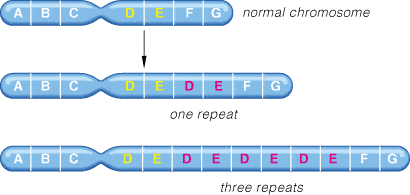
What type of mutation is shown in the image?

1

Frameshift

2

Nondisjunction

3

Trinucleotide Repeat Expansion

4

Silent Mutation

19

Chromosome Mutation

  • duplication

  • deletion

  • inversion

  • translocation

Slide image

20

Multiple Choice

Inversion

1

When a segment of a chromosome breaks off.

2

When a segment of a chromosome breaks off, flips, and reattaches.

3

When a segment of a chromosome is copied or doubles.

4

When a segment of a chromosome breaks and attaches to a non homologous chromosome.

5

When entire chromosomes don't separate evenly during meiosis.

21

Multiple Choice

Question image
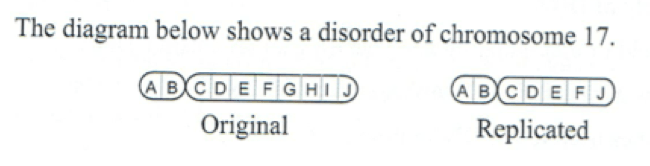
What type of chromosomal mutation has occurred?
1
substitution
2
insertion
3
deletion
4
nondisjunction

22

Multiple Choice

Question image
Identify the mutation in the picture.
1
Inversion
2
Duplication
3
Deletion
4
Translocation

23

Meiosis

24

Meiosis

  • reproductive cell division

  • genetic variation

Slide image

25

Multiple Choice

Which process is necessary for the inherited traits of an organism to be passed along by sexual reproduction?
1
mitosis
2
meiosis
3
mutation
4
fission

26

Multiple Choice

Which of the following cell types is formed by meiosis?
1
muscle cells
2
skin cells
3
sperm cells
4
blood cells

27

PMAT

  • during prophase crossing over occurs

  • segments of homologous chromosomes are crossed

Slide image

28

Multiple Choice

__________-RE-ORDERS THE BASE SEQUENCE ;

EXAMPLE TO CREATE MORE GENETIC DIVERSITY

(ATA-CCG) TO (TTA-GGC)

1

CROSSING OVER

2

MITOSIS

3

ASEXUAL REPRODUCTION

29

Multiple Choice

Question image
1

INCREASES GENETIC VARIATION

2

TAKES PLACE IN PROPHASE I

3

CROSSING OVER

4

ALL ARE TRUE

30

Division

  • during meiosis a reproductive cell goes through 2 stages of division (PMAT)

  • this results in 4 genetically different single strand chromosomes called haploid cells

Slide image

31

Multiple Choice

Why is meiosis important for sexual reproduction? 
1
It allows the zygote formed from fertilization to have triple the chromosome number of the organism. 
2
It allows gametes to have twice the original number of chromosomes of the organism.
3
It allows gametes to have half the original number of chromosomes of the organism.
4
It allows the zygote formed from fertilization to have half the original number of chromosomes of the organism.

32

Multiple Choice

How many times in meiosis does the cell divide?

1

2

2

4

3

3

4

1

33

Multiple Choice

A human being has a somatic cell that has 46 chromosomes. What is the haploid number found in a gamete (reproductive cell)?

1

23

2

46

3

69

4

92

gene regulation and meiosis Slides

Slide image

Show answer

Auto Play

Slide 1 / 33

SLIDE