
CHAPTER 20 LESSON 2
Presentation
•
History
•
10th Grade
•
Medium
Richard Orton
Used 3+ times
FREE Resource
17 Slides • 9 Questions
1
CHAPTER 20 LESSON 2
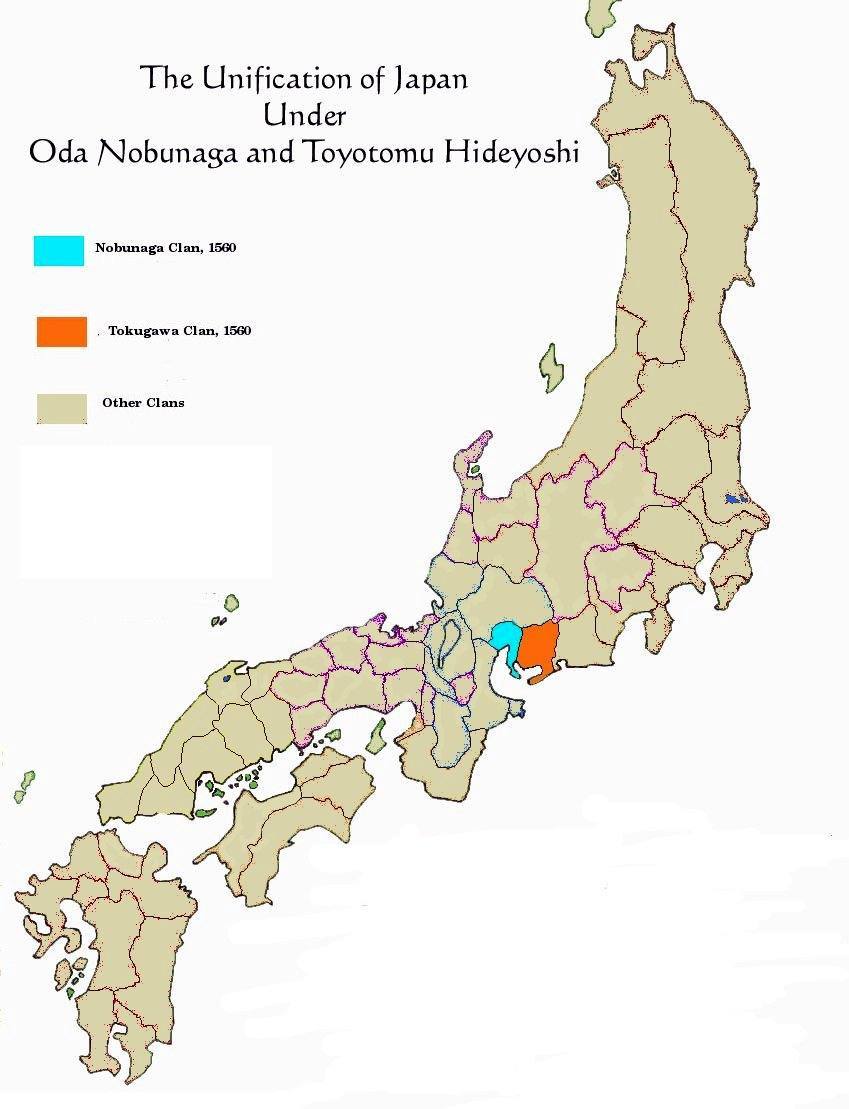
The Reunification of Japan
2
ESSENTIAL QUESTION
What factors help unify a kingdom or dynasty?
3
Political Changes in Japan
4
5
Multiple Choice
Daimyo were heads of noble families who
A.lived in the capital and rarely left.
B.farmed their own lands and kept all the profits.
C.elected a new emperor every time an emperor died.
D.controlled their own lands and waged war with their neighbors.
6
The process of unification began in the late sixteenth century with three powerful political figures. The first was Oda Nobunaga (oh • dah noh • boo • nah • gah). Nobunaga seized the imperial capital of Kӯoto and placed the reigning shogun under his control. By 1582 he had unified the central part of present-day Japan.
7
Nobunaga was succeeded by Toyotomi Hideyoshi (toh • yoh • toh • mee hee • day • yoh • shee), a farmer’s son who had become a military commander. Hideyoshi located his capital at Ōsaka. By 1590 he had persuaded most of the daimyo on the Japanese islands to accept his authority.
8
After Hideyoshi’s death in 1598, Tokugawa Ieyasu (toh • kuh • gah • wah ee • yah • soo), the powerful daimyo of Edo (modern-day Tokyo), took control of Japan. Ieyasu took the title of shogun in 1603 and technically ruled on behalf of the Emperor, who remained at the court in Kyoto. The Tokugawa rulers completed the restoration of central authority that had begun with Nobunaga and Hideyoshi
9
Multiple Choice
Tokugawa leyasu succeeded in _____ after Oda Nobunaga and Toyotomi Hideyoshi had tried and failed.
A.ruling Japan
B.reunifying all of Japan
C.trading with Europe
D.removing the daimyo from power
10
11
Multiple Choice
ow did Japan treat the first European traders, the Portuguese?
A.The Portuguese were refused landing rights.
B.The local daimyo bought goods from them.
C.The Japanese were frightened of them and sent them away.
D.The local daimyo came out to shoot at the Europeans.
12
Open Ended
Interpreting How did the rule of Japan shift from the rule of the daimyo to the rule of the three great commanders?
13
The Tokugawa Era
In theory, the daimyo were independent because they were able to support themselves from taxes on their lands. In actuality, the shogunate controlled the daimyo by a hostage system.
In this system, the daimyo were required to maintain two residences— one in their own lands and one in Edo, where the shogun’s court was located.
14
During this long period of peace—known as the “Great Peace”— brought by Tokugawa rule, the samurai who had served the daimyo gradually ceased to be a warrior class. Many became managers on the daimyo’s lands.
15
16
17
Multiple Choice
The Tokugawa rulers ushered in a period called the
A."Great Peace."
B."Great Names."
C."Great Rule."
D."Great Unifiers."
18
19
Below the warriors were the farmers, artisans, and merchants. Farmers produced rice and held a privileged position in society but were often poor. The artisan class included craftspeople such as sword makers and carpenters. Merchants, who distributed basic goods, were at the bottom of the social hierarchy because they profited from others’ labor.
20
Multiple Choice
Why were farmers highly respected in Japanese society?
A.They dealt with merchants.
B.They were warriors.
C.They produced rice.
D.They were often poor.
21
22
Multiple Choice
Under Tokugawa rule, whose rights were restricted the most?
A.women's
B.men's
C.artisans'
D.the daimyo's
23
In the Tokugawa Era, a new set of cultural values began to appear, especially in the cities. It included the rise of popular literature written by and for the people. The best example of the new urban fiction is from Ihara Saikaku, considered one of Japan’s greatest writers. Saikaku’s greatest novel, Five Women Who Loved Love, tells of a search for love by five women.
24
A new world of entertainment in the cities gave rise to Kabuki in the theater. Early Kabuki dramas dealt with the world of teahouses and dance halls in the cities. Government officials, fearing that these subjects onstage might corrupt people's moral standards, forbade women to appear on stage. Thus a new profession was created—male actors who portrayed female characters on stage.
25
Multiple Choice
The new cultural values of the Tokugawa era included the rise of ______ written by and for the people.
A.Kabuki
B.popular literature
C.Western-style fables
D.haiku
26
Open Ended
What factors help unify a kingdom or dynasty?
CHAPTER 20 LESSON 2
The Reunification of Japan
Show answer
Auto Play
Slide 1 / 26
SLIDE

Similar Resources on Wayground
20 questions
Memoir Intro
Presentation
•
10th Grade
20 questions
ATP Photosynthesis Cellular Respiration Review
Presentation
•
10th Grade
20 questions
Roman Empire Notes
Presentation
•
10th Grade
22 questions
WWII Homefront
Presentation
•
11th Grade
21 questions
Imperialism in India
Presentation
•
10th Grade
18 questions
Cuban Missile Crisis
Presentation
•
9th - 10th Grade
20 questions
The American Revolution
Presentation
•
11th Grade
20 questions
Naming and Writing Acids
Presentation
•
10th Grade
Popular Resources on Wayground
11 questions
Hallway & Bathroom Expectations
Quiz
•
6th - 8th Grade
10 questions
HCS SCI 03 Summer School Assessment 2
Quiz
•
3rd Grade
11 questions
Home Scope
Quiz
•
7th - 8th Grade
12 questions
2026 TAP Technology in the Classroom
Presentation
•
Professional Development
15 questions
HCS SCI 05 Summer School Assessment 2 Review
Quiz
•
5th Grade
15 questions
HCS SCI 04 Summer School Review 2
Quiz
•
4th Grade
59 questions
Geometry Unit 3 Review
Quiz
•
9th - 12th Grade
14 questions
FAST ELA READING SMAPLE TEST MATERIALS
Passage
•
3rd Grade