

Coasts Revision Part 1

Presentation
•
Geography
•
10th Grade
•
Easy

Miss Goodyear
Used 4+ times
FREE Resource
12 Slides • 7 Questions
1
Coasts Revision Part 1
- Wave types and characteristics
- Coastal Processes: Weathering/ Mass Movement/ Erosion/ Transportation/ Deposition
- Erosional Landforms: Headlands and Bays/ Wave Cut Platforms/ Caves, Arches, Stack and Stumps.
- Depositional Landforms: Beaches/ Sand Dunes/ Spits and Bars.

2
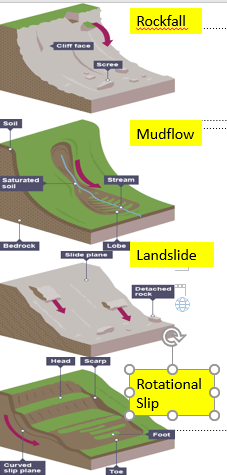
Mass Movement
Rockfall - Bits of rock fall off the cliff face, usually due to freeze-thaw weathering.
Mudflow - Saturated soil (soil filled with water) flows down a slope.
Landslide - Large blocks of rock slide downhill.
Rotational Slip - Saturated soil slumps down a curved surface.
3
Multiple Choice
4
Multiple Choice
5
Multiple Choice
6
Deposition
When the sea loses energy, it drops the sand, rock particles and pebbles it has been carrying. This is called deposition.
Deposition happens when the swash is stronger than the backwash and is associated with constructive waves.
Deposition is likely to occur when:
waves enter an area of shallow water; waves enter a sheltered area, e.g. a cove or bay; there is little wind; there is a good supply of material.

7
Longshire Drift
The transport of sand and pebbles along the coast is called longshore drift.
The prevailing wind (the direction the wind usually blows from) causes waves to approach the coast at an angle.
The swash carries the sand and pebbles up the beach at the same angle (usually 45º). The backwash, however carries the material back down the beach at right angles (90°).
If a pebble was placed in the water it would be carried along the coastline in a zig-zag motion and would eventually be deposited when the waves lose energy.
The general direction of longshore drift is decided by the prevailing wind.

8
Open Ended
9
Depositional Landforms: Spits.
Spits are also created by deposition.
A spit is an extended stretch of beach material that projects out to sea and is joined to the mainland at one end.
Spits are formed where the prevailing wind blows at an angle to the coastline, resulting in longshore drift.
Longshore drift is when sediment is taken from the beach and deposited further down the coastline.
This results in a spit being formed when the coastline changed directions, and the sediment is deposited into shallow areas of the sea.
An example of a spit is Spurn Head, found along the Holderness coast in Humberside.

10
Depositional Landforms: Bars
Sometimes a spit can grow across a bay, and joins two headlands together. This landform is known as a bar.
They can trap shallow lakes behind the bar, these are known as lagoons.
Lagoons do not last forever and may be filled up with sediment.

11
Multiple Select
12
13
Headlands and Bays
At discordant coastlines (alternating bands of rock), where there are layers of hard and soft rock. Water erodes the soft rock at a much faster rate which leads to the formation of bays. The hard rock erodes much slower, this leaves areas of cliff sticking out into the sea, we call these headlands.

14
Multiple Choice
15
16

17
Caves, Arches, Stacks and Stumps
Weathering and erosion can create caves, arches, stacks and stumps along a headland.
Caves occur when waves force their way into cracks in the cliff face. The water contains sand and other materials that grind away at the rock until the cracks become a cave. Hydraulic action is the main process. If the cave is formed in a headland, it may eventually break through to the other side forming an arch.
The arch will gradually become bigger until it can no longer support the top of the arch.
When the arch collapses, it leaves the headland on one side and a stack (a tall column of rock) on the other.
The stack will be attacked at the base in the same way that a wave-cut notch is formed. This weakens the structure and it will eventually collapse to form a stump.

18
Open Ended
19
Coasts Revision Part 1
- Wave types and characteristics
- Coastal Processes: Weathering/ Mass Movement/ Erosion/ Transportation/ Deposition
- Erosional Landforms: Headlands and Bays/ Wave Cut Platforms/ Caves, Arches, Stack and Stumps.
- Depositional Landforms: Beaches/ Sand Dunes/ Spits and Bars.
Show answer
Auto Play
Slide 1 / 19
SLIDE


