

Saturn's Rings

Presentation
•
English
•
8th Grade
•
Practice Problem
•
Hard
+12
Standards-aligned

Jessica Greeson
Used 38+ times
FREE Resource
11 Slides • 3 Questions
1
Saturn's Rings
2
Rings of Mystery
For four centuries, astronomers have pondered the mystery of Saturn’s rings. When Galileo first saw Saturn in 1610, he thought it was a triple-bodied planet. Later, he drew the two small clusters he saw as ears or handles protruding from the planet. Then, in 1612, Saturn seemed to vanish. No further sightings were made until 1659 when Christian Huygens developed a more powerful telescope. At that time, Huygens proposed that Galileo’s “clusters” were a ring around the planet. In 1675, Jean-Dominique Cassini discovered that Huygens’s single ring was actually two rings with a space between them. The mystery surrounding Saturn was growing.
3
Where did the rings come from?
From the very first sighting, people have searched for answers to the origin of the rings. One theory from the past is that the rings existed before the planet and that Saturn formed within the rings.
4
Where did the rings come from? (continued)
A second and more popular theory was that the rings formed when another celestial body came too close to Saturn. This body was then torn apart by Saturn’s tidal forces, the gravitational pulls of planets, moons, and the sun. It was believed that the small bits from this body orbited the planet in rings. Then, in the early 1980s, information gathered by the spacecraft Voyager 1 and Voyager 2 made this theory seem less likely. Scientists from the National Aeronautical and Space Administration (NASA) learned that the rings were not alike. Some contained braided rings, while others held what looked like ringlets or spokes.
5
Where did the rings come from? (continued)
In addition, scientists learned that only one percent of the particles within the rings were rocky debris. Most of the particles were ice. With so few rock particles present, the rings don’t appear to be the result of a large moon or other large body slamming into Saturn.
6
What is the make-up of the rings?
As far back as 1859, people knew that Saturn’s rings were not solid. James Clerk Maxwell believed the rings were made of many small particles moving independently of each other. Today we know the rings are made up of billions of particles moving in waves around the planet. Most of the particles are tiny grains of ice, but a few are as big as mountains. There are also particles too small to see. Special equipment is used to sense their presence in the rings.
Within each ring, there are two gaps. A small moon sits in each space keeping the gap open. Some scientists now believe the rocky bits found in the rings may have come from comets, asteroids, or moons that shattered without coming in contact with Saturn.
7
How many rings are there?
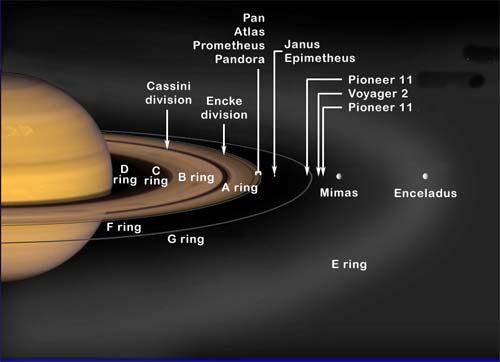
This is a question whose answer has changed many times. At this time, scientists have identified seven distinct rings, as well as several other faint unnamed rings. The main rings are named alphabetically in the order in which they were discovered. The order of the rings from Saturn moving outward are D, C, B, A, F, G, and E. Each ring is a different width, and each circles Saturn at a different speed from the other rings near it.

8
Multiple Choice
According to evidence in the diagram and the section “How many rings are there?” which of the following statements is true?
Saturn’s rings are named in order from the planet outward.
Saturn’s rings are named from oldest to youngest.
Saturn’s rings are named in random order.
Saturn’s rings are named in the order in which they were discovered.
9
How are we learning more about Saturn?
In October 1977, NASA launched the Cassini spacecraft. Cassini, originally called Cassini-Huygens, is an unmanned spacecraft that has been orbiting Saturn since 2004. The spacecraft entered Saturn’s orbit by flying through the gap between the F and G rings.
10
How are we learning more about Saturn? (continued)
Cassini is one of the largest interplanetary spaceships ever made. It is about the same length as a school bus and weighs about six tons with a full tank of rocket fuel. Inside the spacecraft are a dozen instruments capable of completing twenty-seven different scientific investigations. Scientists on Earth control the instruments and are constantly receiving information from them. These instruments are highly technical and collect data that humans could not gather on their own. For example, the instruments can “see” wavelengths of light that humans cannot, and they sense magnetic pulls that humans cannot feel. Since entering Saturn’s orbit, Cassini has sent more than 200,000 images back to Earth.
11
How are we learning more about Saturn? (continued)
Cassini has already helped scientists discover new ringlets, new moons near the rings, and bumps and ridges along some of the larger rings. It has also provided scientists with information about how the rings may have formed. Scientists now believe that while ring formation is connected to Saturn’s many moons, not all of the rings formed at the same time or in the same way. The particles in the E ring, for example, come from icy material blasting forth from one of Saturn’s moons. In addition, some of the smaller moons orbit within rings formed from bits of their surfaces. In contrast, at least one moon is getting particles from the F ring.
12
How are we learning more about Saturn? (continued)
The spacecraft will continue to orbit Saturn until 2017, when it will plunge into Saturn’s atmosphere. During these final years of Cassini’s exploration, scientists hope the information and images they receive from it will provide even more answers to their questions about Saturn’s rings.
13
Multiple Choice
Evidence in the section “How are we learning more about Saturn?” best supports which of the following conclusions?
Advancements in technology have greatly improved space exploration.
Each of Saturn’s known rings was discovered by a different scientist.
In the future, scientists are likely to find additional rings around other planets.
Unmanned spacecraft like Cassini have replaced human-controlled flights to space.
14
Multiple Choice
Which statement names the text structure and best describes the effect that structure has on the reader?
By describing events in order of importance, the author helps readers appreciate how long scientists have studied Saturn.
By posing questions and answers, the author helps readers focus on important aspects of Saturn’s rings.
By describing Saturn’s rings, the author helps readers understand the value of space exploration.
By comparing theories, the author shows readers that different approaches can solve problems.
Saturn's Rings
Show answer
Auto Play
Slide 1 / 14
SLIDE
Similar Resources on Wayground

12 questions
RI6: Analyzing How Authors Respond
Presentation
•
8th Grade
10 questions
Theme
Presentation
•
8th - 9th Grade
11 questions
Conflict/Conflicto
Presentation
•
7th - 8th Grade
12 questions
Past Perfect
Presentation
•
7th - 8th Grade
9 questions
Comparatives & Superlatives
Presentation
•
7th Grade
10 questions
Summarizing Information
Presentation
•
8th Grade
12 questions
An Introduction to Research Skills
Presentation
•
8th Grade
12 questions
Prepositions
Presentation
•
3rd Grade
Popular Resources on Wayground
10 questions
How much do you know about our Portrait of an Eagle?

Quiz
•
10th Grade
10 questions
Fast Food Slogans
Quiz
•
6th - 8th Grade
21 questions
Continents and Oceans
Quiz
•
6th Grade
20 questions
Parts of Speech
Quiz
•
5th Grade
16 questions
Subject & Predicate
Quiz
•
5th Grade
25 questions
Multiplication Facts
Quiz
•
5th Grade
12 questions
Map Skills
Quiz
•
3rd Grade
22 questions
Continents and Oceans
Quiz
•
5th Grade
Discover more resources for English
25 questions
Making Inferences
Quiz
•
6th - 8th Grade
20 questions
Figurative Language Review
Quiz
•
8th Grade
30 questions
Central Idea practice Grade 7-8
Quiz
•
6th - 8th Grade
12 questions
Final Figurative Language Review
Presentation
•
6th - 8th Grade
20 questions
Sentences, Fragments, and Run-ons
Quiz
•
8th Grade
20 questions
TEXTUAL EVIDENCE & INFERENCES
Quiz
•
6th - 8th Grade
11 questions
Objective Summary Review
Quiz
•
6th - 8th Grade
17 questions
Plot
Quiz
•
8th Grade