

8.3-Opening the Constitutional Convention

Presentation
•
History, Social Studies
•
8th Grade
•
Practice Problem
•
Medium

Elizabeth McKee
Used 18+ times
FREE Resource
18 Slides • 21 Questions
1
Opening the constitutional convention
Benjamin Franklin, the oldest delegate to the Constitutional Convention, had doubts about the drafting of the Constitution. However, he said, “The older I grow, the more apt I am to doubt my own judgment and pay more respect to the judgment of others.”

2
Multiple Choice
This event showed the the Articles of Confederation were weak...
Shays' Rebellion
The American Revolution
The French and Indian War
The Boston Tea Party
3
4
Philadelphia was already hot and humid when delegates began drifting into the city. On May 25, 1787, the Constitutional Convention met for the first time in the east room of the Pennsylvania State House (now known as Independence Hall). The Declaration of Independence had been debated in this very room just 11 years earlier. The delegates would meet in the east room all summer. On some days, temperatures rose well into the nineties.

5
The delegates' first action was to elect George Washington president of the convention because no man was more admired and respected than the former commander in chief of the Continental army. When the war ended, Washington could have used his power and popularity to make himself a king. Instead, he went home to Virginia to resume his life as an ordinary citizen. Despite his reluctance to return to public life, however, Washington would play a key role by presiding over the convention and lending it his prestige.

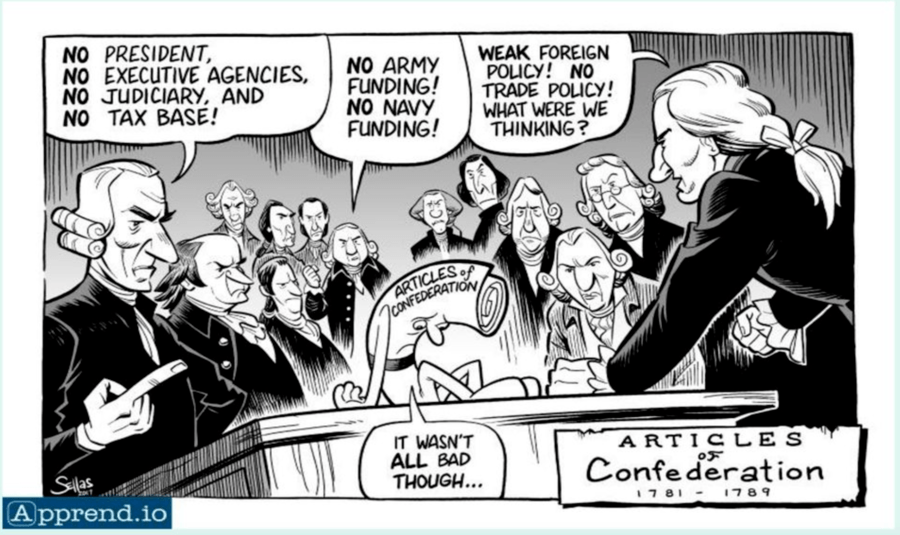
6
Multiple Choice
Who was elected president of the conference?
Ben Franklin
George Washington
James Madison
John Adams
Thomas Jefferson
7
The Delegates
Fifty-five delegates from 12 states attended the Constitutional Convention. Rhode Island, which prided itself as “the home of the otherwise minded” and feared a strong national government, boycotted the meeting.
8
Multiple Choice
How many delegates attended the convention ?
12
55
24
13
9
Multiple Choice
How many states were represented at the convention ?
12
55
24
13
10
Some leaders of the revolution were also missing. John Adams and Thomas Jefferson were representing the United States in Great Britain and France, respectively. Others who did not attend included Sam Adams, John Hancock, and Patrick Henry. They feared that a strong national government would endanger the rights of states.
11
Multiple Choice
Why did Sam Adams, Patrick Henry, and John Hancock not attend the Constitutional Convention?
They were in France.
They were in Great Britain.
They feared that a strong national government would endanger the rights of states.
They believed there was nothing wrong with the Articles of Confederation.
12
As a group, the delegates were, in the words of a modern historian, “the well-bred, the well-fed, the well-read, and the well-wed.” Their average age was 42. At 81, Benjamin Franklin of Pennsylvania was the oldest, arriving at the convention each day in a sedan chair carried by four good-natured prisoners from a nearby jail.

13
Multiple Choice
The average age of the attendees was...
41
42
84
14
Multiple Choice
The oldest person in attendance was ...
41
42
81
15
Most of the delegates brought extensive political experience to the meeting. More than two-thirds were lawyers, and most had served in their state legislatures or held a state office. Thomas Jefferson was so impressed by the ability and experience of these men that he called the convention “an assembly of demi-gods.”
16
Multiple Choice
Most delegates were..
Laywers
Farmers
Merchants
Tabacco Farmers
17
The Father of the Constitution
The best prepared of the delegates was James Madison of Virginia. One delegate wrote of Madison, “In the management of every great question he evidently took the lead in the Convention.” Indeed, Madison's influence was so great that later he would be called the “Father of the Constitution.”

18
Multiple Choice

Who was known as The Father of the Constitution?
Thomas Jefferson
George Washington
Alexander Hamilton
James Madison
19
Madison addressed the convention numerous times, and when he was not speaking, he was taking notes. Sitting near the front of the room so that he could hear everything that was said, Madison wrote down nearly every word. Altogether, his notes covered more than 600 printed pages, and this remarkable record helps us understand what went on inside the convention day by day.

20
The Rule of Secrecy
At the time, however, no one outside the convention knew what was happening. After choosing a president, the delegates voted on rules for the convention, the most important of these being the rule of secrecy. The delegates wanted to feel free to speak their minds without causing alarm or opposition among the general public, so they agreed to keep secret whatever was said in the meeting room until their work was done.
21
Multiple Choice
True or False:
The delegates were free to discuss what happened at the convention with everyone.
true
false
I don't know
22
Multiple Choice
True or False:
The Convention was often in the newspaper
true
false
I don't know
23
Shared Beliefs and Clashing Views
Once the convention was organized, the delegates got down to business. As a group, the delegates had much in common, but they also had very different views on many issues facing the new nation.
24
To be sure, all the delegates were committed to the ideals of the Declaration of Independence. The basic purpose of government, they believed, was to protect the rights to “life, liberty, and the pursuit of happiness.” And they agreed, in the words of the Declaration, that the “just powers” of governments came from “the consent of the governed. ”
25
In part, these beliefs reflected the ideas of Enlightenment thinkers like England's John Locke. Human institutions, these liberal thinkers had argued, should be based on “laws of nature,” among which were the rights to liberty and equality. The best way to protect these rights, the delegates agreed, was through some form of republic.
26
From New England's town meetings to lawmaking bodies like the Virginia House of Burgesses, Americans had a long tradition of participating in their own government. After the American Revolution, all the states had adopted constitutions that embraced republican ideals.
Despite many differences in details, every state had some form of representative government and had expanded the rights to vote and to hold office. The state constitutions helped to shape the delegates' thinking.
27
Multiple Choice
What is a republic (this was a vocabulary word)?
the first written plan of government for the United States. A confederation is an association of states that cooperate for a common purpose.
a written plan that provides the basic framework of a government
a strong disagreement
a country governed by elected representatives
28
Despite the delegates' broad agreement on a government “of the people,” many questions were left unanswered. For example, who exactly should have a say in a truly “representative” government? Even in liberal Pennsylvania, only free, white males could vote, while other states allowed only wealthier citizens to vote or hold office. Women could not vote in any state except New Jersey. (New Jersey women would lose the right to vote in 1807. )
29
Perhaps the most troubling question of all was how powerful the national government should be. Many delegates wanted to keep government close to the people by preserving the rights of the states.
They feared that a strong national government would threaten individual liberty, but others, including Madison, argued just the opposite. Look at what has happened under the Articles of Confederation, they said, referring to events like Shays' Rebellion. If the central government is too weak, it cannot do its job of protecting liberty and property.
30
Multiple Choice
What was the most troubling question facing the delegates?
should they keep things a secret
should they open a window because it was so hot outside
how powerful the national government should be
should they kick anyone out of the meeting if they broke the rule of secrecy
31
Tempers often flared as the delegates wrestled with these and other issues behind closed doors. Several times it seemed the convention might collapse in failure. But the delegates ultimately found ways to save the convention—and the nation.
32
Multiple Choice
This person was NOT a leader at the constitutional convention
George Washington
James Madison
Thomas Jefferson
Ben Franklin
33
Multiple Choice
he was the best-prepared delegate, spoke numerous times, and kept the best records.
James Madison
George Washington
Benjamin Franklin
Thomas Jefferson
34
Multiple Choice
made sure the rules were enforced
James Madison
George Washington
Benjamin Franklin
Thomas Jefferson
35
Multiple Choice
arrived at the convention each day in a sedan chair carried by four good-natured prisoners from a nearby jail.
James Madison
George Washington
Benjamin Franklin
Thomas Jefferson
36
Multiple Choice
Why did the important leaders Sam Adams, John Hancock, and Patrick Henry not attend the convention?
They were out of town
They feared that a stronger national government would hurt the rights of the states.
37
Multiple Choice
Why did the important leaders John Adams and Thomas Jefferson not attend the convention?
They were out of town
They feared that a stronger national government would hurt the rights of the states.
38
Multiple Choice
What did delegates for a strong national government believe?
The national government should have more power so it can do its job of protecting the people’s rights. Under the Articles of Confederation, which gives more power to the states, the nation is falling apart.
A strong national government could threaten individual liberty. The state governments are closer to the people’s control and so should have more power than the national government.
39
Multiple Choice
What did delegates for stronger state governments (weaker national government) believe?
The national government should have more power so it can do its job of protecting the people’s rights. Under the Articles of Confederation, which gives more power to the states, the nation is falling apart.
A strong national government could threaten individual liberty. The state governments are closer to the people’s control and so should have more power than the national government.
Opening the constitutional convention
Benjamin Franklin, the oldest delegate to the Constitutional Convention, had doubts about the drafting of the Constitution. However, he said, “The older I grow, the more apt I am to doubt my own judgment and pay more respect to the judgment of others.”
Show answer
Auto Play
Slide 1 / 39
SLIDE
Popular Resources on Wayground

10 questions
5.P.1.3 Distance/Time Graphs

Quiz
•
5th Grade
10 questions
Fire Drill
Quiz
•
2nd - 5th Grade
20 questions
Equivalent Fractions
Quiz
•
3rd Grade
22 questions
School Wide Vocab Group 1 Master
Quiz
•
6th - 8th Grade
20 questions
Main Idea and Details
Quiz
•
5th Grade
20 questions
Context Clues
Quiz
•
6th Grade
20 questions
Inferences
Quiz
•
4th Grade
12 questions
What makes Nebraska's government unique?
Quiz
•
4th - 5th Grade
Discover more resources for History
23 questions
Mock Social Studies STAAR Review 2024
Quiz
•
8th Grade
50 questions
social studies staar review 1
Quiz
•
8th Grade
20 questions
Holocaust Review
Quiz
•
8th Grade
19 questions
SS8H12 GMAS PREP
Quiz
•
8th Grade
10 questions
Exploring the Causes of World War I

Interactive video
•
6th - 10th Grade
10 questions
Exploring Ancient Greece: Key Periods and Fascinating Facts
Interactive video
•
6th - 10th Grade
20 questions
Civil War and Reconstruction Era
Quiz
•
8th Grade
15 questions
Constitution STAAR REVIEW
Quiz
•
8th Grade