

Search Header Logo
9.5 More about conservation of mass

9.5 More about conservation of mass

Assessment

Presentation

•

Chemistry

•

7th Grade

•

Easy

Created by

Otgonkhuu Ragchaasuren

Used 19+ times

FREE Resource

6 Slides • 9 Questions

1

9.5 More about conservation of mass

Grade 7

Slide image

2

Not what you expect

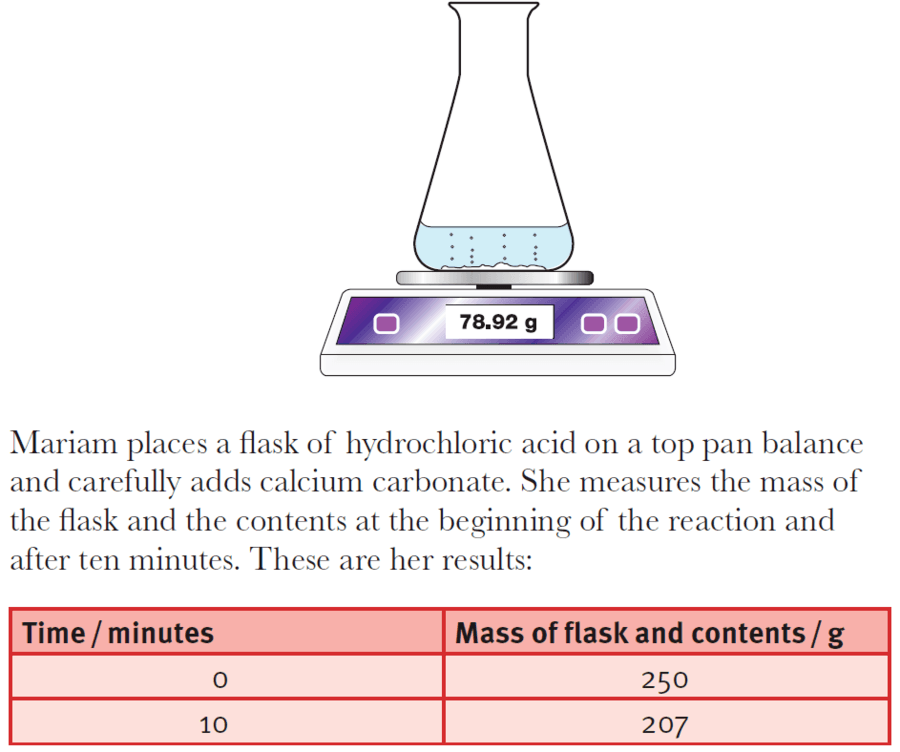
  • When you add calcium carbonate to hydrochloric acid, there is a

    chemical reaction.

  • The word equation for this reaction is:

    calcium carbonate + hydrochloric acid → calcium chloride + water + carbon dioxide
Slide image

3

Not what you expect

  • The carbon dioxide gas escapes into the air because the flask is open.

  • You then cannot measure its mass. So it appears as if the mass decreases as the

    reaction continues.

Slide image

4

Open Ended

Calcium carbonate + hydrochloric acid → calcium chloride + water + carbon dioxide

1. In the reaction between calcium carbonate and hydrochloric acid:

a. Which one of the reactants contains the element oxygen?

5

Open Ended

Calcium carbonate + hydrochloric acid → calcium chloride + water + carbon dioxide

1. In the reaction between calcium carbonate and hydrochloric acid:

b. Which two of the products contain the element oxygen?

6

Open Ended

Calcium carbonate + hydrochloric acid → calcium chloride + water + carbon dioxide

1. In the reaction between calcium carbonate and hydrochloric acid:

c. Where does the element hydrogen in the water come from in

this reaction?

7

Open Ended

Calcium carbonate + hydrochloric acid → calcium chloride + water + carbon dioxide

2. Explain why the mass decreased in Mariam’s experiment.

8

Another surprising result

  • A French scientist called Antoine Lavoisier carried out this experiment in 1772.

Slide image

9

Another surprising result

  • Magnesium + oxygen => magnesium oxide

  • There is an increase in mass because oxygen from the air has combined with magnesium.

Slide image

10

Summary

  • Sometimes results in experiments are unexpected.

  • Finding explanations for unexpected results can lead to new ideas about science.

11

Multiple Choice

In a reaction A + B ----> C, reactant A has 5g and product C has 9g. How many grams does reactant B have?

1

4g

2

5g

3

9g

4

14g

12

Multiple Choice

A 55-gram egg is placed in a pot. After the egg is boiled, which is most likely the mass of the egg?
1
50 
2
55 

13

Multiple Choice

Jamie weighs a glass of water and observes its weight to be 12 ounces. Jamie then adds 6 ice cubes to the glass of water. Each ice cube weighs one ounce. After all of the ice cubes have melted, what will be theapproximate weight of the glass of water?
1
6 
2
12 
3
18 ounces

14

Multiple Choice

A student notices that an inflated balloon gets larger when it is warmed by a lamp. Which best describes the mass of the balloon as a result of this change?
1
The mass of the balloon increases because the size of the balloon has increased.
2
The mass of the balloon increases because the temperature of the balloon has increased.
3
The mass of the balloon stays the same because the gas inside the balloon still has the same mass after it warms up.

15

Multiple Choice

A 500-gram block of solid cheese is melted in a pot. Which is most likely the mass of the cheese after it is melted?
1
500 grams, because the cheese does not gain or lose mass just because it was melted
2
499 grams, because some of the cheese evaporates as it melts
3
502 grams, because the cheese absorbs heat as it melts
pattern-tertiary

9.5 More about conservation of mass

Grade 7

Slide image

Show answer

Auto Play

Slide 1 / 15

SLIDE
