Search Header Logo
The Waves Halftime Show

The Waves Halftime Show

Assessment

Presentation

•

Science, Physics

•

6th - 8th Grade

•

Medium

•
NGSS
MS-PS4-1, HS-PS4-1, MS-PS4-2

+1

Standards-aligned

Created by

Jawara Senghor

Used 63+ times

FREE Resource

14 Slides • 16 Questions

1

The Waves Halftime Show

Types & Properties of Waves

media

2

What are waves?

  • A wave is a disturbance that transfers energy from one place to another

  • Waves transfer energy but they do NOT transfer matter

3

Ways to transfer energy

  • As a Transverse wave - particles of the medium move perpendicular to the direction of the energy of the wave

  • As a Longitudinal wave - particles move in the same direction as the energy of the wave

  • As a surface wave - a combination of a transverse and longitudinal wave

4

Types of waves

  • Mechanical - Waves that disturb matter require a medium

  • Electromagnetic - Waves that disturb an electric and magnetic field. They do NOT require a medium to transfer energy. All EM waves travel at light speed (186,000 meters per second) in a vacuum.

5

Properties of waves

  • Crest

  • Trough

  • Wavelength

  • Amplitude

  • Frequency

  • Wave period

  • Wave speed

6

Crest

The highest point of a wave

media

7

Trough

The lowest point of a wave

media

8

Wavelength

The distance over which the wave repeats. This is measured by the distance from one point on a wave to the next identical point later in the wave.

media

9

Amplitude

A measure of how far particles in the medium move away from their normal rest position.

media

10

Frequency

How many cycles of a wave occur in a given amount of time.  This property is measured in a unit of measurement called hertz (Hz), with one hertz (1Hz) being equal to one cycle per second.

media

11

Amplitude & Frequency in Sound Waves

When it comes to sound waves, humans detect a change in amplitude as a change in volume. Changes in frequency are detected as a change in the pitch of the sound.

media

12

Amplitude & Frequency in Light waves

With light waves, a change of frequency is seen as a change in color. A difference in amplitude is detected as a change in the brightness of the color of the wave.

media

13

Wave Period

This is the amount of time it takes for one wavelength or wave cycle to pass.

media

14

Wave speed

The speed at which a wave travels, called wave speed, depends on the properties of the medium. To calculate wave speed, you would multiply the frequency of the wave by its wavelength. The speed of waves depend on many factors, among them are the state of matter of the substance and the density of the substance.

media

15

Multiple Choice

What is transferred from place to place by waves?

1

matter

2

energy

3

particles

4

waves

16

Multiple Choice

Question image

What is a wavelength?

1

How many waves pass a certain point

2

The distance from one wave crest to another

3

The entire length of a wave

17

Multiple Choice

A wave that can travel through matter and empty space is a:

1

electromagnetic wave

2

longitudinal wavy

3

transverse wave

18

Multiple Choice

Question image
What kind of wave is pictured?
1
Transverse
2
Longitudinal
3
surface
4
none of the above

19

Multiple Choice

In longitudinal waves, the parts where the coils are spread apart are called what?
1
rarefactions
2
compressions
3
mechanicals
4
longitudes

20

Multiple Choice

Any material that a wave travels through is called a ____________________.
1
vibration
2
compression
3
medium
4
crest

21

Multiple Choice

Question image

You can't hear sounds in outer space because there is no

1

medium

2

light

3

energy

4

heat

22

Multiple Choice

Question image
What kind of wave is pictured below?
1
compressional wave
2
transverse wave
3
sound wave
4
mechanical wave

23

Multiple Choice

Transverse waves are ___.
1
Parallel
2
Perpendicular
3
Weird

24

Multiple Choice

Longitudinal waves are ______.
1
Parallel
2
Perpendicular
3
Crazy

25

Multiple Choice

Question image

What does this picture represent?

1

wavelength

2

echolocation

3

amplitude

4

peak

26

Multiple Choice

Question image
How would a person measure the wavelength on this sound wave?
1
dense to less dense
2
trough to crest
3
compression to compression
4
beginning of illustration to the end

27

Multiple Choice

Question image

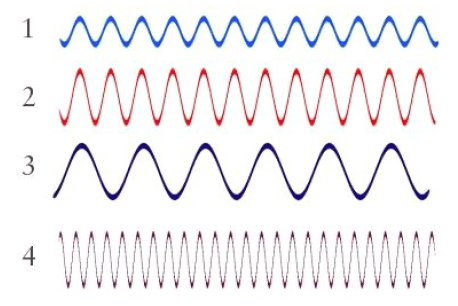
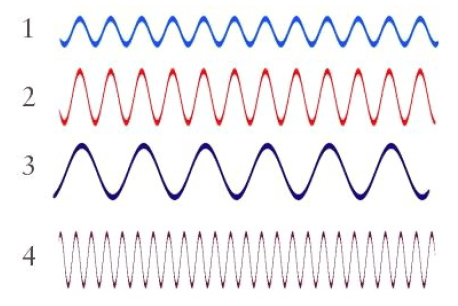
Which transverse wave has the highest frequency?

1

1

2

2

3

3

4

4

28

Multiple Choice

Question image
Which wave in the diagram has the greatest wavelength?
1
1
2
2
3
3
4
4

29

Multiple Choice

Question image
Which wave in the diagram has the greatest frequency?
1
1
2
2
3
3
4
4

30

Multiple Choice

What happens when you increase the amplitude of a sound?
1
it makes the sound louder
2
it makes the sound travel faster
3
it increases the wavelength of the sound
4
it increases the frequency of the sound

The Waves Halftime Show

Types & Properties of Waves

media

Show answer

Auto Play

Slide 1 / 30

SLIDE