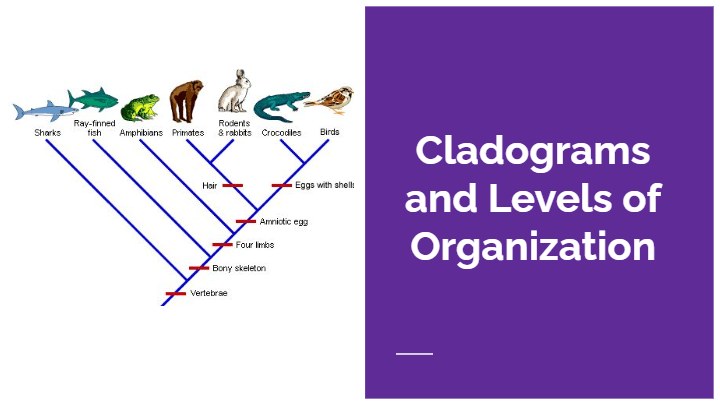
Cladograms and Levels of Organization
Presentation
•
Biology
•
9th Grade
•
Medium
+4
Standards-aligned
AMAIRENI BENJUME SANCHEZ
Used 169+ times
FREE Resource
29 Slides • 17 Questions
1
Cladograms and Levels of Organization
2
3
4
5
6
7
8
9
10
Multiple Choice
11
12
13
Multiple Choice
14
15
16
Multiple Choice
8B The cladogram shows the evolution of land plants as indicated by fossil records.
Which discovery would challenge the validity of this cladogram?
A large aquatic vascular plant about 200 million years old
A species of algae that has existed for less than one million years
A moss species that has existed for less than 380 million years
A fossil of a fern more than 425 million years old
17
Multiple Choice
8B A cladogram is shown.
All the animals to the right of the hagfish would have the common characteristic of —
fur
claws or nails
lungs
jaws
18
Multiple Choice
7A This cladogram shows the evolutionary relationships among some mammals based on homologous structures.
Which statement is supported by this cladogram?
Hippopotamuses are more closely related to cows than to javelinas.
Toothed whales are more closely related to mouse deer than to hippopotamuses.
Javelinas and pigs are more closely related than baleen whales and toothed whales.
Cows and mouse deer are more closely related than javelinas and pigs
19
20
Multiple Choice
21
Multiple Choice
22
23
24
25
26
Multiple Choice
The smallest unit
of a compound consisting of two or more atoms
bonded together.
Organelle
Cell
Molecule
Atom
27
28
29
Multiple Choice
The basic building block of living things, made up of organelles.
Tissue
Organelle
Cell
Atom
30
31
Multiple Choice
10C Recent studies in bone research indicate that using ultrasound on a broken bone can decrease the healing time by 25%. Which of these are the most basic levels of organization involved when a bone heals?
Cells and tissue
Cells and organ system
Organ system and organism
Tissue and organ system
32
33
Multiple Choice
Group of tissues with similar functions.
Organelles
Cells
Tissues
Organs
34
35
Multiple Choice
10C The human body is composed of organ systems. Which list represents a system organized from least to most complex?
Heart, cardiac muscle, muscle tissue, muscle cell
Lung tissue, trachea, nostrils, circulatory system
Muscle cell, muscle tissue, biceps muscle, muscular system
Integumentary system, skin cell, hair, sweat glands
36
37
Multiple Choice
Any single living individual, and can refer to a single human, animal, plant,
Protista, bacteria, or fungi.
Community
Cell
Population
Organism
38
39
40
Multiple Choice
10C The diagrams show some of the levels of biological organization. In what order are the levels in the diagrams?
Population, community, ecosystem
Organism, community, population
Organism, population, community
Ecosystem, population, community
41
Multiple Choice
10C Which answer choice best describes a community
Praying mantises caring for their young
Three-spined sticklebacks living in estuaries
Different species of lizards occupying the same niche in a desert
Roosting mother bats recognizing their offspring
42
43
Multiple Choice
10C A science class is planning a field trip to a local farm that has a large pond. Which of the following lists the order of biological organization from smallest to largest that the students can expect to find at the pond?
Organism, community, population, ecosystem
Organism, population, community, ecosystem
Population, organism, community, ecosystem
Population, organism, ecosystem, community
44
45
Multiple Choice
A biological community that includes various species and their physical environment (Biotic and Abiotic Factors).
Organism
Community
Biosphere
Ecosystem
46
Cladograms and Levels of Organization

Show answer
Auto Play
Slide 1 / 46
SLIDE

Similar Resources on Wayground
44 questions
The Carbon and Nitrogen Cycle and Microorganisms
Presentation
•
9th Grade
38 questions
Rhetorical Appeals and Strategies
Presentation
•
9th Grade
42 questions
Cell Theory Eukaryotic and Prokaryotic Cells
Presentation
•
9th Grade
42 questions
Cell Theory and Prokaryotes vs Eukaryotes
Presentation
•
9th Grade
42 questions
Prokaryote vs Eukaryote Lesson
Presentation
•
9th Grade
43 questions
Cell Transport and Cell Energy
Presentation
•
9th Grade
43 questions
Energy and Transport
Presentation
•
9th Grade
39 questions
G9 Chap 2.1 - Organisms and Their Relationships
Presentation
•
9th Grade
Popular Resources on Wayground
20 questions
"What is the question asking??" Grades 3-5
Quiz
•
1st - 5th Grade
20 questions
“What is the question asking??” Grades 6-8
Quiz
•
6th - 8th Grade
10 questions
Fire Safety Quiz
Quiz
•
12th Grade
20 questions
Equivalent Fractions
Quiz
•
3rd Grade
34 questions
STAAR Review 6th - 8th grade Reading Part 1
Quiz
•
6th - 8th Grade
20 questions
“What is the question asking??” English I-II
Quiz
•
9th - 12th Grade
20 questions
Main Idea and Details
Quiz
•
5th Grade
47 questions
8th Grade Reading STAAR Ultimate Review!
Quiz
•
8th Grade
Discover more resources for Biology
24 questions
BIOLOGY STAAR REVIEW
Quiz
•
9th Grade
30 questions
Biology STAAR Review #3
Quiz
•
9th Grade
16 questions
AP Biology: Unit 1 Review (CED)
Quiz
•
9th - 12th Grade
50 questions
Biology EOC Review
Quiz
•
9th Grade
25 questions
photosynthesis and cellular respiration
Quiz
•
9th Grade
20 questions
AP Biology: Unit 3 Review (CED)
Quiz
•
9th - 12th Grade
20 questions
Enzymes
Quiz
•
9th Grade
20 questions
Food Chains and Food Webs
Quiz
•
7th - 12th Grade